
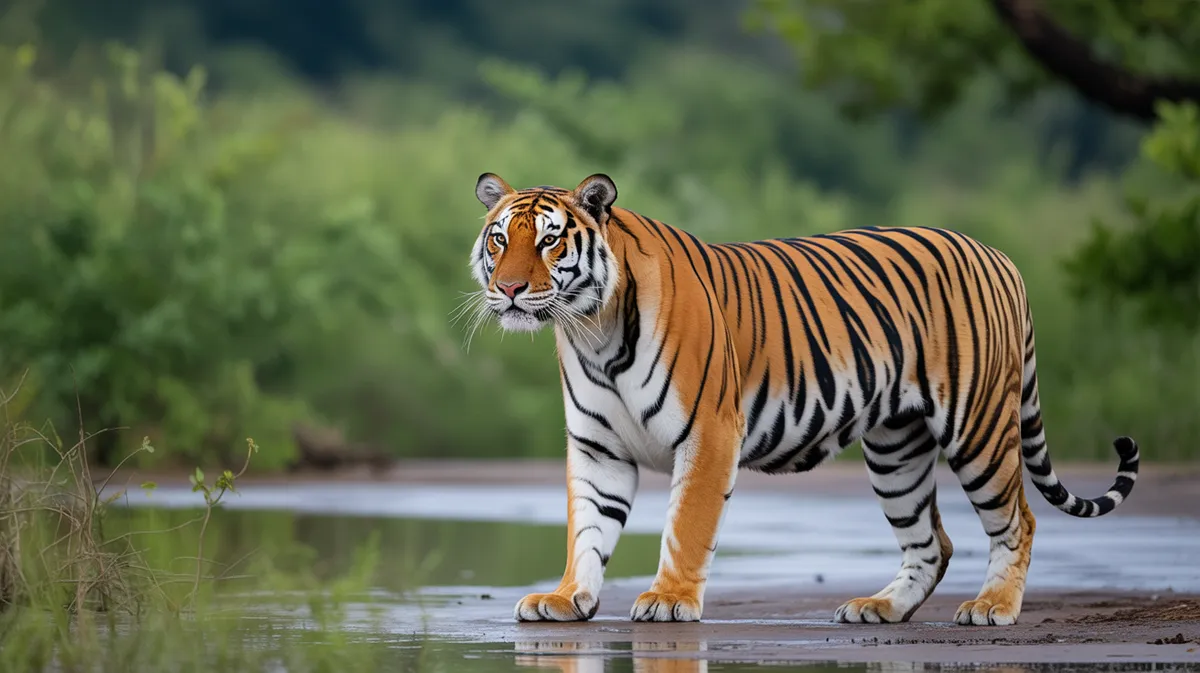
About the Bengal Tiger
A tiger's stripes are in the skin, not just the fur: shave one and the pattern is still there, and the pattern is unique to the individual, which is why India's national tiger census works by photographing flanks with camera traps and matching them like fingerprints. India now holds around 3,600 of the roughly 5,500 wild tigers left on Earth. The strangest Bengal tiger population lives in the Sundarbans, the mangrove delta straddling India and Bangladesh: these tigers swim routinely between islands, drink brackish water, and kill more people than any other tiger population anywhere — theories range from the salinity and scarcity of normal prey to habituation from scavenging bodies washed into the delta. A tiger's roar carries around 3 km and contains infrasound below the range of human hearing, which is part of why it produces a physical, chest-felt effect at close range. Tigers are ambush hunters with a low success rate, taking perhaps one hunt in ten to twenty.
Fascinating facts
Unique Stripes
Each Bengal tiger has a unique stripe pattern, which helps researchers identify individuals in the wild.
Strong Swimmers
Unlike many big cats, Bengal tigers enjoy water and are strong swimmers, often crossing rivers and lakes in search of prey.
Powerful Hunters
Bengal tigers primarily hunt large ungulates such as deer, wild boar, and occasionally even young elephants or rhinos.
Detailed description
The Bengal tiger (Panthera tigris tigris) is the largest tiger subspecies and one of the most iconic apex predators of the Indian subcontinent. Adult males typically weigh between 180–260 kg (400–570 lbs) and measure 270–310 cm (8.9–10.2 ft) in total length, including the tail, while females are smaller, averaging 100–160 kg (220–350 lbs) and 240–265 cm (7.9–8.7 ft). Their distinctive pelage features a rich orange coat with 80–100 vertical black stripes, a white ventral area, and facial ruffs. Bengal tigers possess powerful forelimbs, retractable claws, and large canines (up to 10 cm) adapted for subduing large prey. They are solitary and territorial, with home ranges varying from 20 km² for females to over 100 km² for males, depending on prey density and habitat quality. Bengal tigers are crepuscular, most active during dawn and dusk, and are highly adaptable, occupying diverse habitats from dense tropical forests and mangrove swamps (notably the Sundarbans) to dry grasslands. Their diet is broad, including ungulates such as chital, sambar, gaur, and wild boar, but they are capable of preying on larger animals like water buffalo and, rarely, young elephants or rhinos. Reproduction is non-seasonal, but peaks are observed in cooler months; cubs are born blind and helpless, relying entirely on maternal care. Bengal tigers are apex predators, playing a key ecological role in regulating prey populations and maintaining ecosystem health. Their population is fragmented and declining due to anthropogenic pressures, but they remain a symbol of wilderness and conservation in South Asia.
Did you know?
A Bengal tiger's roar can be heard up to 3 kilometers (almost 2 miles) away.
Research & sources
Wikipedia summary
The Bengal tiger is a population of the Panthera tigris tigris subspecies and the nominate tiger subspecies. It ranks among the largest wild cats alive today. It is estimated to have been present in the Indian subcontinent since the Late Pleistocene for about 12,000 to 16,500 years. Its historical range covered the Indus River valley until the early 19th century, almost all of India, southern Nepal, Bangladesh, Bhutan and southwestern China. Today, it inhabits India, Bangladesh, Nepal, Bhutan, and southwestern China. It is threatened by poaching, habitat loss and habitat fragmentation.
Behaviour & social structure
Bengal tigers are solitary by nature, with individuals maintaining exclusive territories marked by scent markings, scratch marks, and vocalizations such as roars and chuffing. Males' territories may overlap with those of several females, but direct encounters are typically avoided except during mating. They are primarily nocturnal or crepuscular hunters, using stealth and camouflage to stalk prey before launching a rapid, powerful ambush. Success rates for hunts are relatively low (about 10–20%), and tigers may travel 10–20 km in a night searching for food. After a successful kill, tigers drag prey to cover and may feed for several days, consuming up to 40 kg of meat in one sitting. Social interactions are mostly limited to mothers with cubs or transient associations during mating. Communication includes vocalizations, scent marking, and visual cues. Resting periods are frequent, with tigers spending up to 16–20 hours per day inactive, especially after large meals.
Reproduction & life cycle
Bengal tigers reach sexual maturity at 3–4 years for females and 4–5 years for males. Courtship involves vocalizations, scent marking, and mutual following, with copulation occurring multiple times over several days. There is no strict breeding season, but most births occur between November and April. Gestation lasts approximately 104–106 days, after which the female gives birth to a litter of 2–4 cubs (range 1–6) in a secluded den. Cubs are born blind and weigh about 780–1,600 grams. The mother nurses and protects the cubs, which begin to follow her at 2–3 months and are weaned by 5–6 months. Cubs learn hunting skills through play and observation, becoming independent at 18–24 months. Male tigers do not participate in parental care and may pose a threat to unrelated cubs.
Adaptations & survival
Bengal tigers exhibit several adaptations for predation and survival. Their striped coat provides disruptive camouflage in dappled light environments, aiding in stalking prey. Powerful limb musculature and flexible joints enable explosive bursts of speed (up to 60 km/h for short distances) and leaping capabilities. Acute night vision, sensitive whiskers, and a keen sense of smell facilitate nocturnal hunting. Retractable claws and robust canines are specialized for gripping and killing large prey. Behavioral adaptations include opportunistic feeding, swimming proficiency (especially in mangrove habitats), and the ability to traverse varied terrain. Their large home ranges and territoriality reduce intraspecific competition and optimize resource use.
Cultural significance
The Bengal tiger holds profound cultural and symbolic importance across South Asia. It is the national animal of India and Bangladesh, featured prominently in folklore, mythology, and art. Tigers are revered as symbols of power, courage, and royalty, often associated with Hindu deities such as Durga, who rides a tiger in iconography. In literature and popular culture, the Bengal tiger is a central figure, from ancient epics to modern works like 'The Jungle Book.' Traditional uses of tiger parts in medicine and rituals have contributed to their decline, but contemporary conservation messaging emphasizes their ecological and cultural value.
Recent research
Recent research on Bengal tigers includes advances in non-invasive genetic monitoring, camera trapping, and satellite telemetry, providing insights into population structure, dispersal, and habitat connectivity. Studies in the Sundarbans have highlighted unique adaptations to saline, tidal environments and a higher frequency of human-tiger conflict. Ongoing research focuses on disease ecology, prey dynamics, and the effects of climate change on tiger habitats. Conservation genetics is increasingly important for managing small, isolated populations and mitigating inbreeding. Collaborative transboundary projects, such as those between India, Nepal, and Bhutan, aim to secure landscape-level connectivity and gene flow.
Videos
Habitat
Tropical and subtropical forests, mangroves, and grasslands


Conservation
The Bengal Tiger is currently classified as Endangered on the IUCN Red List.
Threats & challenges
Bengal tigers face significant threats from habitat loss due to deforestation, agricultural expansion, and infrastructure development, leading to fragmentation and isolation of populations. Poaching for skins, bones, and body parts (used in traditional medicine and illegal wildlife trade) remains a critical issue. Human-tiger conflict arises from livestock predation and encroachment into tiger habitats, often resulting in retaliatory killings. Prey depletion due to overhunting by humans further exacerbates survival challenges. The current wild population is estimated at 2,500–3,000 individuals, with India harboring over 70% of the global Bengal tiger population. Conservation efforts include protected areas, anti-poaching patrols, community engagement, and transboundary cooperation, but genetic bottlenecks and inbreeding in isolated populations are emerging concerns.
Taxonomy
Scientific name
Panthera tigris tigris
- Kingdom
- Animalia
- Phylum
- Chordata
- Class
- Mammalia
- Order
- Carnivora
- Family
- Felidae
- Genus
- Panthera
- Species
- tigris
Where to see a bengal tiger
6 zoos and aquariums in 1 country are recorded as keeping this species.
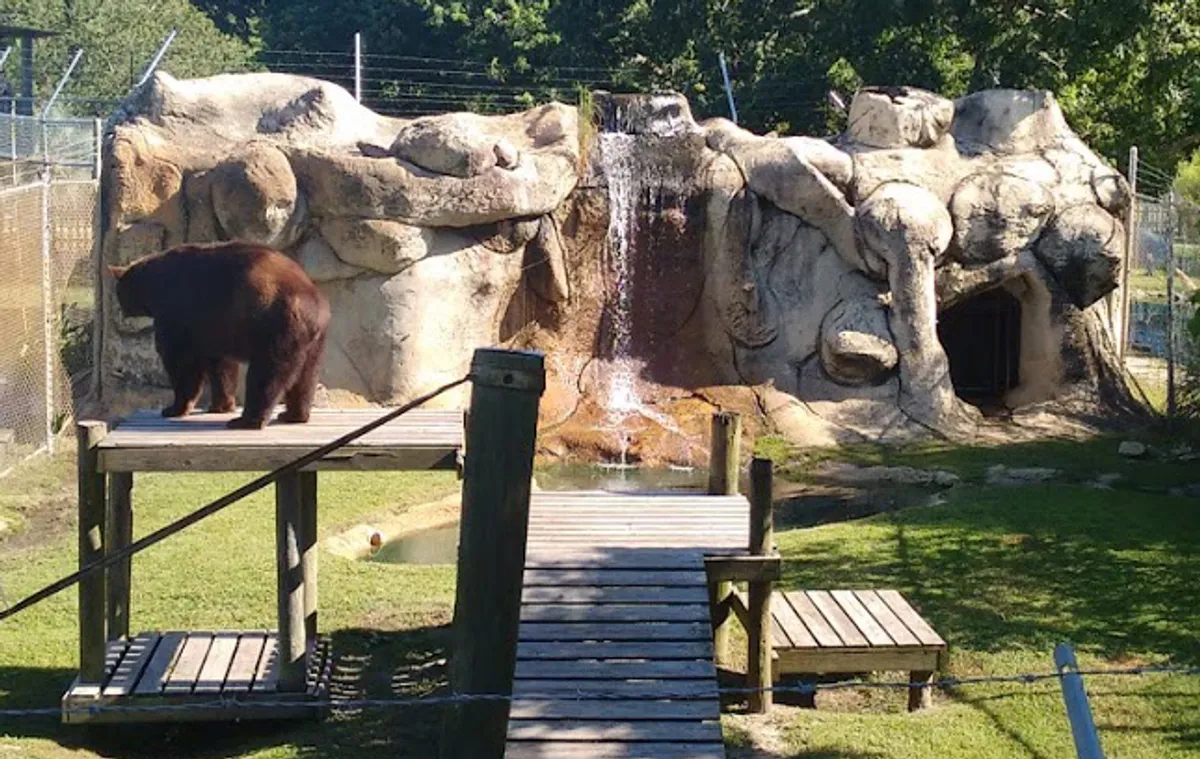 Alabama Gulf Coast Zoo🇺🇸 Gulf Shores, United States
 Metro Richmond Zoo🇺🇸 Moseley, United States
- 🦁Dakota Zoo🇺🇸 Bismarck, United States
 Montgomery Zoo🇺🇸 United States
- 🦁Palm Beach Zoo & Conservation Society🇺🇸 West Palm Beach, United States
Community notes
Share your observations about the Bengal Tiger.
No community notes yet. Be the first!
Discover more wildlife
More fascinating animals from the encyclopedia.