
About the Blobfish
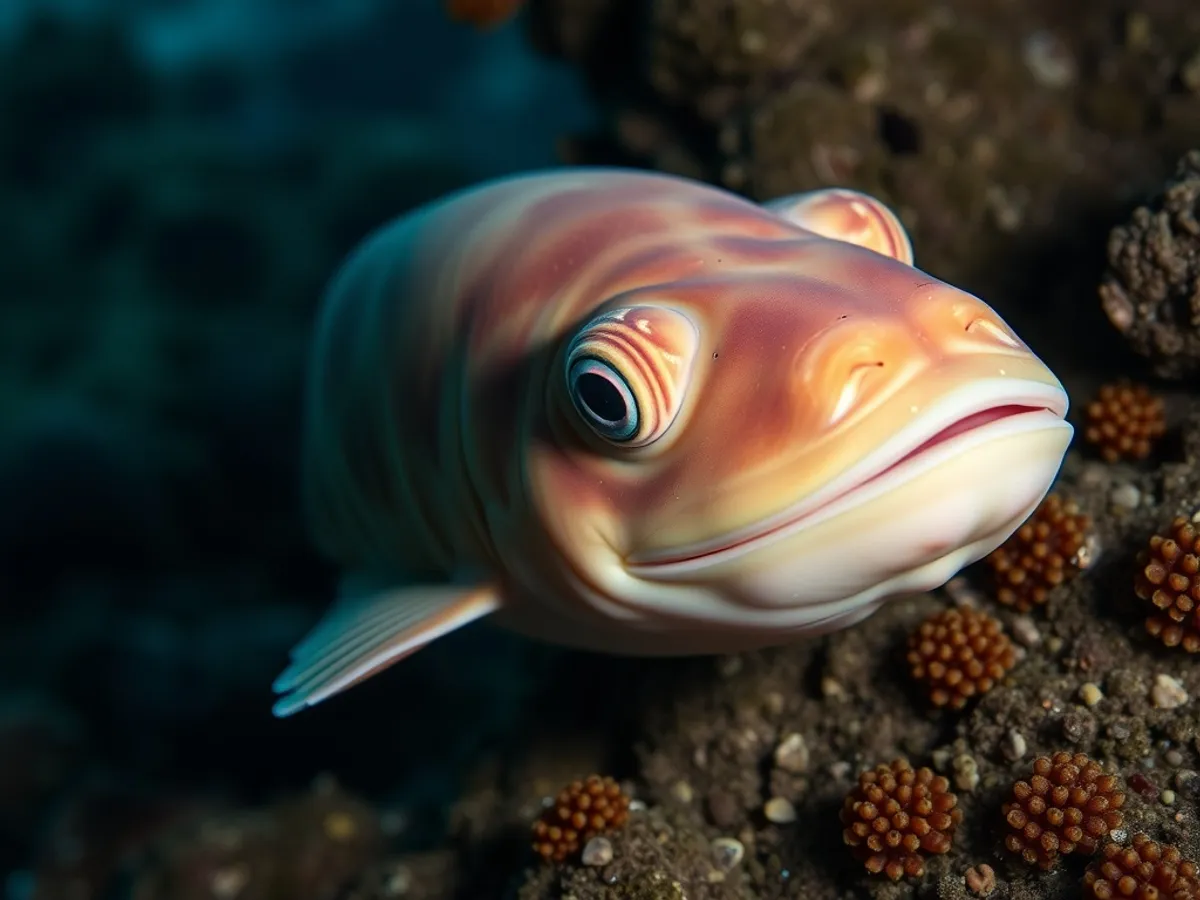
The blobfish is famous for a photograph that badly misrepresents it. In its natural habitat, 600 to 1,200 m down off Australia and New Zealand, it looks like an unremarkable, chunky, big-headed fish; the sagging, melted face the internet knows is what happens when a body adapted to roughly a hundred atmospheres is hauled to the surface and decompresses. The real adaptation is subtler and more interesting. It has almost no swim bladder, because a gas-filled organ is useless and dangerous at that depth, and instead its flesh is a gelatinous tissue of very low density — marginally less dense than seawater — so the fish simply hovers just above the seafloor at zero energetic cost. It has minimal muscle and a reduced skeleton, because it does not chase anything: it waits, mouth open, and takes whatever crustaceans and invertebrates drift or crawl within reach. It is a fish designed to spend almost no energy at all.
Fascinating facts
Deep-sea Dweller
Blobfish live at depths where the pressure is up to 120 times higher than at the surface, which is why their bodies are adapted to such extreme environments.
Passive Feeder
Instead of actively hunting, blobfish feed passively by consuming edible matter like crustaceans and mollusks that float by in the water.
Misleading Appearance
The iconic 'blobby' look only occurs when blobfish are brought to the surface; in their natural habitat, they are shaped more like typical fish, with their bodies supported by water pressure.
Detailed description
The blobfish (Psychrolutes marcidus) is a deep-sea demersal fish belonging to the family Psychrolutidae, characterized by its gelatinous, unmuscular body and distinctive, sagging appearance when brought to the surface. In its native environment, at depths ranging from 600 to 1,200 meters (1,970–3,940 ft), the blobfish maintains a more compact and streamlined form due to the immense pressure of the deep ocean. Adults typically reach lengths of 30 cm (12 in) and weigh around 2 kg (4.4 lbs). The body is pale pink to grayish, with loose, flabby skin and minimal skeletal structure, lacking substantial muscle mass and swim bladder, which are unnecessary at such depths. The head is large and broad, with a blunt snout and small, widely spaced eyes adapted for low-light conditions. Blobfish are benthic ambush predators, spending most of their time hovering just above the seafloor, where they feed on invertebrates such as sea pens, crabs, mollusks, and echinoderms. Their anatomy is highly specialized for energy conservation, as food is scarce in the deep-sea environment. Reproduction involves demersal egg-laying, with females often brooding large clutches of pink eggs on the seafloor. The blobfish's unique adaptations allow it to survive in extreme pressure, but make it highly vulnerable to rapid decompression and bycatch from deep-sea trawling.
Did you know?
Despite their reputation as the ugliest animal, blobfish are rarely seen by humans in their natural habitat and look quite different under the immense pressure of the deep sea.
Research & sources
Wikipedia summary
Blobfish may refer to:Psychrolutidae, a fish family commonly known as blobfishes Psychrolutes microporos, commonly known as a blobfish or fathead Mr Blobby (fish), a individual specimen of Psychrolutes microporos and the subject of a well-known photograph Psychrolutes marcidus, commonly known as a smooth-head blobfish or simply a blobfish Psychrolutes occidentalis, Western blobfish or Western Australian sculpin Psychrolutes phrictus, blob sculpin, also commonly known as a blobfish Ebinania, a genus of fish
Behaviour & social structure
Blobfish are solitary and sedentary, exhibiting minimal movement to conserve energy in the nutrient-poor deep sea. They are opportunistic feeders, relying on their proximity to the substrate to ambush small crustaceans, gastropods, and other benthic organisms that drift within reach. Rather than actively hunting, blobfish typically wait for prey to pass by, then quickly engulf it using a rapid expansion of the mouth cavity. Social interactions are rare, except during breeding periods when multiple individuals may be found in proximity to suitable spawning sites. There is no evidence of complex social structures or territoriality. Daily activity patterns are largely dictated by the availability of drifting food particles, with little variation due to the constant darkness and stable environmental conditions of their habitat.
Reproduction & life cycle
Blobfish are oviparous, with females laying several thousand large, pink eggs in clusters on the seafloor, often in depressions or under rocky ledges. Spawning is believed to occur seasonally, though precise timing is not well documented due to the difficulty of deep-sea observation. Females are known to guard their eggs, remaining motionless over the clutch to protect it from predators and prevent sedimentation. Incubation periods are not well established but are presumed to be extended, given the cold temperatures and low metabolic rates at depth. There is no evidence of parental care post-hatching; larvae are likely planktonic before settling to the benthos as juveniles.
Adaptations & survival
The blobfish displays several remarkable adaptations to deep-sea life. Its body is composed primarily of gelatinous tissue with a density slightly less than seawater, enabling neutral buoyancy without the need for a gas-filled swim bladder, which would collapse under high pressure. The reduced musculature and soft skeleton minimize energy expenditure, a crucial adaptation in an environment with limited food resources. The large head and mouth facilitate the ingestion of sizable prey items relative to body size. Sensory adaptations include small, well-spaced eyes optimized for low-light vision and mechanoreceptors that detect vibrations in the water. These evolutionary specializations allow the blobfish to thrive where few other vertebrates can survive.
Cultural significance
The blobfish gained international notoriety after a 2003 photograph of a specimen, nicknamed 'Mr Blobby,' was widely circulated online, leading to its reputation as the 'world's ugliest animal.' This status has made the blobfish a symbol of deep-sea biodiversity and the impacts of human activity on little-known marine life. While it has no traditional uses or roles in indigenous cultures, the blobfish has become an icon in popular culture, conservation campaigns, and internet memes, often used to highlight the need for deep-sea protection.
Recent research
Recent research has focused on the impact of deep-sea trawling on blobfish populations and their ecological role in benthic communities. Advances in remotely operated vehicles (ROVs) and deep-sea submersibles have enabled in situ observations of blobfish behavior and habitat use, revealing previously unknown aspects of their reproductive ecology and feeding strategies. Genetic studies are ongoing to clarify the phylogenetic relationships within the Psychrolutidae family and to assess population structure across their range. There is growing interest in the physiological mechanisms underlying their extreme pressure tolerance, which may have biomedical and biotechnological applications.
Videos
Habitat
Deep-sea ocean floor

Conservation
The Blobfish is currently classified as Vulnerable on the IUCN Red List.
Threats & challenges
The primary threat to blobfish populations is bycatch from deep-sea bottom trawling, particularly in fisheries targeting orange roughy and other deep-sea species off the coasts of Australia and New Zealand. Blobfish are not targeted commercially but are frequently caught incidentally, suffering fatal decompression injuries when brought to the surface. Habitat degradation from trawling also poses a risk by disturbing spawning grounds and benthic ecosystems. The species is currently listed as 'Vulnerable' by the IUCN, though population data are limited due to the inaccessibility of their habitat. Climate change and ocean acidification may further impact deep-sea environments, but specific effects on blobfish remain uncertain.
Taxonomy
Scientific name
Psychrolutes marcidus
- Kingdom
- Animalia
- Phylum
- Chordata
- Class
- Actinopterygii
- Order
- Scorpaeniformes
- Family
- Psychrolutidae
- Genus
- Psychrolutes
- Species
- marcidus
Community notes
Share your observations about the Blobfish.
No community notes yet. Be the first!
Discover more wildlife
More fascinating animals from the encyclopedia.