
About the Blue dragon nudibranch
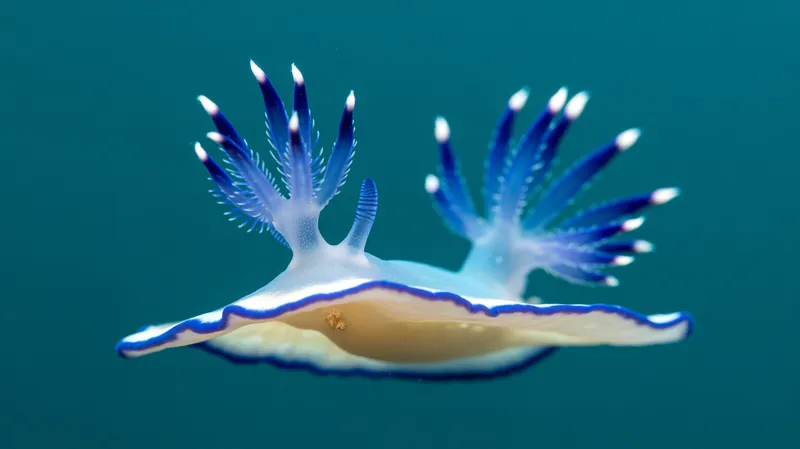
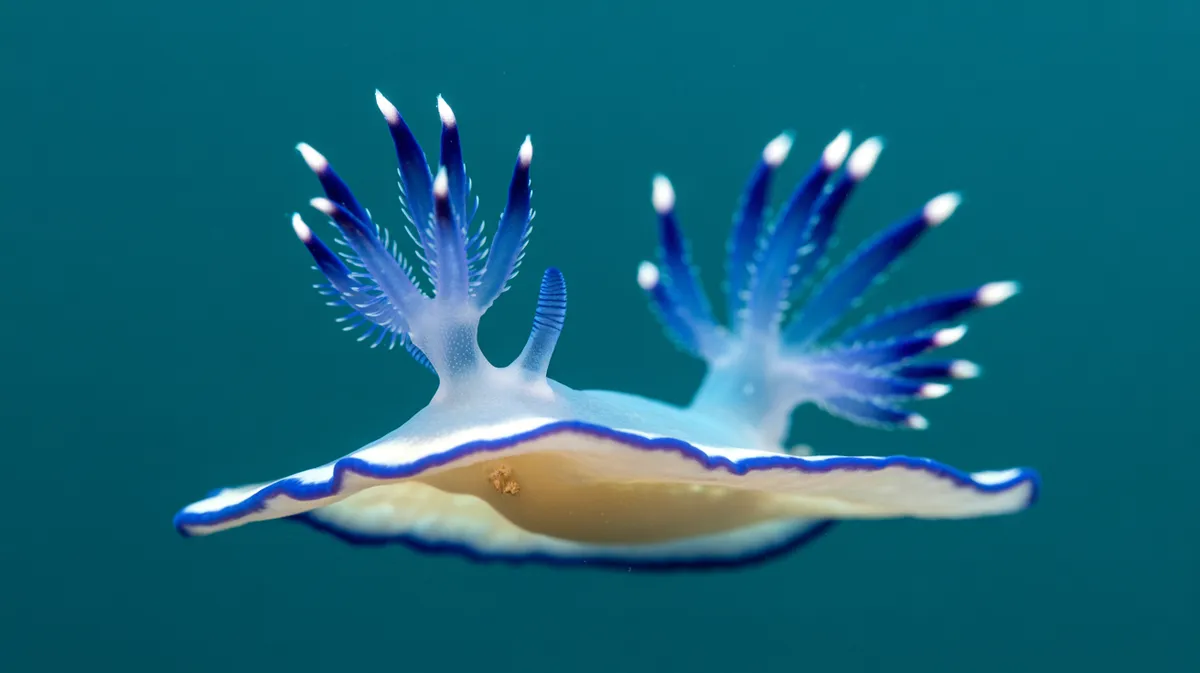
Glaucus atlanticus is a 3 cm sea slug that lives upside down on the surface of the open ocean, hanging from the underside of the water's surface film and kept there by a bubble of gas it swallows and holds in its stomach. It feeds on the most dangerous drifting animals in the sea — the Portuguese man o' war, the by-the-wind sailor, the blue button — and it does not merely tolerate their stings. It stores the prey's unfired stinging cells, moving them intact through its own body to the tips of its finger-like cerata, and because it concentrates them there, a blue dragon's sting can be more painful than that of the man o' war it ate. Its colouring is countershading applied to an upside-down animal: the side facing the sky is silver-grey, and the side facing down into the sea is brilliant blue, so a bird looking down sees water and a fish looking up sees sky. It is a hermaphrodite, and both partners lay eggs after mating — sometimes on the carcass of the prey they have just eaten.
Fascinating facts
Master of Camouflage
Their blue and silver coloration helps them blend in with the water surface, protecting them from both aerial and underwater predators.
Sting Stealer
They feed on venomous creatures like the Portuguese man o' war and store the prey’s stinging nematocysts in their own tissues for defense.
Floating Lifestyle
Blue dragons float upside down on the ocean surface by using a gas-filled sac in their stomachs, drifting wherever the currents take them.
Detailed description
Glaucus atlanticus, commonly known as the blue dragon nudibranch, is a small pelagic gastropod mollusk measuring typically 20–40 mm in length, though some individuals may reach up to 60 mm. Its striking coloration consists of a silvery-grey dorsal side and a vivid blue ventral side, a form of countershading that provides camouflage both from predators above and below. The body is elongated and flattened, with six prominent cerata (finger-like appendages) radiating from the sides, which aid in buoyancy and defense. Unlike most nudibranchs, G. atlanticus floats upside down at the ocean’s surface, supported by a gas-filled sac in its stomach. Its radula (a toothed, chitinous ribbon) is highly specialized for feeding on cnidarians such as the Portuguese man o’ war, siphoning nematocysts (stinging cells) and storing them in the tips of its cerata for its own use. This nudibranch is solitary and drifts with ocean currents, often aggregating in large numbers when prey is abundant. Reproduction is hermaphroditic, with both partners exchanging sperm during mating. Egg strings are laid on floating debris or prey carcasses. G. atlanticus is a highly specialized predator, uniquely adapted to the open ocean’s surface environment, and plays a significant role in the pelagic food web.
Did you know?
Despite their small size and delicate appearance, blue dragons can deliver a painful sting to humans if handled.
Research & sources
Behaviour & social structure
Blue dragon nudibranchs are primarily solitary and exhibit minimal social interaction outside of mating. They are diurnal, remaining near the water’s surface throughout the day, where they rely on wind and currents for movement. Their hunting behavior is opportunistic; they use chemosensory cues to locate prey, including Portuguese man o’ war, blue button jellyfish (Porpita porpita), and by-the-wind sailor (Velella velella). Upon contact, they use their radula to rasp tissue and ingest nematocysts, which are then transported through specialized ducts to the cerata. When threatened, they can autotomize (shed) cerata to distract predators. Blue dragons are not known to form stable groups, but mass strandings can occur when wind patterns drive large numbers ashore.
Reproduction & life cycle
Glaucus atlanticus is a simultaneous hermaphrodite, possessing both male and female reproductive organs. Mating occurs when two individuals align ventral sides, exchanging sperm via a long, hooked penis to minimize the risk of being stung by each other's nematocyst-laden cerata. Fertilization is internal, and each individual can lay up to 20–30 egg strings, each containing dozens of eggs. The eggs are attached to floating substrates such as driftwood, plastic debris, or even the remains of prey. Embryonic development lasts 2–4 days, depending on water temperature, after which planktonic larvae emerge and eventually metamorphose into juvenile nudibranchs. There is no parental care post-oviposition.
Adaptations & survival
Key adaptations include countershading for camouflage, a gas-filled sac for buoyancy, and the ability to sequester and reuse prey nematocysts for defense—a rare trait among animals. The cerata not only serve as defensive structures but also increase surface area for respiration. The specialized radula allows efficient feeding on gelatinous prey. Floating upside down maximizes exposure of the blue ventral side to aerial predators and the silvery dorsal side to aquatic predators, enhancing survival. Their mucous coating protects them from their own stored nematocysts.
Cultural significance
The blue dragon nudibranch has gained popularity in marine enthusiast communities and social media due to its striking appearance. In some cultures, it is associated with mythological sea dragons or spirits. There are no known traditional uses, but its image is often used in art and educational materials to promote marine biodiversity awareness. Its ability to harness the stings of its prey has inspired scientific interest and public fascination.
Recent research
Recent studies have focused on the molecular mechanisms of nematocyst sequestration and resistance, as well as the ecological impacts of plastic pollution on pelagic nudibranchs. Genetic analyses have revealed significant population structure across ocean basins, suggesting limited gene flow despite their pelagic lifestyle. Ongoing research is investigating the potential effects of climate-driven shifts in prey distribution on blue dragon populations. There is also interest in the pharmacological properties of sequestered toxins and their potential biomedical applications.
Sources
The Biology of Glaucus atlanticus Forster, 1777 (Gastropoda: Nudibranchia)
Thompson, T.E. & Bennett, I. (1969)
scientificThe anatomy and functional morphology of Glaucus atlanticus
Churchill, C.K.C. et al. (2014)
scientificSequestration of nematocysts by Glaucus atlanticus and implications for defense
Thompson, T.E. & Bennett, I. (1969)
scientificVideos
Habitat
Open ocean (pelagic zone), floating at the water's surface

Conservation
The Blue dragon nudibranch is currently classified as Least Concern on the IUCN Red List.
Threats & challenges
Currently, G. atlanticus faces few natural predators due to its potent sting, but loggerhead sea turtles (Caretta caretta) and some seabirds may prey on them. Human threats include habitat degradation, pollution (especially plastic debris, which can alter their distribution and egg-laying behavior), and climate change, which may affect prey abundance and ocean currents. Mass strandings can lead to high mortality. Despite these challenges, the species is currently listed as Least Concern, with stable populations globally, though localized impacts may occur.
Taxonomy
Scientific name
Glaucus atlanticus
- Kingdom
- Animalia
- Phylum
- Mollusca
- Class
- Gastropoda
- Order
- Nudibranchia
- Family
- Glaucidae
- Genus
- Glaucus
- Species
- atlanticus
Community notes
Share your observations about the Blue dragon nudibranch.
No community notes yet. Be the first!
Discover more wildlife
More fascinating animals from the encyclopedia.