
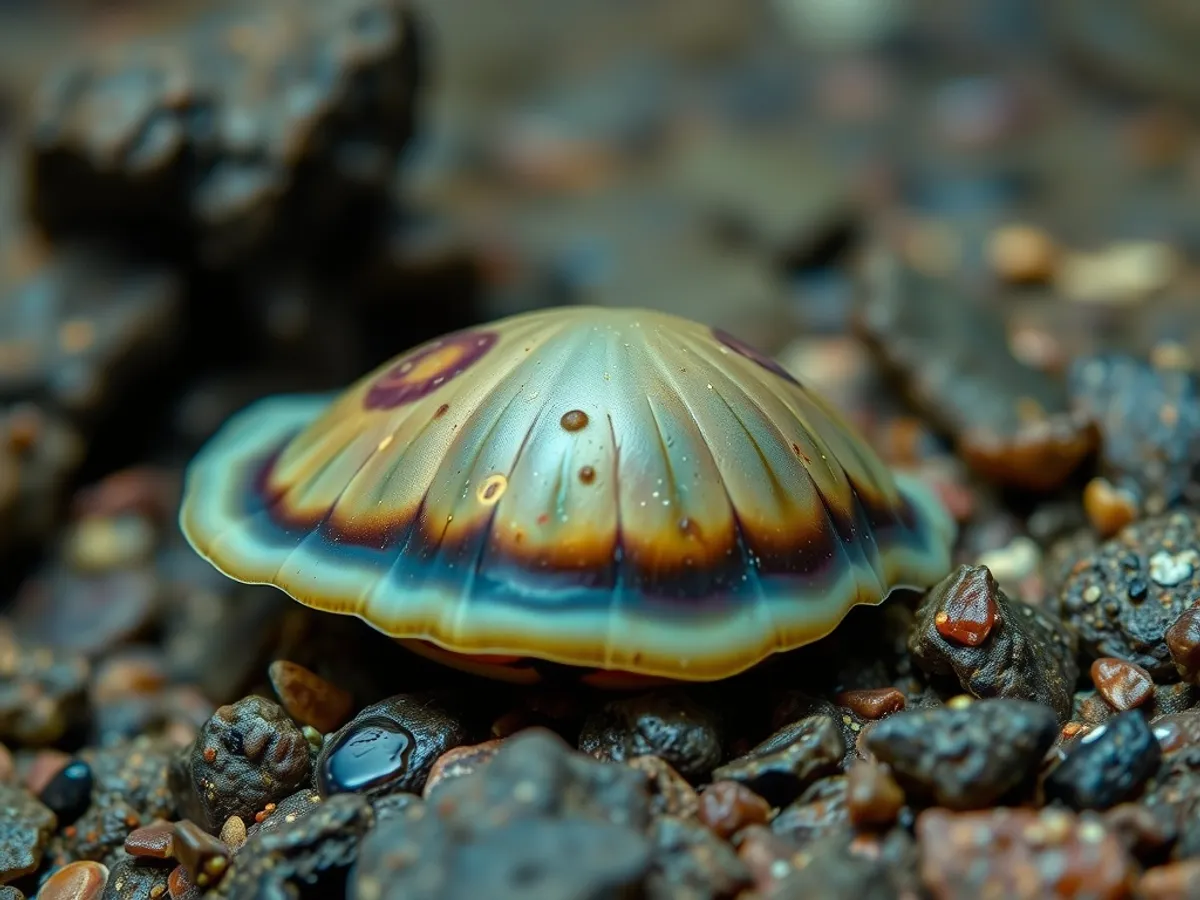
About the Blue-rayed limpet
The blue-rayed limpet is a small and striking marine mollusk known for its translucent shell adorned with vibrant, iridescent blue stripes. Found along the coasts of the northeastern Atlantic, it typically resides on brown algae, especially kelp. Its delicate shell usually measures less than 2 centimeters and provides effective camouflage on its seaweed hosts. The blue rays are produced by microscopic structures that refract light, making this limpet one of the most visually remarkable invertebrates in its range. Despite its beauty, the species is well-adapted to withstand the rough conditions of the intertidal zone.
Fascinating facts
Unique Camouflage
The limpet’s blue stripes blend with the underwater light, helping it remain hidden from predators on kelp fronds.
Microscopic Structure
Their blue lines are not pigments but result from microscopic structures that refract and reflect light, creating intense color.
Specialized Diet
Blue-rayed limpets feed almost exclusively on kelp, scraping microscopic algae and biofilm from the surface with their radula.
Detailed description
The blue-rayed limpet (Patella pellucida) is a diminutive marine gastropod, rarely exceeding 15–20 mm in length, with a thin, translucent shell that is ovate to elongate in shape. Its most distinctive feature is the presence of several brilliant, iridescent blue lines running longitudinally across the shell, which are produced by microscopic multilayered structures within the shell’s aragonite matrix that selectively reflect blue light. The shell itself is fragile and often conforms closely to the contours of its substrate, typically the fronds and stipes of large brown algae such as Laminaria and Saccharina species. The animal’s soft body is pale yellowish or orange, with a broad muscular foot adapted for strong adhesion to slippery surfaces. Patella pellucida is primarily a solitary species, though multiple individuals may be found on the same kelp frond, especially in dense kelp forests. Its radula—a ribbon-like structure studded with chitinous teeth—is specialized for scraping epiphytic algae and kelp tissue. The blue-rayed limpet exhibits a two-phase life cycle: juveniles initially settle on kelp fronds, migrating down to the stipe as they mature, where they excavate shallow depressions (home scars) that provide shelter and reduce predation risk. This species is highly adapted to the dynamic and exposed conditions of the lower intertidal and subtidal zones, tolerating significant wave action and periodic desiccation. Its lifespan is typically 1–2 years, with rapid growth during the first few months post-settlement. The blue-rayed limpet plays a key ecological role in regulating epiphyte loads on kelp, thus influencing the health and productivity of kelp forest ecosystems.
Did you know?
Despite their dazzling appearance, blue-rayed limpets are extremely well-camouflaged on the dark surfaces of kelp, making them difficult for predators and humans to spot.
Research & sources
Wikipedia summary
Patella pellucida, common name the blue-rayed limpet, is a species of small saltwater limpet, a marine gastropod mollusc in the family Patellidae, the true limpets.
Behaviour & social structure
Patella pellucida is primarily nocturnal, becoming more active at night when it grazes on the surface of kelp fronds and stipes. It uses its radula to scrape off microscopic algae and kelp tissue, leaving characteristic feeding scars. The limpet exhibits strong homing behavior, often returning to the same depression or 'scar' it has created in the kelp stipe after foraging excursions. This behavior minimizes exposure to predators and environmental stressors. While generally solitary, blue-rayed limpets may aggregate in areas of high kelp density, but they do not display coordinated social behaviors. They are relatively sedentary, with movement limited to a few centimeters per day. When threatened, they can clamp tightly to the substrate using their muscular foot, making dislodgement by predators or waves difficult. Predators include fish, crabs, and birds, but the limpet’s cryptic coloration and iridescent stripes may serve as a deterrent or disruptive camouflage.
Reproduction & life cycle
Blue-rayed limpets are dioecious, with separate male and female individuals. Spawning typically occurs in late spring to early summer, though timing can vary with local environmental conditions. Fertilization is external: both sexes release gametes into the water column, where fertilization takes place. The resulting planktonic larvae (trochophores) remain in the water for several days to weeks, depending on temperature and food availability, before settling onto suitable kelp hosts. There is no parental care post-spawning. The species is capable of rapid population turnover, with most individuals reaching sexual maturity within their first year. Recruitment success is closely linked to the availability of healthy kelp beds, as juveniles require living kelp for settlement and subsequent growth.
Adaptations & survival
Patella pellucida exhibits several remarkable adaptations for survival in the exposed, dynamic environments of kelp forests. The shell’s iridescent blue stripes are produced by photonic crystal structures, which not only create striking visual effects but may also serve to disrupt the outline of the limpet, confusing predators or mimicking the appearance of water droplets. The limpet’s foot secretes a strong adhesive mucus, allowing it to maintain a firm grip on smooth, flexible kelp surfaces even in turbulent water. Its radula is adapted for efficiently scraping both epiphytic algae and kelp tissue, providing dietary flexibility. The ability to excavate and return to home scars in the kelp stipe reduces predation risk and physical stress. Furthermore, the limpet’s life cycle is synchronized with kelp growth, ensuring optimal habitat availability for juvenile settlement and adult feeding.
Cultural significance
The blue-rayed limpet has limited direct cultural significance, but its striking appearance has made it a subject of interest among naturalists, divers, and marine photographers. Its unique shell structure has attracted scientific attention in the fields of biomimetics and materials science, inspiring research into photonic crystals and structural coloration. In some coastal communities, the limpet is recognized as an indicator of healthy kelp forests, and its presence is valued as a sign of ecological balance.
Recent research
Recent research has focused on the limpet’s photonic shell structures, revealing that the blue stripes are formed by stacks of calcite lamellae separated by protein-rich layers, creating a multilayer interference effect. These findings have implications for the development of advanced optical materials. Studies have also examined the limpet’s role in kelp forest ecology, demonstrating that moderate grazing by limpets can promote kelp health by reducing epiphyte loads, while excessive grazing may damage kelp tissues. Ongoing research is investigating the impacts of ocean acidification on shell formation and larval development, as well as the genetic basis of color patterning and habitat selection in this species.
Videos
Habitat
Marine kelp forests and rocky shores

Conservation
The Blue-rayed limpet is currently classified as Least Concern on the IUCN Red List.
Threats & challenges
Currently, Patella pellucida is classified as Least Concern, with stable populations throughout its range. However, it faces indirect threats from the decline of kelp forests due to climate change, ocean warming, increased storm frequency, and coastal pollution. Overgrazing by sea urchins and invasive species can also reduce kelp availability, impacting limpet recruitment and survival. Localized pollution, such as oil spills and heavy metal contamination, may affect larval development and adult health. Despite these challenges, the species’ high reproductive output and rapid growth confer resilience, provided that kelp habitats remain intact.
Taxonomy
Scientific name
Patella pellucida
- Kingdom
- Animalia
- Phylum
- Mollusca
- Class
- Gastropoda
- Order
- Patellogastropoda
- Family
- Patellidae
- Genus
- Patella
- Species
- pellucida
Community notes
Share your observations about the Blue-rayed limpet.
No community notes yet. Be the first!
Discover more wildlife
More fascinating animals from the encyclopedia.