
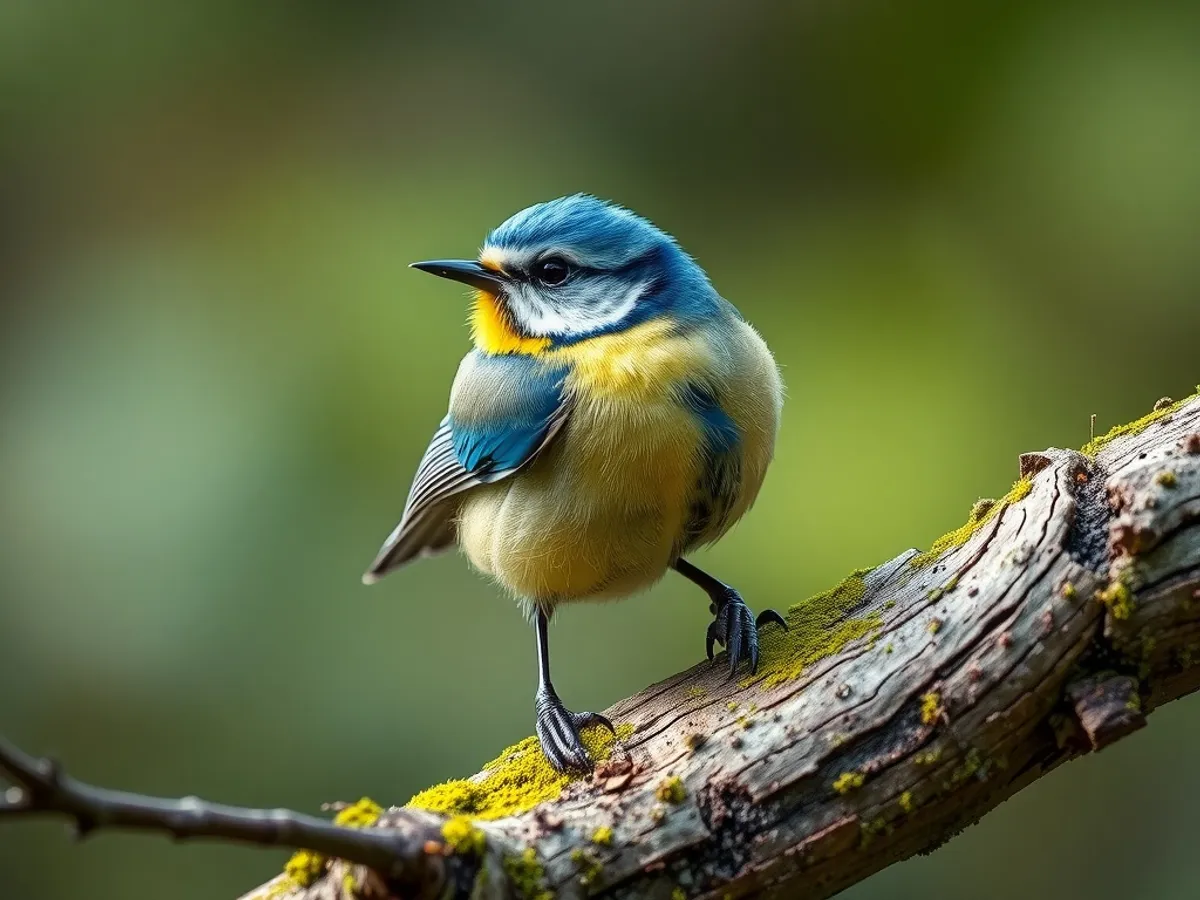
About the Blue Tit
A blue tit is a much more colourful bird than you can see. Its blue crown reflects strongly in ultraviolet, and blue tits can see UV, so where a human sees two similar birds, they see a bright male and a duller female — and females choose mates on the brightness of that UV crown, adjusting even the sex ratio of their chicks depending on how attractive the male is. It is also the bird that famously learned to steal milk. From the 1920s, blue tits and great tits across Britain began piercing the foil caps of doorstep milk bottles to reach the cream, and the habit spread through the population as a genuine case of socially transmitted innovation, mapped as it went. Its ecology hinges on a single narrow window: it times its brood so that the chicks' peak demand coincides with the mass emergence of winter moth caterpillars on oak, and it must get this right within days. Warming springs are causing the caterpillars to peak earlier than the birds can track — one of the best-documented cases of climate-driven mismatch, studied for decades at Wytham Woods near Oxford.
Fascinating facts
Nest Builders
Blue Tits construct their nests in tree holes or nest boxes, using moss, wool, and feathers for comfort and insulation.
Keen Observers
These birds are known for their curiosity and problem-solving skills, often figuring out how to access new food sources.
Insect Control
Blue Tits help gardeners by consuming large numbers of insects, especially caterpillars, during the breeding season.
Detailed description
The Eurasian Blue Tit (Cyanistes caeruleus) is a diminutive passerine bird, measuring approximately 11–12 cm in length and weighing 9–12 grams. Its plumage is a vibrant combination of azure-blue on the crown, wings, and tail, contrasted with a lemon-yellow underside, a white face, and a distinctive dark blue line running through the eye. The species exhibits a short, stubby bill adapted for gleaning insects and seeds from foliage and bark. Blue Tits are highly acrobatic, often seen hanging upside down as they forage, a behavior facilitated by their strong, grasping feet. Socially, they are gregarious outside the breeding season, forming mixed-species flocks with other tits and small birds, which enhances foraging efficiency and predator vigilance. Their vocal repertoire is complex, featuring a variety of trills, chirps, and alarm calls used for communication and territory defense. During the breeding season, Blue Tits become territorial and exhibit pronounced nest-site fidelity. They are cavity nesters, frequently utilizing natural tree holes or nest boxes, and are known for their adaptability to urban and suburban environments. Their intelligence is notable; Blue Tits have demonstrated problem-solving abilities, such as the famous behavior of opening milk bottle tops in the UK to access cream.
Did you know?
A single Blue Tit pair can feed their chicks up to 1,000 caterpillars per day during the breeding season.
Research & sources
Wikipedia summary
The Eurasian blue tit is a small passerine bird in the tit family, Paridae. It is easily recognizable by its blue and yellow plumage and small size.
Behaviour & social structure
Blue Tits are diurnal and spend much of their day foraging for food, employing agile and acrobatic maneuvers to access insects, spiders, and seeds hidden in foliage or bark. They frequently join mixed-species foraging flocks in winter, which reduces predation risk and increases foraging success. Their feeding behavior is opportunistic, and they readily exploit new food sources, including garden feeders and anthropogenic resources. Social interactions are complex; outside the breeding season, they are tolerant of conspecifics, but during nesting, they become highly territorial and aggressive toward intruders. Blue Tits use a variety of vocalizations to maintain contact, warn of predators, and establish territory boundaries. They exhibit a daily routine of intense morning and late afternoon feeding, with periods of rest and preening in between. Roosting usually occurs in dense foliage or cavities, often communally in winter for thermoregulation.
Reproduction & life cycle
Blue Tits are monogamous during the breeding season, which typically spans from April to June in most of their range. Courtship involves males displaying their plumage and feeding females. Nests are built in tree cavities, nest boxes, or occasionally in crevices in buildings, constructed primarily by the female using moss, feathers, and animal hair. Clutch size is large for a bird of its size, typically 7–13 eggs, which are white with reddish speckles. The female incubates the eggs for 13–15 days, while the male provides food. After hatching, both parents feed the chicks a protein-rich diet of caterpillars and insects. Fledging occurs after 16–22 days, but parents may continue to feed fledglings for several days post-departure. Blue Tits often raise a single brood per year, though a second brood is possible in favorable conditions.
Adaptations & survival
Blue Tits possess several key adaptations for survival. Their strong, zygodactyl feet (two toes forward, two backward) allow them to cling and maneuver acrobatically on branches and twigs. Their short, pointed bill is specialized for extracting insects and seeds from crevices. The species demonstrates remarkable cognitive abilities, including spatial memory for locating food caches and innovative problem-solving skills. Physiologically, they are capable of entering shallow torpor to conserve energy during cold nights. Their plumage provides effective camouflage among foliage, and their bright colors may play a role in mate selection. Blue Tits are also highly adaptable to human-altered landscapes, readily exploiting nest boxes and feeders.
Cultural significance
The Blue Tit is a beloved garden bird in Europe, frequently featured in literature, folklore, and art. Its inquisitive nature and striking appearance have made it a favorite among birdwatchers and a symbol of cheerfulness and adaptability. The species gained notoriety in the 20th century for its learned behavior of opening milk bottle tops, a testament to its intelligence and adaptability. In some cultures, Blue Tits are associated with good luck or the arrival of spring. They are also important in environmental education and citizen science, serving as a flagship species for garden bird surveys and nest box monitoring programs.
Recent research
Recent research on Blue Tits has focused on their cognitive abilities, including problem-solving, learning, and memory. Studies have shown that individuals vary in personality traits such as boldness and exploration, which can influence survival and reproductive success. Long-term monitoring projects, such as those at Wytham Woods in the UK, have provided valuable insights into the effects of climate change on breeding phenology and population dynamics. Genomic studies have revealed patterns of local adaptation and gene flow across their range. Research into their role as bioindicators has highlighted their sensitivity to environmental contaminants, making them useful for monitoring ecosystem health.
Videos
Habitat
Woodlands, gardens, parks, and hedgerows
 Various Continental Regions
Grassland
Open areas dominated by grasses rather than trees, supporting numerous herbivores and their predators.
 Elevated Terrain
Mountain
High-altitude environments with varying climates and specialized wildlife adapted to rugged terrain and thin air.
 Global
Forest
Wooded areas with significant tree cover and diverse plant and animal communities.
Conservation
The Blue Tit is currently classified as Least Concern on the IUCN Red List.
Threats & challenges
Currently, the Blue Tit is listed as Least Concern by the IUCN, with stable or increasing populations across much of its range. However, local populations can be affected by habitat loss, pesticide use (which reduces insect prey), and competition for nesting sites with other cavity-nesting birds. Climate change poses a potential threat by altering the timing of insect emergence, which may lead to mismatches between peak food availability and chick-rearing periods. Urbanization has both positive and negative impacts, providing new nesting and feeding opportunities but also exposing birds to increased predation and pollution. Disease outbreaks, such as avian pox and trichomonosis, have been recorded but have not caused significant population declines.
Taxonomy
Scientific name
Cyanistes caeruleus
- Kingdom
- Animalia
- Phylum
- Chordata
- Class
- Aves
- Order
- Passeriformes
- Family
- Paridae
- Genus
- Cyanistes
- Species
- caeruleus
Community notes
Share your observations about the Blue Tit.
No community notes yet. Be the first!
Discover more wildlife
More fascinating animals from the encyclopedia.