
About the Bohemian Waxwing
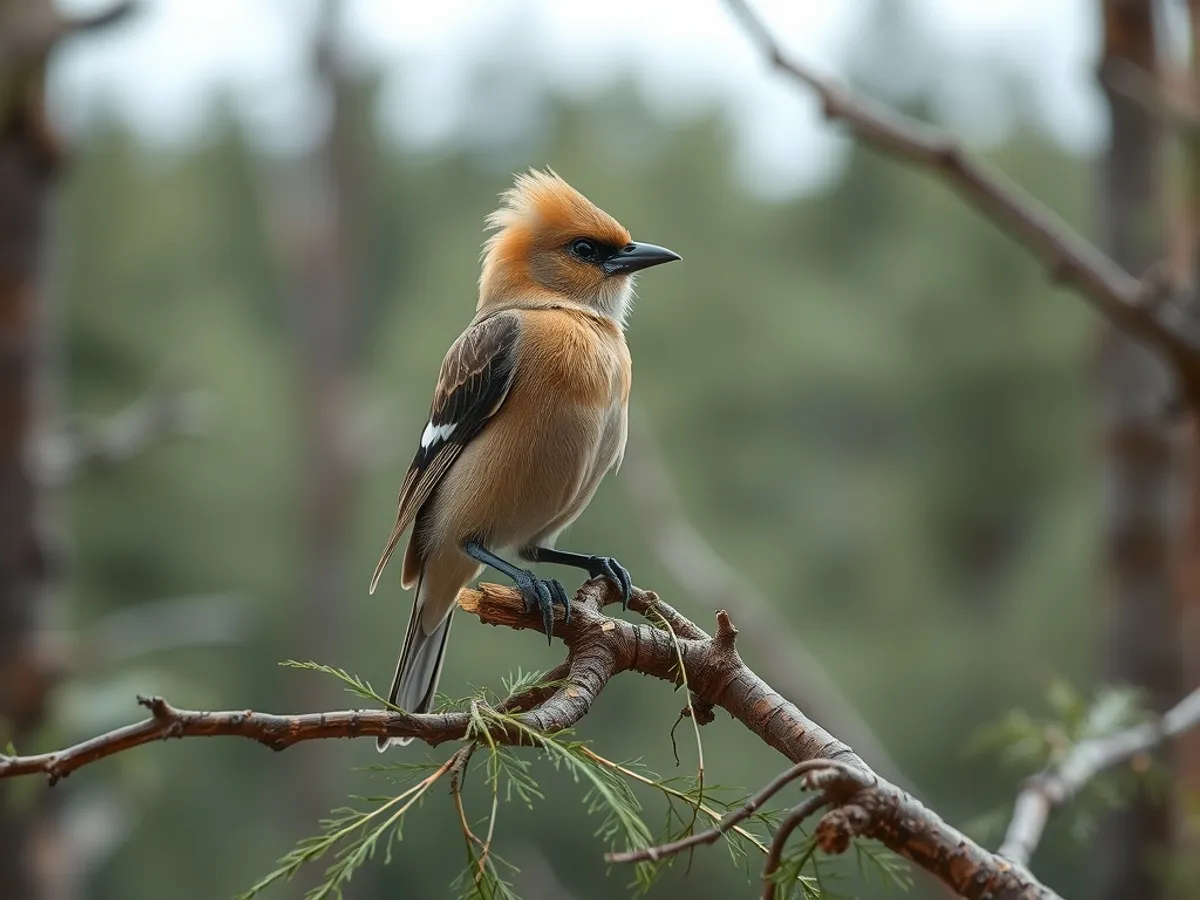
The Bohemian Waxwing is a striking medium-sized passerine bird known for its silky-smooth plumage and prominent crest. Its plumage is predominantly soft grey, with a peachy face, black mask, and bright yellow and white accents on the wings and tail. These birds are highly social, often seen in large flocks foraging for berries in northern forests during winter. They migrate in search of food, sometimes appearing in large numbers far outside their typical range. The Bohemian Waxwing is renowned for its beautiful appearance and distinctive, trilling calls.
Fascinating facts
Berry Specialists
Bohemian Waxwings rely heavily on berries, especially in winter, and can strip entire trees of fruit within hours.
Nomadic Wanderers
These birds do not have fixed migration routes and wander over vast areas depending on food supplies.
Elegant Appearance
Their soft, silky plumage and distinct crests make them one of the most visually appealing birds in the northern forests.
Detailed description
The Bohemian Waxwing (Bombycilla garrulus) is a medium-sized passerine, measuring 19–23 cm in length with a wingspan of 32–35.5 cm and an average weight of 55–67 grams. Its plumage is exceptionally smooth and silky, dominated by a soft, buffy-grey coloration. The bird is instantly recognizable by its prominent, swept-back crest, black mask bordered by white, and a sharply defined black chin patch. The wings are marked with striking white and yellow bars, and several secondary feathers bear bright red, wax-like tips—modified feather shafts that give the species its common name. The tail is short and square-tipped, with a bright yellow terminal band. Both sexes are similar in appearance, though females may have slightly duller coloration and less extensive waxy tips. Juveniles are paler and lack the full adult markings, especially the waxy appendages. Bohemian Waxwings are highly gregarious, forming large, noisy flocks outside the breeding season. Their vocalizations are distinctive, consisting of high-pitched, trilling calls. Anatomically, they possess a short, broad bill adapted for plucking berries, and their digestive tract is specialized for rapid fruit processing.
Did you know?
Bohemian Waxwings can eat up to several times their body weight in berries each day during winter.
Research & sources
Wikipedia summary
The Bohemian waxwing is a starling-sized passerine bird that breeds in the northern forests of the Palearctic and North America. It has mainly buff-grey plumage, black face markings and a pointed crest. Its wings are patterned with white and bright yellow, and some of the wing feathers have red tips, the resemblance of which to sealing wax gives these birds their common name. The two or three subspecies show only minor differences in appearance. Females are similar to males, although young birds are less well-marked and have few or no waxy wingtips. Although the Bohemian waxwing's range overlaps those of the cedar and Japanese waxwings, it is easily distinguished from them by size and plumage differences.
Behaviour & social structure
Bohemian Waxwings are highly social birds, rarely seen alone except during the breeding season. In winter, they form flocks ranging from a few dozen to several hundred individuals, sometimes joining mixed-species flocks with other berry-eating birds. Their daily routine is dominated by foraging, with birds moving en masse between fruiting trees and shrubs. They primarily feed on berries and small fruits—especially those of rowan (Sorbus), juniper, and hawthorn—but will also consume insects during the breeding season. Waxwings are known for their acrobatic feeding behavior, often hanging upside down to reach fruit. They exhibit irruptive migration, with large numbers moving southward in years when northern berry crops fail. Social interactions are generally peaceful, with minimal aggression, and flock cohesion is maintained by constant vocal contact.
Reproduction & life cycle
Breeding occurs in the boreal forests of the Palearctic and North America, typically from May to July. Bohemian Waxwings are monogamous for the breeding season, with pairs forming shortly after arrival on the breeding grounds. The female constructs a cup-shaped nest, usually placed on a horizontal branch of a conifer, 2–10 meters above ground. Clutch size ranges from 3 to 7 eggs, with 5 being typical. Eggs are pale blue-grey with dark spots. Incubation lasts 13–14 days and is performed almost exclusively by the female, while the male provides food. Both parents feed the nestlings, which fledge at about 14–17 days post-hatching. Parental care continues for several days after fledging. Breeding success is closely tied to local food abundance, especially the availability of insects for nestlings.
Adaptations & survival
Bohemian Waxwings exhibit several adaptations for their frugivorous lifestyle. Their short, broad bills and wide gape facilitate rapid berry consumption. Their digestive systems are highly efficient at processing sugary fruits, and they can metabolize ethanol from fermented berries, though intoxication can occur. The waxy tips on their secondary feathers, more pronounced in older individuals, may play a role in mate selection, signaling age and fitness. Their cryptic plumage provides camouflage among the branches of coniferous trees. Behavioral adaptations include nomadic flocking and irruptive migration, enabling them to exploit unpredictable fruit resources across vast areas. During the breeding season, their diet shifts to include more protein-rich insects, supporting chick growth.
Cultural significance
The Bohemian Waxwing has long been admired for its striking appearance and elegant plumage, featuring in folklore and art across northern Eurasia. In some cultures, waxwings are seen as harbingers of winter or symbols of abundance due to their association with fruit-laden trees. Their sudden, unpredictable appearances in large flocks have inspired both wonder and superstition. In Russia and Scandinavia, they are sometimes called 'the bird of joy' for their lively presence during the dark winter months. There is no significant history of traditional use for food or ornamentation, but they are occasionally kept as cage birds in some regions, though this practice is rare and discouraged.
Recent research
Recent research has focused on the Bohemian Waxwing’s irruptive migration patterns, using banding and stable isotope analysis to trace movement across continents. Studies have highlighted the species’ reliance on specific berry crops and the impact of climate-driven changes in fruiting phenology. Genetic analyses confirm low differentiation among subspecies, supporting the view of a single, widespread species with minor regional variation. There is ongoing interest in the function of the waxy feather tips, with evidence suggesting a role in sexual selection. Urban ecology studies have documented increased mortality from window strikes, prompting conservation recommendations for bird-friendly building design. Ongoing monitoring programs track population trends and the effects of environmental change.
Videos
Habitat
Boreal forests and woodland edges
 Polar and Subpolar Regions
Tundra
Cold, treeless regions with permafrost supporting specialized cold-adapted wildlife.
 Elevated Terrain
Mountain
High-altitude environments with varying climates and specialized wildlife adapted to rugged terrain and thin air.
 Global
Forest
Wooded areas with significant tree cover and diverse plant and animal communities.
Conservation
The Bohemian Waxwing is currently classified as Least Concern on the IUCN Red List.
Threats & challenges
Currently assessed as Least Concern by the IUCN, the Bohemian Waxwing has a wide distribution and a large, stable population. However, local declines can occur due to habitat loss, particularly the reduction of mature boreal forests and the removal of fruit-bearing trees. Climate change may alter the distribution and productivity of key berry-producing plants, potentially impacting food availability. Collisions with windows and vehicles are a notable mortality factor during irruptive winters in urban areas. Pesticide use affecting berry crops and insect prey may also pose localized risks. Despite these challenges, the species remains resilient due to its flexible foraging and migratory behavior.
Taxonomy
Scientific name
Bombycilla garrulus
- Kingdom
- Animalia
- Phylum
- Chordata
- Class
- Aves
- Order
- Passeriformes
- Family
- Bombycillidae
- Genus
- Bombycilla
- Species
- garrulus
Community notes
Share your observations about the Bohemian Waxwing.
No community notes yet. Be the first!
Discover more wildlife
More fascinating animals from the encyclopedia.