
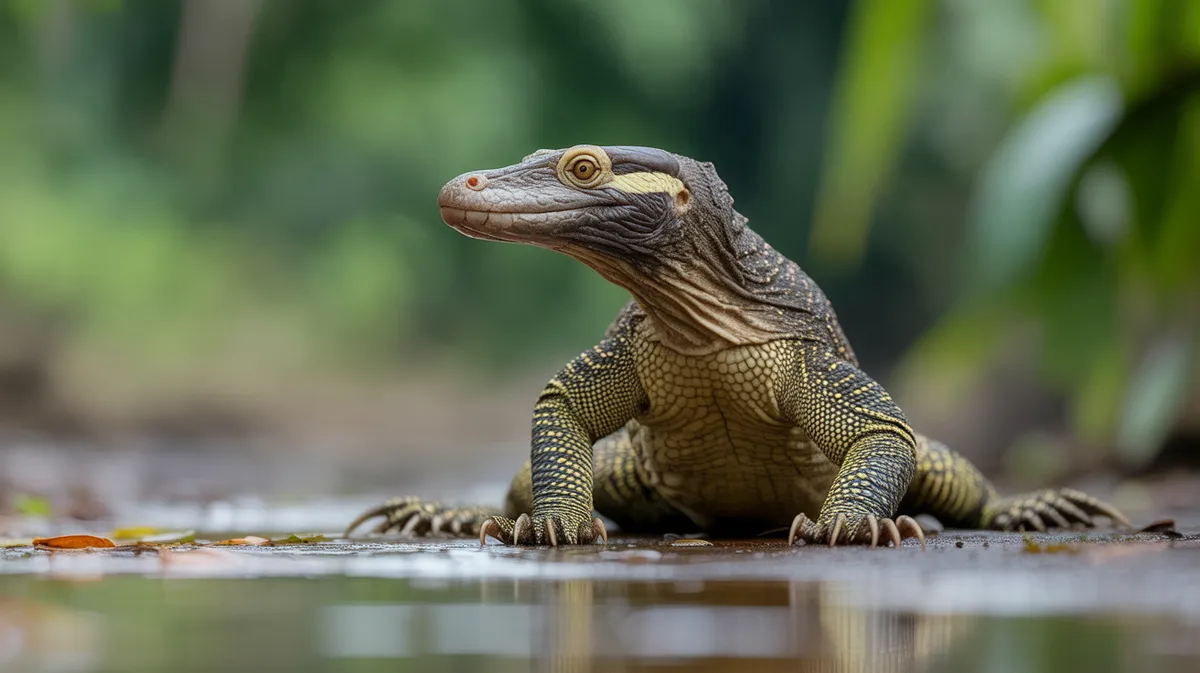
About the Borneo Earless Monitor
The Borneo Earless Monitor is a rare, semi-aquatic lizard endemic to the island of Borneo. Characterized by its lack of external ear openings, this secretive reptile has a cylindrical, elongated body covered in rough, reddish-brown scales and a distinctive prehensile tail. It inhabits lowland rainforests near streams and swamps, where it is mostly nocturnal and fossorial, spending much of its life hidden under leaf litter or in burrows. Due to its elusive nature, little is known about its wild behavior, and it is highly sought after by herpetologists and the illegal pet trade.
Fascinating facts
Ancient Lineage
The Borneo Earless Monitor is often referred to as a 'living fossil' and is the sole surviving member of its family, Lanthanotidae, which diverged from other lizards tens of millions of years ago.
Nocturnal and Secretive
This species is mostly nocturnal and spends much of its time hidden under rocks, logs, or in burrows near water sources, making it extremely difficult to observe in the wild.
Semi-Aquatic Lifestyle
The Borneo Earless Monitor is an excellent swimmer and is often found in or near clear, flowing streams in Borneo's rainforests.
Detailed description
The Borneo Earless Monitor (Lanthanotus borneensis) is a highly distinctive, semi-aquatic lizard reaching 40–53 cm in total length, with a robust, cylindrical body and a laterally compressed, prehensile tail that aids in swimming and maneuvering through dense riparian vegetation. Its skin is covered in heavily keeled, bead-like scales, providing protection and camouflage among leaf litter and muddy stream banks. The species lacks external ear openings—a rare trait among lizards—hence its common name, and possesses small, lidless eyes adapted for low-light conditions. The head is wedge-shaped with a blunt snout, and the jaws are lined with sharp, recurved teeth suited for gripping slippery prey. Limbs are short but strong, each ending in five clawed digits, facilitating both digging and climbing. Internally, Lanthanotus borneensis exhibits a primitive lung structure and a cloacal gland capable of secreting a foul-smelling substance, likely used for defense. The species is primarily nocturnal and fossorial, emerging at night to hunt along stream margins. It is solitary by nature, with individuals occupying overlapping but loosely defined territories. Reproduction is oviparous, with females laying small clutches of eggs in concealed, humid microhabitats. The Borneo Earless Monitor is considered a 'living fossil,' representing the only extant member of its family, Lanthanotidae, and is of significant evolutionary interest due to its unique anatomical and physiological features.
Did you know?
The Borneo Earless Monitor is the only living species in its family, Lanthanotidae, making it one of the most evolutionarily distinct lizards on Earth.
Research & sources
Behaviour & social structure
Lanthanotus borneensis is predominantly nocturnal, spending daylight hours hidden beneath rocks, logs, or within self-dug burrows near water sources. Its activity peaks shortly after dusk, when it emerges to forage along stream banks and shallow waters. The species is an opportunistic carnivore, preying on aquatic and semi-aquatic invertebrates such as earthworms, crustaceans, insect larvae, and occasionally small fish and amphibians. It employs a sit-and-wait hunting strategy, relying on its cryptic coloration and slow, deliberate movements to ambush prey. Feeding is facilitated by its strong jaws and recurved teeth, which help subdue slippery or hard-shelled prey. Social interactions are minimal outside of the breeding season, and individuals exhibit territorial behavior, with occasional aggressive encounters if territories overlap. Communication is poorly understood but may involve chemical cues, as suggested by the presence of cloacal glands. The species is known for its secretive, elusive nature, making field observations rare.
Reproduction & life cycle
Reproductive activity in Lanthanotus borneensis is believed to coincide with the onset of the rainy season, typically between November and March, although precise timing may vary locally. Courtship and mating behaviors are not well documented, but captive observations suggest that males may engage in gentle biting and body alignment to facilitate copulation. Females are oviparous, laying 2–12 elongated, leathery eggs per clutch in moist, concealed locations such as under logs or within burrows. The incubation period ranges from 90 to 120 days, depending on ambient temperature and humidity. Hatchlings measure approximately 10–15 cm in length and are fully independent at birth, receiving no parental care. Sexual maturity is estimated to be reached at 3–4 years of age, but detailed demographic data from wild populations are lacking.
Adaptations & survival
The Borneo Earless Monitor exhibits several unique adaptations for its semi-aquatic, fossorial lifestyle. The absence of external ear openings reduces the risk of water and debris entering the auditory canal during burrowing or swimming. Its prehensile tail provides balance and propulsion in water, while the heavily keeled scales offer protection and aid in camouflage. The species has a reduced but functional pineal eye, which may play a role in circadian rhythm regulation. Its low metabolic rate and ability to remain motionless for extended periods help conserve energy and avoid detection by predators. Chemoreception is highly developed, with the tongue and Jacobson’s organ used to detect prey and conspecifics. The cloacal gland secretes a malodorous substance, likely serving as a deterrent to predators and possibly as a territorial marker.
Cultural significance
The Borneo Earless Monitor is not widely represented in local folklore or traditional practices, likely due to its elusive habits and rarity. However, it has gained symbolic importance among herpetologists and conservationists as a 'living fossil' and a flagship species for the conservation of Borneo’s unique freshwater ecosystems. In recent years, its enigmatic status has led to increased attention from wildlife enthusiasts and the illegal pet trade, but it does not appear to have significant roles in indigenous mythology or traditional medicine.
Recent research
Recent molecular phylogenetic studies have confirmed that Lanthanotus borneensis is the sole surviving member of the family Lanthanotidae, with its closest relatives being monitor lizards (family Varanidae). Comparative genomic analyses have provided insights into the evolutionary history of anguimorph lizards, highlighting the species’ ancient lineage. Field research remains challenging due to its cryptic behavior, but advances in radio telemetry and environmental DNA (eDNA) sampling are beginning to yield new data on its distribution and habitat use. Captive breeding programs have achieved limited success, offering hope for ex situ conservation, but long-term population viability in the wild remains uncertain. Ongoing research priorities include detailed studies of its reproductive biology, population genetics, and ecological requirements.
Sources
The biology and systematics of Lanthanotus borneensis Steindachner, 1878 (Squamata: Anguimorpha: Lanthanotidae), the Bornean earless monitor
André Koch, Wolfgang Böhme, Ulrich Eidenmüller (2014)
scientificLanthanotus borneensis: The IUCN Red List of Threatened Species 2016
IUCN SSC Amphibian and Reptile Specialist Group
conservationThe Borneo Earless Monitor, Lanthanotus borneensis: Natural History, Ecology, and Conservation
Das, I. & Lim, K.K.P. (2019)
scientificLanthanotus borneensis: The IUCN Red List of Threatened Species 2019
IUCN SSC Amphibian and Reptile Specialist Group
conservationVideos
Habitat
Tropical lowland rainforest streams and wetlands
 Tropical Regions
Rainforest
Dense, wet forests with the highest biodiversity on Earth, containing more than half of the world's plant and animal species.
 Global
Forest
Wooded areas with significant tree cover and diverse plant and animal communities.
 Global
Freshwater
Lakes, rivers, and wetlands with diverse aquatic ecosystems.
Conservation
The Borneo Earless Monitor is currently classified as Endangered on the IUCN Red List.
Threats & challenges
Lanthanotus borneensis faces significant threats from habitat loss due to deforestation, conversion of lowland rainforests to oil palm plantations, and pollution of freshwater habitats. Illegal collection for the international pet trade has further exacerbated population declines, as the species commands high prices due to its rarity and unique appearance. Its restricted range and specialized habitat requirements make it particularly vulnerable to environmental changes. Population trends are poorly understood, but field surveys suggest that the species is rare and declining throughout its range. Conservation efforts are hampered by the species’ secretive nature and the lack of comprehensive ecological data. It is currently listed as Endangered by the IUCN Red List, and international trade is regulated under CITES Appendix II.
Taxonomy
Scientific name
Lanthanotus borneensis
- Kingdom
- Animalia
- Phylum
- Chordata
- Class
- Reptilia
- Order
- Squamata
- Family
- Lanthanotidae
- Genus
- Lanthanotus
- Species
- borneensis
Community notes
Share your observations about the Borneo Earless Monitor.
No community notes yet. Be the first!
Discover more wildlife
More fascinating animals from the encyclopedia.