
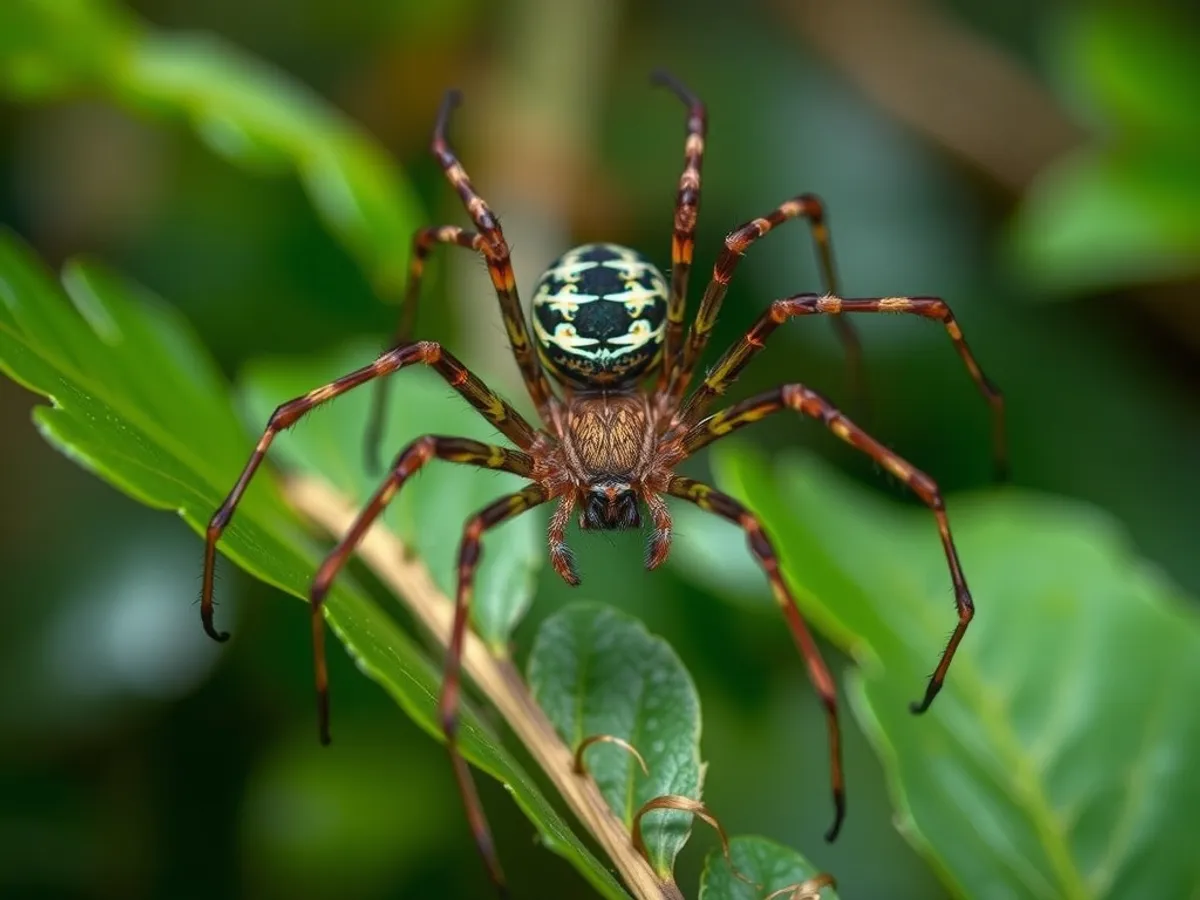
About the Brazilian Wandering Spider
The name is the important part: it wanders. Phoneutria spiders do not build capture webs and do not sit in one place — they hunt across the forest floor at night, and by day they cram into any dark cavity they can find, which is how they end up in shoes, log piles, and banana shipments and get flown to European supermarkets. That habit, not any special aggression, is what produces the encounters. It is routinely billed as the world's most venomous spider, and its venom is genuinely serious: it contains a peptide toxin that causes prolonged, painful priapism, which is why it is being actively investigated as a lead compound for erectile dysfunction drugs. But the popular framing is misleading. Brazilian hospital data covering thousands of Phoneutria bites show that the great majority produce nothing worse than intense local pain, effective antivenom exists, and fewer than one percent of cases require it — deaths are exceptionally rare and mostly involve children. Threatened, it rears up, lifts its front legs vertically over its head, exposes red-hued fangs, and sways side to side.
Fascinating facts
Venomous Bite
The Brazilian Wandering Spider's venom contains a potent neurotoxin that can cause paralysis and, in rare cases, be fatal to humans.
Nocturnal Hunter
Instead of spinning webs, this spider actively hunts for insects, small lizards, and even small mammals during the night.
Banana Spider
It earned the nickname 'banana spider' because it is frequently found in banana plantations and has occasionally been discovered in exported banana shipments.
Detailed description
Phoneutria fera, commonly known as the Brazilian wandering spider, is a large, robust arachnid belonging to the family Ctenidae. Adults typically exhibit a body length of 17–48 mm, with leg spans reaching up to 15 cm, making them among the largest spiders in South America. Their coloration is generally brown to dark brown, with dense setae (hairs) covering the body and legs, providing camouflage among leaf litter and vegetation. The cephalothorax is broad and slightly flattened, while the abdomen is oval and often patterned with subtle markings. P. fera possesses eight eyes arranged in three rows, granting it acute vision for nocturnal hunting. Its chelicerae are powerful and house venom glands capable of delivering a potent neurotoxic venom. Unlike web-building spiders, P. fera is an active hunter, relying on speed and agility to ambush prey. Sexual dimorphism is present, with females being larger and more robust than males. The species exhibits solitary behavior, except during mating periods. Adaptations such as strong, spiny legs and sensitive sensory hairs enable it to detect vibrations and prey movements efficiently. This spider is renowned for its defensive posture, raising its front legs and displaying fangs when threatened.
Did you know?
A bite from the Brazilian Wandering Spider can sometimes cause priapism, a painful and prolonged erection in humans.
Research & sources
Wikipedia summary
Phoneutria fera is a species of spider with medically significant venom in the family Ctenidae found in South America. It is commonly known as the Brazilian wandering spider and the banana spider, although these names are applied to other species in the genus Phoneutria, particularly Phoneutria nigriventer. P. fera tends to spend a larger amount of time in vegetation during the early period of its life and spends more time on the ground once it becomes larger. This is more common in females, since they are usually larger than males. Medical records from within the geographic range of P. fera show bites, have the potential to develop moderate to severe systematic reactions in humans.
Behaviour & social structure
P. fera is primarily nocturnal, emerging at dusk to actively forage for prey rather than relying on webs. Its diet consists mainly of insects, other arthropods, and occasionally small vertebrates such as frogs and lizards. The spider employs a sit-and-wait or active pursuit strategy, using rapid bursts of speed to capture prey. It is highly responsive to ground vibrations and air movements, which it detects through specialized trichobothria (sensory hairs) on its legs. During the day, P. fera seeks shelter in leaf litter, under logs, or within dense vegetation. The species is solitary and territorial, with individuals avoiding direct contact except during the breeding season. When threatened, it adopts a characteristic threat display, raising its front legs and exposing red or orange warning coloration on the ventral side. Defensive bites are rare but can occur if provoked or cornered.
Reproduction & life cycle
Reproduction in P. fera involves complex courtship behaviors, with males approaching females cautiously to avoid being mistaken for prey. Mating typically occurs during the rainy season, when humidity and prey availability are high. After successful copulation, the female produces a silken egg sac containing up to 1,000 eggs, which she guards aggressively until spiderlings emerge after an incubation period of 3–4 weeks. Spiderlings disperse soon after hatching to reduce cannibalism risk. There is no extended parental care beyond guarding the egg sac. Sexual maturity is reached within 10–12 months, and the lifespan of P. fera in the wild is estimated at 1–2 years.
Adaptations & survival
P. fera exhibits several adaptations for survival in the tropical rainforest. Its cryptic coloration and dense body hairs provide camouflage against predators and prey. The spider's robust legs, equipped with spines, enhance climbing ability and grip on various substrates. Acute sensory organs, including trichobothria and slit sensilla, allow detection of minute vibrations and chemical cues. The potent neurotoxic venom, containing a complex mixture of peptides and proteins (notably PhTx3), is highly effective at immobilizing prey and deterring predators. Behavioral adaptations include nocturnal activity patterns to avoid diurnal predators and reduce competition, as well as the use of threat displays to warn off potential threats.
Cultural significance
The Brazilian wandering spider holds a prominent place in local folklore and popular culture, often cited as one of the world's most dangerous spiders due to its potent venom and aggressive reputation. It is sometimes referred to as the 'banana spider' because of its frequent discovery in banana shipments, leading to widespread myths and exaggerated accounts of deadly encounters. In some indigenous cultures, the spider is associated with cautionary tales and is used symbolically to represent danger or vigilance. There are no known traditional medicinal or utilitarian uses for this species.
Recent research
Recent research has focused on the biochemical properties of P. fera venom, particularly its neurotoxic peptides, which have shown potential for pharmaceutical applications such as novel painkillers and treatments for erectile dysfunction. Studies have also investigated the spider's ecological role as a top arthropod predator in neotropical forests, contributing to the regulation of insect populations. Molecular phylogenetic analyses continue to refine the taxonomy of the genus Phoneutria, clarifying species boundaries and evolutionary relationships. Ongoing field studies are examining the impact of habitat fragmentation on population genetics and dispersal patterns.
Videos
Habitat
Tropical rainforest


Conservation
The Brazilian Wandering Spider is currently classified as Least Concern on the IUCN Red List.
Threats & challenges
Currently, P. fera is classified as Least Concern, with stable populations across its range. However, localized threats include habitat loss due to deforestation, agricultural expansion, and urbanization in the Amazon and surrounding regions. Pesticide use may also impact prey availability and spider health. Human encounters, often resulting from the spider's tendency to seek shelter in banana shipments, can lead to negative perceptions and unnecessary killing. Despite these challenges, the species demonstrates resilience due to its broad habitat tolerance and adaptability.
Taxonomy
Scientific name
Phoneutria fera
- Kingdom
- Animalia
- Phylum
- Arthropoda
- Class
- Arachnida
- Order
- Araneae
- Family
- Ctenidae
- Genus
- Phoneutria
- Species
- fera
Community notes
Share your observations about the Brazilian Wandering Spider.
No community notes yet. Be the first!
Discover more wildlife
More fascinating animals from the encyclopedia.