
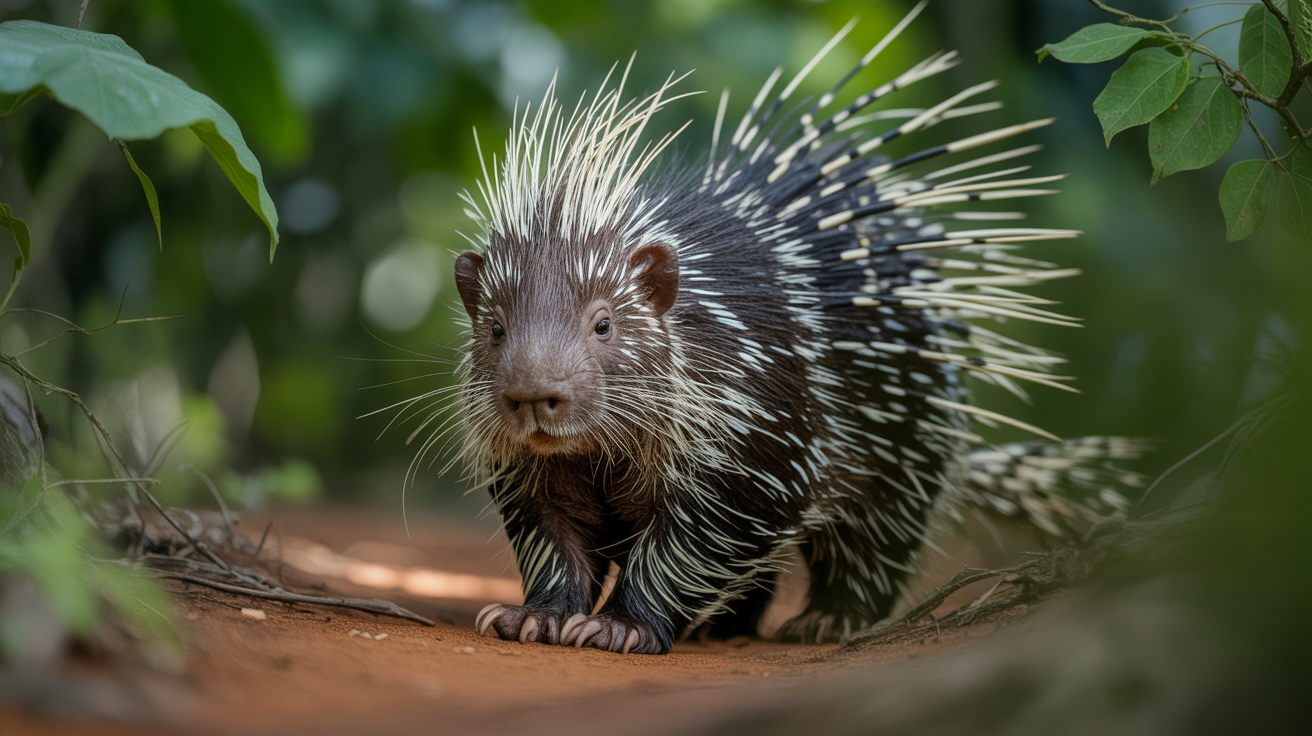
About the Bristle-spined Porcupine
The Bristle-spined Porcupine is a unique rodent native to the Atlantic Forest of eastern Brazil. Unlike other porcupines, it has long, bristle-like spines mixed with fur rather than rigid, sharp quills. This nocturnal and arboreal animal is secretive and difficult to spot in the wild. Adapted for a life in the trees, it uses its strong limbs and prehensile tail to navigate through dense forest canopies. The species is threatened mainly by habitat loss, making it an increasingly rare sight.
Fascinating facts
Tree-dweller
The Bristle-spined Porcupine is highly arboreal, spending most of its life in the trees of Brazil's Atlantic Forest.
Unique Spines
Unlike typical porcupines, its spines are bristle-like and flexible, blending with its fur for effective camouflage.
Taxonomic Mystery
Its unusual features have puzzled scientists, leading to debates about its relationship to other rodents.
Detailed description
The Bristle-spined Porcupine (Chaetomys subspinosus) is a medium-sized arboreal rodent, typically measuring 38–45 cm in head-body length, with a tail of 15–20 cm, and weighing approximately 1.3–2.0 kg. Its most distinctive feature is its pelage: the dorsal fur is interspersed with long, flexible, bristle-like spines rather than the rigid, barbed quills seen in other porcupines. These spines are thin, pale, and sometimes translucent, providing camouflage among the branches and leaves of the Atlantic Forest canopy. The animal has a rounded head, small ears, and large, forward-facing eyes adapted for nocturnal vision. Its limbs are robust, with strong, curved claws and a partially prehensile tail that aids in grasping branches and maintaining balance while climbing. The Bristle-spined Porcupine is strictly nocturnal and spends most of its life in the upper forest strata, rarely descending to the ground. Its dentition is specialized for gnawing tough plant material, and its digestive system is adapted for a folivorous diet. The species is solitary and elusive, with individuals occupying overlapping home ranges but rarely interacting outside of the breeding season. Vocalizations are infrequent, but individuals may communicate through scent marking and soft grunts or squeaks.
Did you know?
Despite being called a porcupine, genetic studies suggest they are more closely related to spiny rats than to true New World porcupines.
Research & sources
Wikipedia summary
The bristle-spined rat is an arboreal rodent from the Atlantic forest in eastern Brazil. Also known as the bristle-spined porcupine or thin-spined porcupine, it is the only member of the genus Chaetomys and the subfamily Chaetomyinae. It was officially described in 1818, but rarely sighted since, until December 1986, when two specimens—one a pregnant female—were found in the vicinity of Valencia in Bahia. Since then it has been recorded at several localities in eastern Brazil, from Sergipe to Espírito Santo, but it remains rare and threatened due to habitat loss, poaching and roadkills.
Behaviour & social structure
Chaetomys subspinosus is primarily nocturnal, emerging at dusk to forage and returning to its daytime resting sites before dawn. It moves slowly and deliberately through the canopy, using its prehensile tail and strong limbs to navigate gaps between branches. The species is an obligate folivore, feeding mainly on young leaves, buds, shoots, and occasionally fruits and flowers from a variety of native tree species, including those in the genera Ficus and Cecropia. Feeding bouts are interspersed with periods of rest and grooming. The Bristle-spined Porcupine is generally solitary, with minimal direct social interaction. Home ranges are estimated to be 2–5 hectares, with some overlap between individuals. Scent marking is used to delineate territory and communicate reproductive status. When threatened, the animal may freeze or attempt to hide, relying on its cryptic coloration and bristly pelage for concealment rather than active defense.
Reproduction & life cycle
Reproductive biology in the wild is poorly documented, but available evidence suggests a polygynous or promiscuous mating system. Breeding appears to be seasonal, coinciding with periods of increased food availability (typically the rainy season, October to March). Gestation lasts approximately 120–130 days, after which a single precocial offspring is born. Neonates are well-developed, with open eyes and a full coat of fur and bristles. The young remain with the mother for several weeks, clinging to her fur or riding on her back as she forages. Parental care is provided solely by the female, who nurses and protects the offspring until it is able to fend for itself. Sexual maturity is reached at about one year of age. Lifespan in the wild is unknown, but related species may live up to 10–12 years.
Adaptations & survival
The Bristle-spined Porcupine exhibits several unique adaptations for arboreal and nocturnal life. Its flexible, bristle-like spines provide both camouflage and a degree of protection from predators without the encumbrance of heavy, rigid quills. The prehensile tail and strong, curved claws enable precise climbing and gripping of branches. Large eyes enhance night vision, while sensitive vibrissae (whiskers) aid in navigating dense foliage in low light. Its folivorous diet is supported by specialized teeth and a robust digestive system capable of processing fibrous plant material. Behavioral adaptations include cryptic coloration, slow movement to avoid detection, and solitary habits to reduce competition for food resources.
Cultural significance
There is limited documentation of the Bristle-spined Porcupine in local folklore or indigenous cultures, likely due to its rarity and elusive nature. Unlike other porcupines, it is not commonly hunted for meat or quills. However, in some rural communities, it may be mistaken for other porcupine species and occasionally hunted. Its presence is generally considered neutral or of minor significance in traditional beliefs.
Recent research
Recent genetic and morphological studies have clarified the taxonomic position of Chaetomys, confirming it as the sole member of the subfamily Chaetomyinae and highlighting its evolutionary distinctiveness among New World porcupines. Ongoing research focuses on its ecology, distribution, and conservation genetics, with camera trapping and radio telemetry being used to better understand its habitat use and population structure. Notably, a 2012 mitochondrial DNA analysis suggested a closer relationship to the Erethizontidae (New World porcupines) than previously thought, resolving earlier debates about its placement. Conservation biologists are also investigating the effects of habitat fragmentation and the potential for protected area networks to support viable populations.
Videos
Habitat
Atlantic Forest


Conservation
The Bristle-spined Porcupine is currently classified as Vulnerable on the IUCN Red List.
Threats & challenges
The primary threats to Chaetomys subspinosus are habitat loss and fragmentation due to deforestation for agriculture, urbanization, and logging in the Atlantic Forest, one of the world’s most endangered biomes. Road construction leads to frequent roadkills, and poaching for bushmeat or the pet trade, though less common, also poses risks. The species' low population density, specialized habitat requirements, and limited dispersal ability make it particularly vulnerable to local extinctions. Current population trends are declining, with the species classified as Vulnerable by the IUCN. Conservation challenges include enforcing habitat protection, restoring forest corridors, and increasing public awareness.
Taxonomy
Scientific name
Chaetomys subspinosus
- Kingdom
- Animalia
- Phylum
- Chordata
- Class
- Mammalia
- Order
- Rodentia
- Family
- Echimyidae
- Genus
- Chaetomys
- Species
- subspinosus
Community notes
Share your observations about the Bristle-spined Porcupine.
No community notes yet. Be the first!
Discover more wildlife
More fascinating animals from the encyclopedia.