
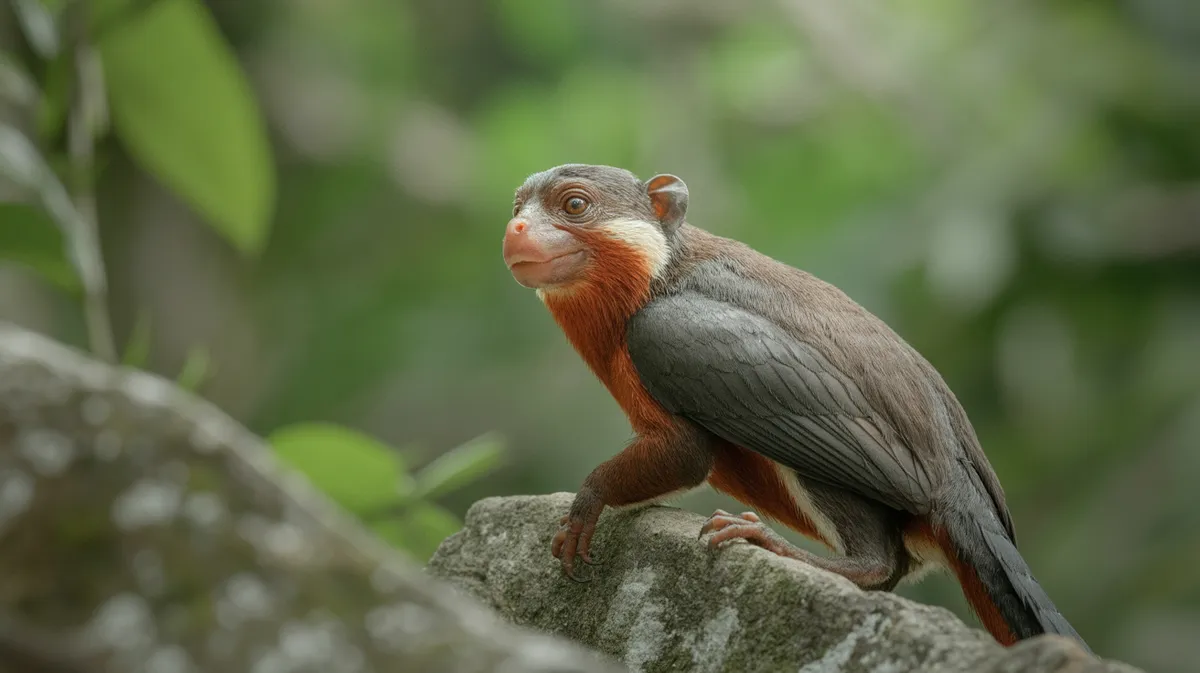
About the Cacomistle
The cacomistle is a medium-sized, nocturnal mammal native to Central America and southern Mexico. It has a slender body, elongated face, and a distinctive bushy tail with black and white rings. Adapted for arboreal life, the cacomistle is agile and skilled at climbing, often found in dense forests and mountainous regions. Its dense fur is grayish to brown with a lighter underside, providing camouflage among the branches. Despite its resemblance to a cat, the cacomistle is more closely related to raccoons.
Fascinating facts
Arboreal Acrobat
The cacomistle is an expert climber, spending most of its life in trees and rarely descending to the ground.
Raccoon Relative
Although it looks cat-like, the cacomistle is closely related to raccoons and coatis, belonging to the family Procyonidae.
Nocturnal Hunter
Cacomistles are primarily nocturnal, hunting insects, small vertebrates, and eating fruits under the cover of darkness.
Detailed description
The cacomistle (Bassariscus sumichrasti) is a slender, medium-sized procyonid mammal, typically measuring 38–47 cm in body length with a tail nearly as long or longer (39–53 cm), and weighing between 0.9 and 1.3 kg. Its fur is soft and dense, colored grayish-brown to dark brown dorsally, with a pale or whitish ventral side. The most distinctive feature is its long, bushy tail, marked by 6–9 black or dark brown rings alternating with lighter bands, which aids in balance during arboreal movement. The face is pointed, with large, rounded ears and prominent, dark eyes adapted for nocturnal vision. Cacomistles possess semi-retractile claws and highly flexible ankles, allowing them to descend trees headfirst and maneuver adeptly among branches. Their dental formula (I 3/3, C 1/1, P 4/4, M 2/2) reflects an omnivorous diet. Generally solitary and elusive, cacomistles are most active at night, spending daylight hours resting in tree hollows or dense vegetation. They are excellent climbers and rarely descend to the ground except to move between trees or forage. Their vocalizations include chirps, chatters, and hisses, used primarily in territorial or mating contexts. Lifespan in the wild is estimated at 7–10 years, though captive individuals may live longer.
Did you know?
Despite their secretive habits, cacomistles play an important role in seed dispersal within their forest habitats.
Research & sources
Wikipedia summary
The cacomistle, also spelled cacomixtle, is a primarily nocturnal, arboreal, omnivorous member of the carnivoran family Procyonidae. Depending on the location, its preferred habitats are humid and tropical evergreen jungle and montane cloud forests; seasonally, it may venture into drier, deciduous forests.
Behaviour & social structure
Cacomistles are primarily nocturnal and arboreal, emerging at dusk to forage and returning to daytime dens in tree cavities or dense foliage. Their home ranges are variable, with males typically occupying larger territories (up to 60 hectares) than females, whose ranges may overlap with those of males but not with other females. They are solitary outside of the breeding season, exhibiting territorial behaviors such as scent marking with anal gland secretions. Their omnivorous diet includes fruits (notably figs and other soft fruits), insects, small vertebrates (rodents, birds, lizards), eggs, and occasionally nectar. Foraging is opportunistic and highly adaptable to seasonal food availability. Cacomistles are agile hunters, using stealth and quick reflexes to capture prey, and they may cache surplus food. Communication is primarily through scent marking, vocalizations, and body postures. They are known to be shy and secretive, rarely seen by humans.
Reproduction & life cycle
Cacomistles are believed to be seasonally polyestrous, with breeding typically occurring in the late dry to early wet season (March to June) in most of their range. Courtship involves vocalizations and scent marking, and males may compete for access to receptive females. After a gestation period of approximately 50–60 days, females give birth to litters of 1–4 young, most commonly 2. The young are altricial, born blind and helpless, and remain in the den for the first 4–6 weeks. Mothers provide all parental care, nursing and grooming the offspring, and later introducing them to solid food. Weaning occurs at about 2–3 months, after which juveniles gradually become independent. Sexual maturity is reached at around 10–12 months of age.
Adaptations & survival
Cacomistles exhibit several key adaptations for an arboreal, nocturnal lifestyle. Their long, bushy, ringed tails provide balance while moving through trees. Flexible ankle joints and semi-retractile claws enable them to climb efficiently and descend headfirst. Large eyes with a reflective tapetum lucidum enhance night vision, while acute hearing aids in detecting prey and predators. Their omnivorous dentition allows them to exploit a wide range of food resources, contributing to their ecological flexibility. Dense, water-resistant fur provides insulation in humid montane environments. Behavioral adaptations include solitary habits to reduce competition and the use of multiple den sites to avoid predation.
Cultural significance
In Mesoamerican cultures, the cacomistle (from the Nahuatl 'tlacomiztli', meaning 'half-cat' or 'half-mountain lion') has been referenced in folklore as a clever and elusive forest dweller. While not as prominent as the ringtail (Bassariscus astutus) in North American folklore, cacomistles are sometimes associated with omens or as minor trickster figures in local legends. There are occasional reports of their fur being used in traditional crafts, but they are not a major target for hunting or trade. Their presence in forests is sometimes seen as a sign of ecosystem health.
Recent research
Recent research has focused on the cacomistle's ecological role as a seed disperser, particularly for fig and other fruiting trees, highlighting its importance in forest regeneration. Genetic studies have clarified its relationship to the ringtail, confirming their divergence approximately 8–10 million years ago. Ongoing studies are investigating the impact of habitat fragmentation on population genetics and movement patterns using radio telemetry and camera traps. There is increasing interest in their adaptability to secondary forests and agroforestry landscapes, as well as their potential vulnerability to climate-driven habitat shifts. Conservation genetics and disease ecology (e.g., susceptibility to canine distemper) are emerging areas of study.
Videos
Habitat
Tropical and subtropical forests, cloud forests, and mountainous woodlands


Conservation
The Cacomistle is currently classified as Least Concern on the IUCN Red List.
Threats & challenges
While currently listed as Least Concern by the IUCN, cacomistles face several threats, primarily habitat loss and fragmentation due to deforestation, agricultural expansion, and urbanization, particularly in lowland and montane forests. Road mortality and occasional hunting for fur or as perceived pests also pose localized risks. Their dependence on mature forest habitats makes them sensitive to environmental changes, and populations may be declining in some regions. Climate change, altering the distribution and composition of cloud forests, is an emerging concern. Despite these challenges, the species persists in several protected areas, and its wide range contributes to its current conservation status.
Taxonomy
Scientific name
Bassariscus sumichrasti
- Kingdom
- Animalia
- Phylum
- Chordata
- Class
- Mammalia
- Order
- Carnivora
- Family
- Procyonidae
- Genus
- Bassariscus
- Species
- sumichrasti
Community notes
Share your observations about the Cacomistle.
No community notes yet. Be the first!
Discover more wildlife
More fascinating animals from the encyclopedia.