
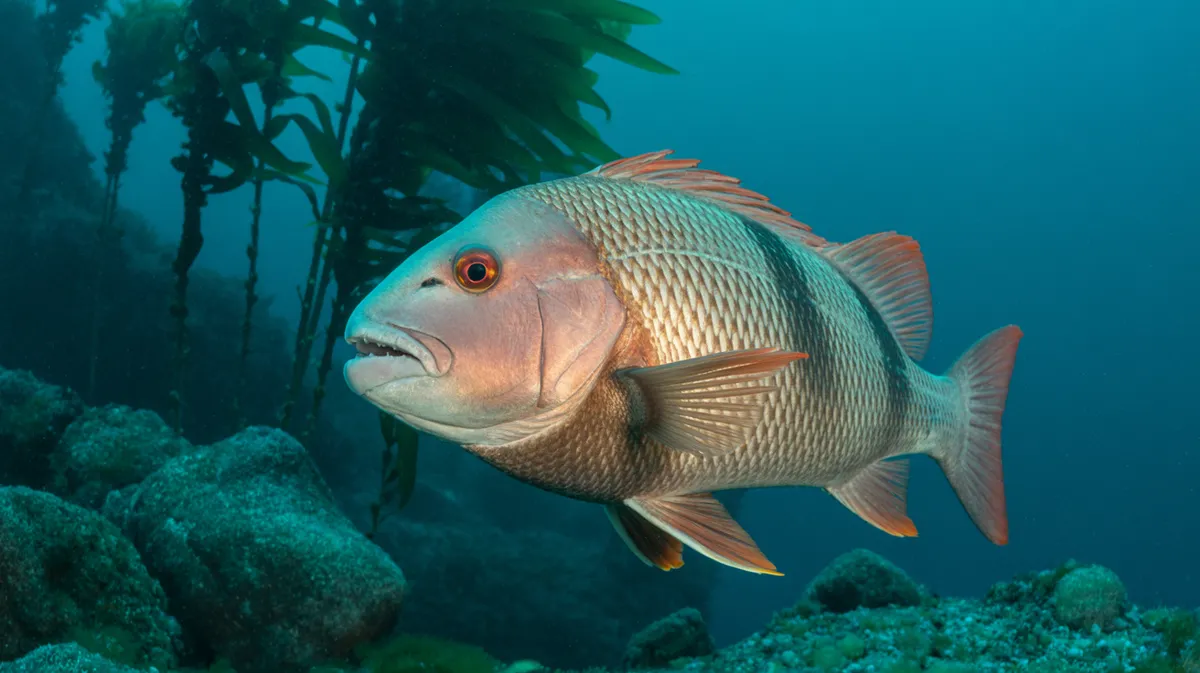
About the California Sheephead
The California Sheephead is a large wrasse native to the rocky reefs and kelp forests of the eastern Pacific Ocean, particularly along the coast of California and the Baja Peninsula. This species is notable for its striking color changes as it matures: juveniles are reddish-orange, while mature males are black with a white chin and red midsection. California Sheephead are protogynous hermaphrodites, meaning all individuals start life as females, with some transitioning to males later. These fish play a crucial ecological role by preying on sea urchins, helping to maintain healthy kelp forest ecosystems.
Fascinating facts
Kelp Forest Protector
By preying on sea urchins, California Sheephead help prevent urchin populations from overwhelming and destroying kelp forests.
Sex Changers
All California Sheephead are born female and some transition to male, typically when there are no dominant males in the area.
Powerful Jaws
Their strong jaws and prominent canine teeth allow them to crush the hard shells of crustaceans and mollusks with ease.
Detailed description
The California Sheephead (Semicossyphus pulcher) is a large, robust wrasse distinguished by its pronounced sexual dimorphism and dramatic color changes throughout its life stages. Adults can reach lengths up to 91 cm (36 inches) and weigh as much as 16 kg (35 lbs), though most individuals are smaller. The species exhibits a thick, elongated body with a steep forehead and prominent canine teeth, which are well-adapted for crushing hard-shelled prey. Juveniles are typically a uniform reddish-orange with a white belly, while mature females retain this coloration but develop a more robust body. Upon transitioning to males—a process triggered by social and environmental cues—individuals develop striking black heads and tails, a white chin, and a reddish midsection. California Sheephead are protogynous hermaphrodites: all are born female, and dominant individuals later change sex to become male. This species is diurnal, spending daylight hours actively foraging among rocky reefs and kelp forests, and seeking shelter in crevices at night. Their powerful jaws and specialized pharyngeal teeth allow them to feed on hard-shelled invertebrates, particularly sea urchins, mollusks, and crustaceans. California Sheephead are long-lived, with some individuals documented at over 50 years old. Their ecological role as top invertebrate predators is crucial for maintaining the balance of kelp forest ecosystems, as they help regulate sea urchin populations and thus prevent overgrazing of kelp.
Did you know?
Despite their tough appearance and strong jaws, California Sheephead start their lives as females and only become males if the social structure of their group requires it.
Research & sources
Wikipedia summary
The California sheephead (Bodianus pulcher, is a species of wrasse native to the eastern Pacific Ocean. Its range is from Monterey Bay, California, to the Gulf of California, Mexico. It can live for over 50 years and can reach a size of up to 91 cm and a weight of 16 kg. It is carnivorous, living in rocky reef and kelp bed habitats, feeding primarily on sea urchins, molluscs, and crustaceans.
Behaviour & social structure
California Sheephead are solitary or loosely social, with individuals often maintaining overlapping home ranges within rocky reef and kelp forest habitats. They are primarily active during the day, foraging extensively along the substrate for benthic invertebrates. Their feeding strategy involves using their strong jaws and prominent canine teeth to pry, crush, and consume hard-shelled prey such as sea urchins, snails, crabs, and bivalves. Sheephead are known to exhibit site fidelity, returning to the same shelter sites at night. Social hierarchies are evident, particularly among females, with the largest and most dominant individuals more likely to undergo sex change to male. Males tend to be territorial during the breeding season, defending access to groups of females. Communication is primarily visual, involving body postures and color displays, especially during courtship and territorial disputes.
Reproduction & life cycle
California Sheephead are protogynous hermaphrodites, with all individuals maturing first as females and some later transitioning to males, typically in response to social structure and the absence of dominant males. Spawning occurs from late spring through early autumn (April–September), peaking in summer. Males establish territories and court multiple females, engaging in elaborate courtship displays that include color changes and body undulations. Fertilization is external: females release pelagic eggs into the water column, which are fertilized by males. There is no parental care; eggs and larvae are planktonic, drifting with ocean currents for several weeks before settling onto the reef as juveniles. Sexual transition from female to male can take several months and involves significant physiological and morphological changes, including the development of male coloration and increased body size.
Adaptations & survival
California Sheephead possess several adaptations for their predatory lifestyle. Their robust jaws and specialized pharyngeal teeth are highly effective at crushing the hard exoskeletons of sea urchins and mollusks. Their coloration provides camouflage among the rocky reefs and kelp, reducing predation risk. The ability to change sex (protogynous hermaphroditism) is an evolutionary adaptation that maximizes reproductive success in environments where male numbers may be limited. Their long lifespan and slow growth rate are typical of species in stable, resource-rich habitats. Additionally, their behavioral flexibility—such as shifting diet in response to prey availability—enables them to persist in variable environments.
Cultural significance
California Sheephead have long been valued as a food fish by indigenous peoples and later by commercial and recreational fishers along the California and Baja coasts. They feature in local sportfishing culture and are sometimes displayed in public aquaria for their striking appearance and ecological importance. While not prominent in mythology, their role as a keystone predator in kelp forests has made them a symbol of healthy marine ecosystems in California. Conservation efforts and fishery regulations have increased public awareness of their ecological significance.
Recent research
Recent research has focused on the impacts of fishing pressure on Sheephead population structure, particularly the consequences of removing large males and altering natural sex ratios. Studies using otolith (ear bone) analysis have provided insight into their age structure, growth rates, and longevity. Genetic studies have examined population connectivity along the California and Baja coasts, revealing limited gene flow between some regions. Ongoing research is investigating the effects of climate change on kelp forest dynamics and Sheephead foraging behavior, as well as the potential for marine protected areas (MPAs) to support population recovery. Notably, California Sheephead are used as indicator species for kelp forest health due to their sensitivity to ecosystem changes.
Sources
Life history and ecology of the California Sheephead (Semicossyphus pulcher)
Cowen, R.K. (1990)
scientificSemicossyphus pulcher: The IUCN Red List of Threatened Species 2006
Cornish, A. & Domeier, M.
conservationVideos
Habitat
Rocky reefs and kelp forests in the eastern Pacific Ocean

Conservation
The California Sheephead is currently classified as Vulnerable on the IUCN Red List.
Threats & challenges
The primary threats to California Sheephead include overfishing, habitat degradation, and ecosystem changes. They are targeted by both commercial and recreational fisheries, particularly for their large size and palatable flesh. Overharvesting of large males can disrupt natural sex ratios, leading to reduced reproductive output and population declines. Habitat loss due to coastal development, pollution, and climate change-induced shifts in kelp forest distribution further threaten their populations. Additionally, declines in predator populations (such as sea otters) can lead to sea urchin population booms, which may alter Sheephead food availability and kelp forest health. The IUCN currently lists the species as Vulnerable, with population declines observed in heavily fished areas.
Taxonomy
Scientific name
Semicossyphus pulcher
- Kingdom
- Animalia
- Phylum
- Chordata
- Class
- Actinopterygii
- Order
- Labriformes
- Family
- Labridae
- Genus
- Semicossyphus
- Species
- pulcher
Where to see a california sheephead
2 zoos and aquariums in 1 country are recorded as keeping this species.


Community notes
Share your observations about the California Sheephead.
No community notes yet. Be the first!
Discover more wildlife
More fascinating animals from the encyclopedia.