
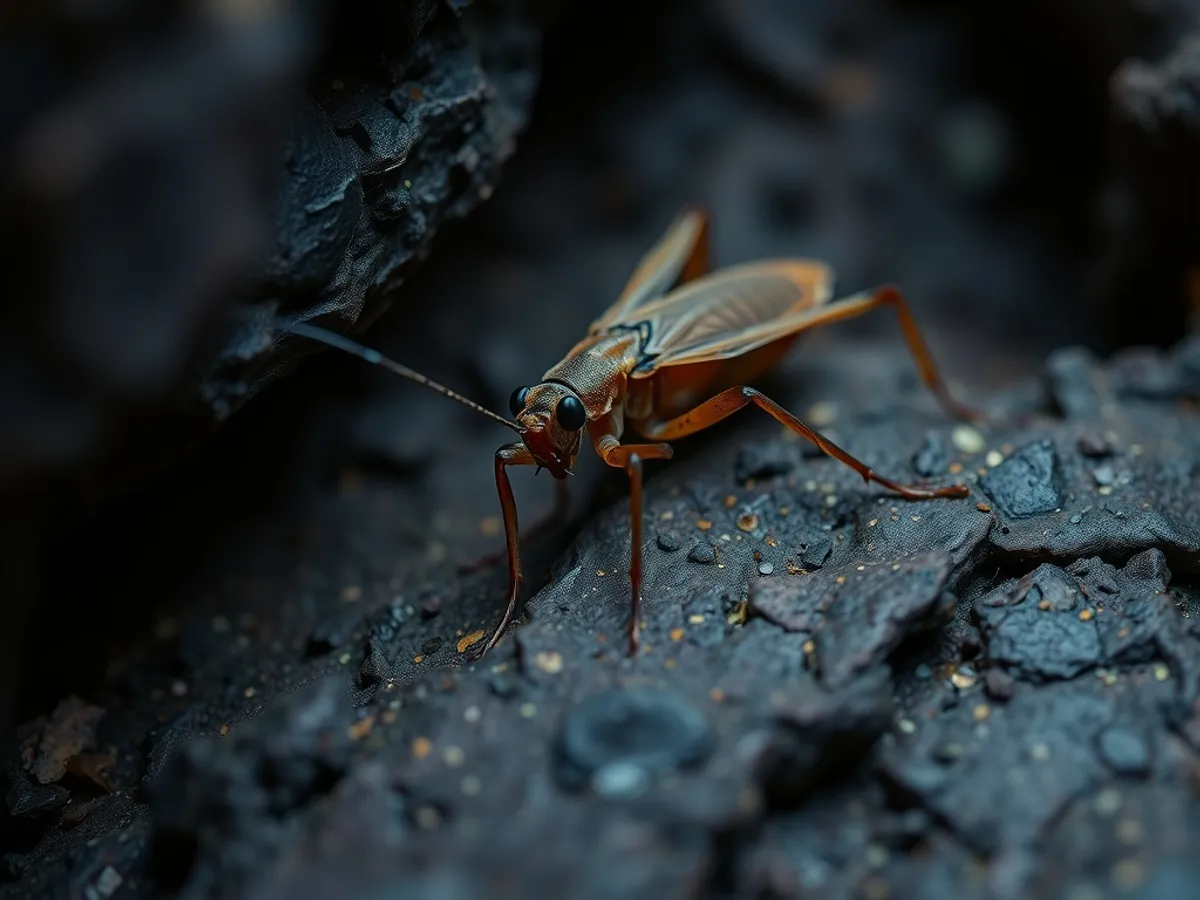
About the Cave Cricket
Cave crickets, also known as camel crickets, are nocturnal insects recognized by their humped backs, long antennae, and powerful hind legs. They are predominantly found in caves, cool damp basements, and other dark, moist environments. Lacking wings, cave crickets rely on their jumping ability to escape predators and navigate their habitats. These insects are generally brownish in color and have a mottled appearance, which helps them blend into their surroundings. Cave crickets are harmless to humans but can become a nuisance when they invade homes in search of moisture.
Fascinating facts
Impressive Jumpers
Cave crickets can jump several times their body length, which helps them escape threats in their dark habitats.
Master Navigators
Their extremely long antennae allow them to feel their way around pitch-black environments, compensating for poor eyesight.
Uninvited House Guests
Cave crickets often invade basements and crawl spaces in search of humidity, especially during dry weather.
Detailed description
Diestrammena asynamora, commonly known as the greenhouse camel cricket or Asian camel cricket, is a medium-sized, flightless orthopteran insect in the family Rhaphidophoridae. Adults typically measure 13–18 mm in body length, with antennae often exceeding twice the body length, enhancing their ability to navigate in darkness. Their bodies are arched, giving a 'humped' appearance, and are covered in a mottled brown and tan exoskeleton that provides camouflage in leaf litter, caves, and human dwellings. Their hind legs are highly developed for jumping, allowing them to leap several times their body length to evade predators. The species lacks wings and tympanal organs (hearing structures), relying instead on tactile and chemical cues. Cave crickets are primarily nocturnal, emerging at night to forage for organic debris, fungi, and occasionally dead insects. They are solitary but may aggregate in favorable microhabitats, especially in moist, dark environments. Reproduction involves the deposition of eggs in moist soil or detritus, with nymphs resembling miniature adults upon hatching. Diestrammena asynamora is notable for its adaptability, thriving in both natural caves and anthropogenic habitats such as basements and greenhouses.
Did you know?
Unlike true crickets, cave crickets are silent and do not chirp, as they lack sound-producing organs.
Research & sources
Wikipedia summary
The orthopteran family Rhaphidophoridae of the suborder Ensifera has a worldwide distribution. Common names for these insects include cave crickets, camel crickets, spider crickets, and sand treaders. Those occurring in New Zealand are typically referred to as jumping or cave wētā. Most are found in forest environments or within caves, animal burrows, cellars, under stones, or in wood or similar environments. All species are flightless and nocturnal, usually with long antennae and legs. More than 500 species of Rhaphidophoridae are described.
Behaviour & social structure
Cave crickets are primarily nocturnal, remaining hidden during daylight hours in moist, sheltered locations to avoid desiccation and predation. They are opportunistic omnivores, feeding on a wide variety of organic material including decaying plant matter, fungi, and dead insects. Their foraging behavior is guided by long antennae, which they use to sense obstacles and locate food in complete darkness. When threatened, they exhibit a rapid, unpredictable jumping response, which serves both as an escape mechanism and a deterrent to predators. Social interactions are minimal, though individuals may be found in loose aggregations in optimal environments, likely due to shared habitat preferences rather than true social behavior. They do not vocalize or produce stridulation sounds, unlike many other orthopterans. Daily routines involve remaining inactive and concealed during the day, becoming active at night to forage and mate.
Reproduction & life cycle
Mating in Diestrammena asynamora typically occurs during the warmer months, though indoor populations may breed year-round. Courtship is relatively simple, involving antennal contact and mounting. Females possess a long, sword-like ovipositor, which they use to deposit eggs deep into moist soil or organic detritus. Each female can lay several dozen eggs over her lifespan. The eggs incubate for several weeks to months, depending on temperature and humidity. Upon hatching, nymphs undergo a series of molts (typically 6–8 instars) before reaching adulthood, a process that may take several months. There is no parental care; eggs and nymphs are left to develop independently. Generation time is generally annual in temperate climates but may be shorter in consistently warm, humid environments.
Adaptations & survival
Diestrammena asynamora exhibits several key adaptations for survival in dark, humid environments. Their elongated antennae and palps are highly sensitive, compensating for the absence of vision and auditory organs. The arched body and long, muscular hind legs enable powerful jumping, which is crucial for escaping predators in confined spaces. The mottled coloration provides effective camouflage against soil, rocks, and decaying organic matter. Physiologically, they are tolerant of high humidity and can survive in environments with low light and limited food resources. Their ability to exploit a wide range of organic materials, including detritus and fungi, allows them to persist in both natural and artificial habitats. The lack of wings reduces water loss and is an adaptation to life in enclosed, humid spaces.
Cultural significance
While Diestrammena asynamora does not hold significant roles in mythology or traditional culture, its presence in human dwellings has led to various colloquial names such as 'sprickets' or 'criders' due to their spider-like appearance and jumping behavior. In some cultures, crickets are associated with good luck, but this is more commonly attributed to true crickets (Gryllidae) rather than camel crickets. In the United States, their increasing prevalence in basements and greenhouses has made them a subject of minor nuisance and curiosity, occasionally featured in pest control literature and urban folklore.
Recent research
Recent research has focused on the spread of Diestrammena asynamora in North America, where it has become the dominant camel cricket in many urban and suburban areas, displacing native species. Studies have examined its dietary flexibility, reproductive biology, and potential ecological impacts. Genetic analyses have clarified its Asian origins and pathways of introduction, likely via horticultural trade. Ongoing research is investigating its interactions with native fauna, potential as a bioindicator of environmental change, and physiological adaptations to low-light environments. Notably, a 2014 study by Epps et al. documented its rapid expansion in the eastern United States, raising questions about long-term ecological consequences.
Videos
Habitat
Caves and moist, dark environments
 Various Continental Regions
Grassland
Open areas dominated by grasses rather than trees, supporting numerous herbivores and their predators.
 Elevated Terrain
Mountain
High-altitude environments with varying climates and specialized wildlife adapted to rugged terrain and thin air.
 Global
Forest
Wooded areas with significant tree cover and diverse plant and animal communities.
Conservation
The Cave Cricket is currently classified as Least Concern on the IUCN Red List.
Threats & challenges
Currently, Diestrammena asynamora faces few significant threats and is considered of Least Concern by conservation authorities. Its adaptability to human-altered environments has facilitated its spread, particularly in North America, where it is an introduced species. In some regions, it may outcompete native cave cricket species, potentially altering local ecological balances. Habitat destruction is not a major concern due to its synanthropic tendencies. However, pesticide use in urban environments can pose localized risks. Climate change may also influence distribution patterns, but the species' broad ecological tolerance suggests resilience to moderate environmental changes.
Taxonomy
Scientific name
Diestrammena asynamora
- Kingdom
- Animalia
- Phylum
- Arthropoda
- Class
- Insecta
- Order
- Orthoptera
- Family
- Rhaphidophoridae
- Genus
- Diestrammena
- Species
- asynamora
Community notes
Share your observations about the Cave Cricket.
No community notes yet. Be the first!
Discover more wildlife
More fascinating animals from the encyclopedia.