
About the Chambered Nautilus
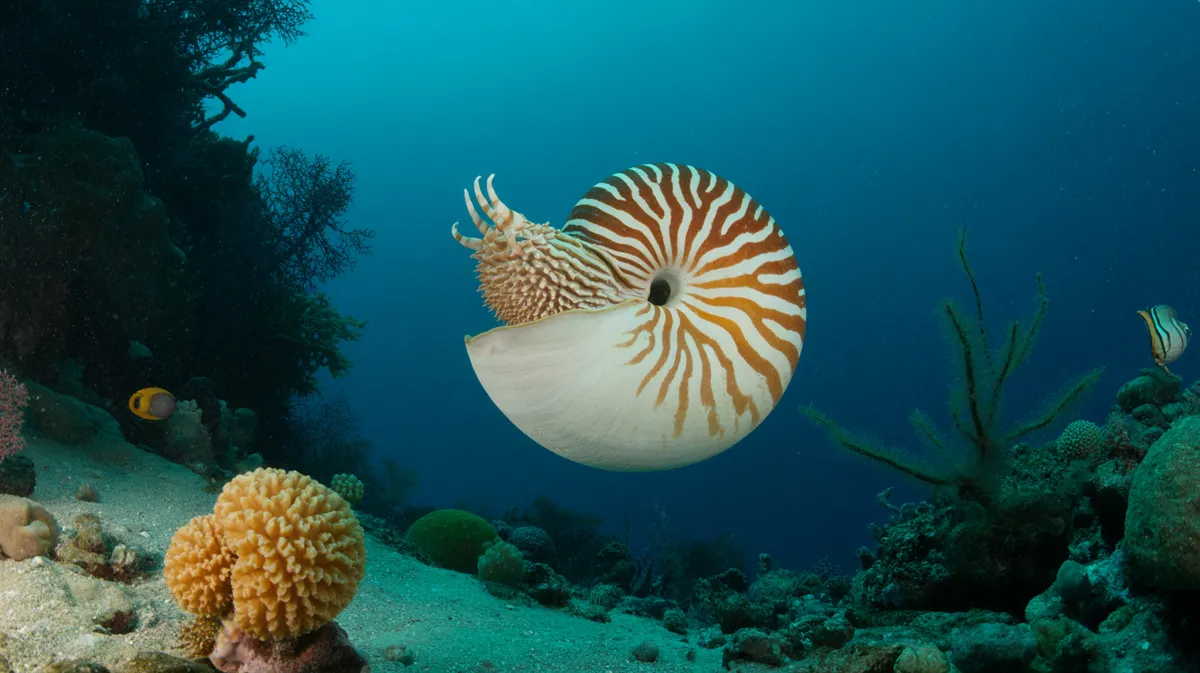
The nautilus is the last of its kind. Its lineage goes back some five hundred million years, and where every other surviving cephalopod — octopus, squid, cuttlefish — abandoned the external shell, the nautilus kept it. That shell is a buoyancy device. It is divided into sealed chambers, and a living tube called the siphuncle threads through them, allowing the animal to adjust the balance of gas and liquid inside and to hover, weightless, without effort. Its eye is startlingly primitive: an open pinhole, with no lens and no cornea, flooded with seawater — it forms an image the way a pinhole camera does, dim and low-resolution, in an era when its cousins evolved eyes rivalling our own. It has up to ninety tentacles, and unlike a squid's they carry no suckers, gripping instead with ridged, sticky surfaces. It is a slow scavenger, drifting up the reef slope at night to feed, and it is now heavily hunted for its shell.
Fascinating facts
Spiraled Shell
The nautilus shell contains a series of internal chambers, which the animal uses to control its buoyancy by adjusting the gas and fluid inside.
Primitive Cephalopod
Unlike its relatives—the octopus and squid—the chambered nautilus retains an external shell and lacks complex behaviors and intelligence.
Deep-sea Dweller
Chambered nautiluses typically inhabit depths between 100 and 500 meters, ascending to shallower waters at night to feed.
Detailed description
The chambered nautilus (Nautilus pompilius) is a marine cephalopod distinguished by its iconic, coiled shell, which can reach up to 27 cm (10.6 in) in diameter. The shell is composed of calcium carbonate and features a series of internal chambers separated by septa; only the outermost chamber is occupied by the living animal, while the inner chambers are filled with a mixture of gas and liquid to regulate buoyancy. The nautilus possesses up to 90 slender, retractable tentacles lacking suckers but covered in adhesive ridges, which it uses to grasp prey. Its large, parrot-like beak is adapted for crushing the shells of crustaceans and other prey. Unlike most modern cephalopods, the nautilus has simple pinhole eyes without a lens, relying on chemoreception and tactile senses for navigation and hunting. The animal’s soft body is protected by the shell, and its head and tentacles can be withdrawn for defense. The nautilus exhibits countershading: its shell is darkly pigmented on top and pale underneath, providing camouflage in the dimly lit ocean depths. It is a slow-moving, primarily nocturnal scavenger and opportunistic predator, spending daylight hours at depths of 200–700 meters and ascending to shallower waters at night to feed. The chambered nautilus is a long-lived species, with individuals estimated to live up to 20 years or more, and is considered a 'living fossil' due to its minimal evolutionary change over millions of years.
Did you know?
The chambered nautilus is so ancient that it has survived relatively unchanged for over 500 million years, making it a true 'living fossil.'
Research & sources
Wikipedia summary
The chambered nautilus, also called the pearly nautilus, is the best-known species of nautilus. The shell, when cut away, reveals a lining of lustrous nacre and displays a nearly perfect equiangular spiral, although it is not a golden spiral. The shell exhibits countershading, being light on the bottom and dark on top. This is to help avoid predators, because when seen from above, it blends in with the darkness of the sea, and when seen from below, it blends in with the light coming from above.
Behaviour & social structure
Chambered nautiluses are solitary animals, rarely observed in groups except during occasional aggregations near food sources or breeding grounds. They exhibit diel vertical migration, remaining at greater depths during the day to avoid predators and ascending to shallower reef slopes at night to forage. Their movement is achieved via jet propulsion, expelling water through a funnel-like siphon, though they are relatively slow compared to other cephalopods. Feeding primarily on carrion, small crustaceans, and detritus, they use their numerous tentacles to probe crevices and capture prey, which is then manipulated towards the beak for consumption. Nautiluses have a highly developed sense of smell, compensating for their poor vision, and use chemosensory cues to locate food. They are generally non-aggressive and avoid confrontation, relying on their hard shell and retraction ability for defense. Daily activity patterns are closely tied to light levels and predation risk, with most active foraging occurring during nighttime hours.
Reproduction & life cycle
Nautilus pompilius exhibits separate sexes (dioecy), with males and females engaging in direct copulation. Mating involves the male transferring spermatophores to the female using a specialized tentacle called the spadix. Females lay relatively few, large eggs (about 2–3 cm in diameter), which are encased in a tough, leathery shell and attached to rocks or coral substrates at depths of 100–300 meters. Incubation is exceptionally long for a cephalopod, lasting between 9 and 12 months, depending on environmental conditions. There is no parental care after egg-laying; hatchlings emerge as miniature adults, fully independent and capable of immediate survival. Breeding appears to occur year-round in some populations, though local environmental factors may influence reproductive timing. Sexual maturity is reached at approximately 12–15 years of age, contributing to the species’ slow population turnover.
Adaptations & survival
The chambered nautilus’ most distinctive adaptation is its chambered shell, which provides both protection and precise buoyancy control through the regulation of gas and fluid within the chambers via the siphuncle, a specialized tissue strand. This adaptation allows the nautilus to maintain neutral buoyancy and move efficiently through the water column. The animal’s countershaded shell offers camouflage from both predators above and below. Its numerous tentacles, lacking suckers but equipped with adhesive ridges, are highly effective for grasping slippery prey and exploring complex reef structures. The nautilus’ simple eyes, although lacking a lens, are adapted to detect changes in light intensity, aiding in depth regulation and predator avoidance. Its slow metabolism and ability to survive long periods without food are further adaptations to the deep-sea environment, where resources can be scarce.
Cultural significance
The chambered nautilus has long captivated human imagination, symbolizing beauty, mathematical perfection, and the mysteries of the deep sea. Its shell, with its striking spiral and pearly interior, has been used in art, jewelry, and as a symbol of spiritual growth and renewal in various cultures. In Western literature, it is famously referenced in Oliver Wendell Holmes’ poem 'The Chambered Nautilus,' where it represents the journey of the soul. Historically, nautilus shells were also mounted in silver or gold as luxury drinking vessels in Europe during the Renaissance. However, increasing demand for decorative shells has contributed to population pressures.
Recent research
Recent research has focused on the population genetics and phylogeography of Nautilus pompilius, revealing significant genetic differentiation between populations, which has implications for conservation management. Studies using remotely operated vehicles (ROVs) and baited traps have improved understanding of their natural behaviors, depth preferences, and habitat use. Advances in imaging and micro-CT scanning have provided insights into shell growth patterns and the mechanics of buoyancy regulation. Ongoing research is examining the effects of ocean acidification on shell formation and the potential impacts of climate change on nautilus distribution. Conservation scientists are also investigating the efficacy of trade regulations and the development of non-lethal survey methods to monitor populations.
Videos
Habitat
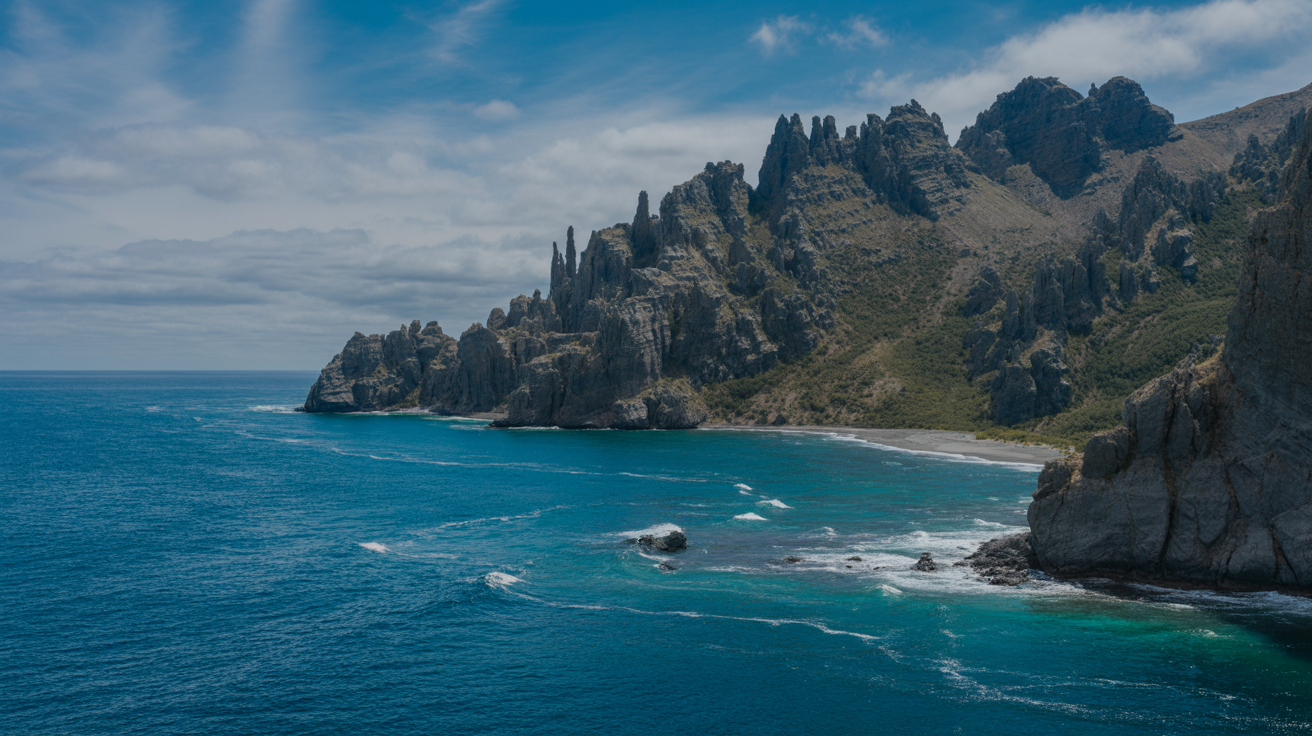
Tropical and subtropical deep ocean slopes and coral reefs
Conservation
The Chambered Nautilus is currently classified as Vulnerable on the IUCN Red List.
Threats & challenges
The chambered nautilus faces significant threats from overharvesting for the ornamental shell trade, which has led to population declines in several regions. Habitat degradation, particularly of coral reefs, also poses a risk to their survival. Due to their slow growth, late maturity, and low reproductive rate, nautilus populations are highly vulnerable to exploitation and have limited capacity for rapid recovery. Bycatch in deep-sea fisheries and the impacts of climate change, such as ocean acidification affecting shell formation, are additional concerns. The species is listed under CITES Appendix II, regulating international trade, and is considered threatened under the U.S. Endangered Species Act. Population trends indicate localized declines, especially in areas with intense shell collection.
Taxonomy
Scientific name
Nautilus pompilius
- Kingdom
- Animalia
- Phylum
- Mollusca
- Class
- Cephalopoda
- Order
- Nautilida
- Family
- Nautilidae
- Genus
- Nautilus
- Species
- pompilius
Where to see a chambered nautilus
2 zoos and aquariums in 1 country are recorded as keeping this species.


Community notes
Share your observations about the Chambered Nautilus.
No community notes yet. Be the first!
Discover more wildlife
More fascinating animals from the encyclopedia.