
About the Chinese Giant Salamander
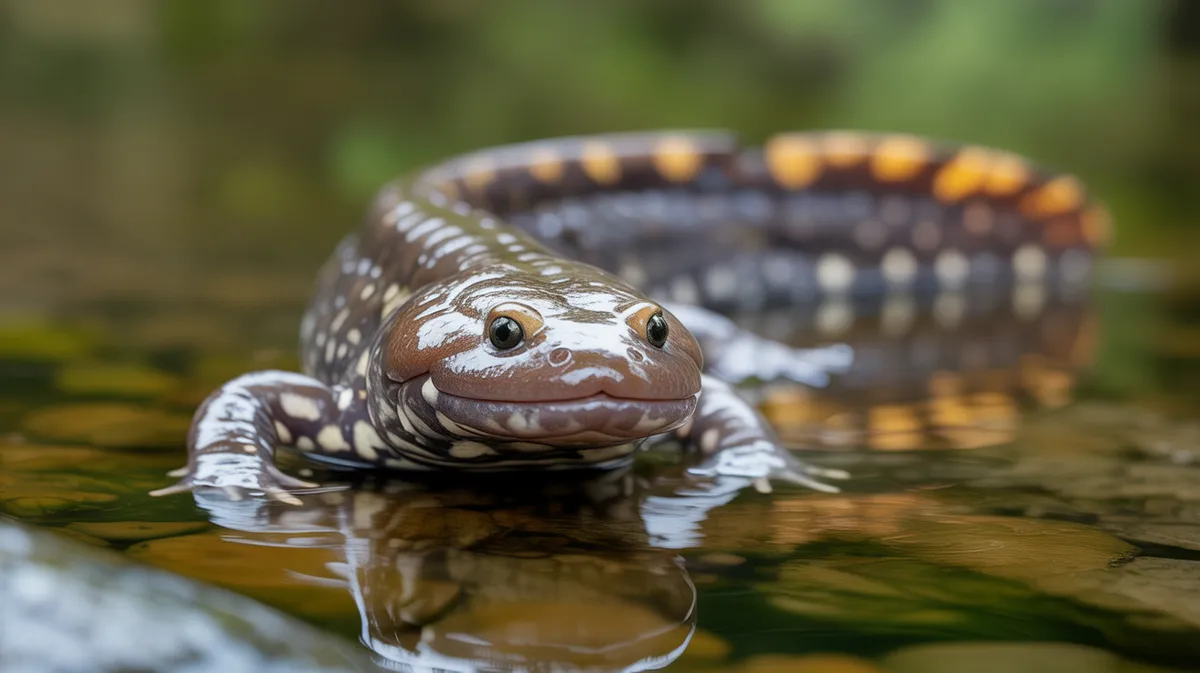
The Chinese giant salamander is the largest amphibian on Earth, reaching 1.8 m, and it breathes almost entirely through its skin — which is why the loose folds and wrinkles along its flanks matter: they are surface area, and they require cold, fast, highly oxygenated mountain streams to work. Remove the oxygen and the animal suffocates in water. Its conservation story is one of the strangest in the world. It was farmed by the million as a luxury food, and farmed animals were released into the wild as a supposed conservation measure — but genetic work has since shown that what was called one species is really a complex of at least five distinct lineages, and the releases dumped the wrong lineage into the wrong rivers, homogenising and swamping the last wild genetic diversity. A field survey covering 97 sites across its range found essentially no verifiably wild animals at all. Its lineage split from other amphibians around 170 million years ago, and it is barely changed from Jurassic fossils.
Fascinating facts
Living Fossil
The Chinese Giant Salamander's lineage has remained almost unchanged since the Jurassic period, over 170 million years ago.
Skin Breather
This salamander breathes mainly through its porous, wrinkled skin, allowing efficient gas exchange in oxygen-rich streams.
Underwater Vocalist
It produces a variety of sounds, such as barking and hissing, to communicate especially during the breeding season.
Detailed description
The Chinese giant salamander (Andrias davidianus) is the largest extant amphibian, with historical records of individuals reaching up to 1.8 meters in length and weighing over 50 kg, though most wild specimens today are considerably smaller due to population pressures. Its body is robust and dorsoventrally flattened, with a broad, rounded head and small, lidless eyes lacking eyelids, which are adapted for its nocturnal and aquatic lifestyle. The skin is thick, wrinkled, and highly vascularized, facilitating cutaneous respiration, which is the primary mode of gas exchange as the species’ lungs are poorly developed. The coloration is typically dark brown or black with mottled patterns, providing camouflage among riverbed rocks. Limbs are short and sturdy, with four unwebbed toes on the forelimbs and five on the hindlimbs. The tail is laterally compressed and muscular, aiding in swimming. Sensory adaptations include a well-developed lateral line system that detects minute water vibrations, allowing the salamander to locate prey in turbid or dark waters. The species is fully aquatic, rarely venturing onto land, and is largely sedentary, occupying shelters such as submerged crevices or burrows during the day. Its longevity is notable, with individuals in captivity living over 50 years, though wild lifespans are likely shorter due to environmental pressures.
Did you know?
The Chinese Giant Salamander can regenerate lost limbs, tail, and even parts of its organs, a remarkable ability among vertebrates.
Research & sources
Wikipedia summary
The Chinese giant salamander is one of the largest salamanders and one of the largest amphibians in the world. It is fully aquatic, and is endemic to rocky mountain streams and lakes in the Yangtze river basin of central China. It has also been introduced to Kyoto Prefecture in Japan, and possibly to Taiwan. It is considered critically endangered in the wild due to habitat loss, pollution, and overcollection, as it is considered a delicacy and used in traditional Chinese medicine. On farms in central China, it is extensively farmed and sometimes bred, although many of the salamanders on the farms are caught in the wild. It has been listed as one of the top-10 "focal species" in 2008 by the Evolutionarily Distinct and Globally Endangered project.
Behaviour & social structure
Chinese giant salamanders are primarily nocturnal and solitary, emerging from their shelters at night to hunt. They are ambush predators, relying on stealth and their sensitive lateral line system to detect prey, which includes fish, crustaceans, insects, amphibians, and occasionally small mammals. Prey is captured using a rapid suction feeding mechanism, where the salamander opens its large mouth suddenly, creating a vacuum that draws in water and prey. They are generally non-territorial but may exhibit aggressive behavior if two adults encounter each other in confined spaces, particularly during the breeding season. During daylight hours, they remain hidden under rocks or in burrows to avoid predators and conserve energy. Communication is limited but includes tactile and chemical cues, especially during courtship. They are known for their vocalizations, producing a range of sounds such as barking, whining, and hissing, which may serve as alarm calls or intraspecific communication.
Reproduction & life cycle
Breeding occurs once annually, typically from late August to September, triggered by seasonal rainfall and water temperature changes. Males establish and defend underwater nesting burrows, often in submerged crevices or tunnels, and may attract multiple females to lay eggs within their territory. Females lay between 400 and 500 eggs in a gelatinous string, which are fertilized externally by the male. The male then guards the eggs for 50 to 60 days, fanning them with his tail to ensure adequate oxygenation and protect them from predators and fungal infections. This form of parental care is relatively rare among amphibians. Upon hatching, larvae are approximately 3 cm long and possess external gills, which are gradually resorbed as they develop. Metamorphosis is incomplete; juveniles retain many larval features (neoteny), such as gill slits, and remain fully aquatic throughout life.
Adaptations & survival
The Chinese giant salamander exhibits several unique adaptations for its aquatic, nocturnal lifestyle. Its highly vascularized skin enables efficient cutaneous respiration, essential in the oxygen-poor, fast-flowing mountain streams it inhabits. The lateral line system, similar to that of fish, allows detection of minute water movements, compensating for its poor eyesight. The flattened body and muscular tail facilitate maneuvering in strong currents and narrow crevices. Its suction feeding mechanism is highly effective for capturing elusive or fast-moving prey. The species’ ability to survive in cold, oxygen-rich waters is supported by a low metabolic rate and tolerance to hypoxia. Neoteny, or the retention of juvenile traits into adulthood, allows the salamander to remain aquatic and avoid terrestrial predators.
Cultural significance
The Chinese giant salamander holds a prominent place in Chinese folklore and mythology, often referred to as the 'wa wa yu' or 'baby fish' due to its vocalizations resembling a crying infant. It has been revered as a symbol of longevity and is featured in ancient texts and art. In traditional Chinese medicine, its flesh is believed to have health-promoting properties, leading to its overexploitation. In recent years, the species has become a flagship for amphibian conservation in China, raising public awareness about the plight of endangered amphibians and the importance of freshwater ecosystem preservation.
Recent research
Recent genetic studies have revealed that what was once considered a single species may actually comprise a complex of several cryptic species, with deep genetic divergences among populations across different river basins. This has significant implications for conservation management and captive breeding programs. Ongoing research focuses on developing effective captive breeding protocols, reintroduction strategies, and disease management, particularly in light of the global amphibian chytrid fungus threat. Conservationists are also studying the impact of farmed salamander releases on wild gene pools and ecosystem health. Advances in environmental DNA (eDNA) techniques have improved the ability to detect remnant wild populations, aiding in targeted conservation actions.
Videos
Habitat
Mountain streams and rivers
 Elevated Terrain
Mountain
High-altitude environments with varying climates and specialized wildlife adapted to rugged terrain and thin air.
 Global
Forest
Wooded areas with significant tree cover and diverse plant and animal communities.
 Global
Freshwater
Lakes, rivers, and wetlands with diverse aquatic ecosystems.
Conservation
The Chinese Giant Salamander is currently classified as Critically Endangered on the IUCN Red List.
Threats & challenges
The Chinese giant salamander faces severe threats, leading to its Critically Endangered status. Habitat loss and fragmentation due to dam construction, deforestation, and water pollution have drastically reduced suitable habitats. Overexploitation for the luxury food market and traditional Chinese medicine has decimated wild populations; the species is highly valued and commands high prices, driving illegal collection. Although commercial farming has expanded, many farmed individuals are wild-caught, further depleting natural populations. Genetic pollution from farmed stock, which often includes hybrids with Japanese giant salamanders (Andrias japonicus), threatens the genetic integrity of wild populations. Climate change, disease (notably chytridiomycosis), and invasive species further exacerbate conservation challenges. Recent surveys indicate a catastrophic decline, with some estimates suggesting wild populations have decreased by over 80% in the past three generations.
Taxonomy
Scientific name
Andrias davidianus
- Kingdom
- Animalia
- Phylum
- Chordata
- Class
- Amphibia
- Order
- Urodela
- Family
- Cryptobranchidae
- Genus
- Andrias
- Species
- davidianus
Where to see a chinese giant salamander
2 zoos and aquariums in 2 countries are recorded as keeping this species.


Community notes
Share your observations about the Chinese Giant Salamander.
No community notes yet. Be the first!
Discover more wildlife
More fascinating animals from the encyclopedia.