
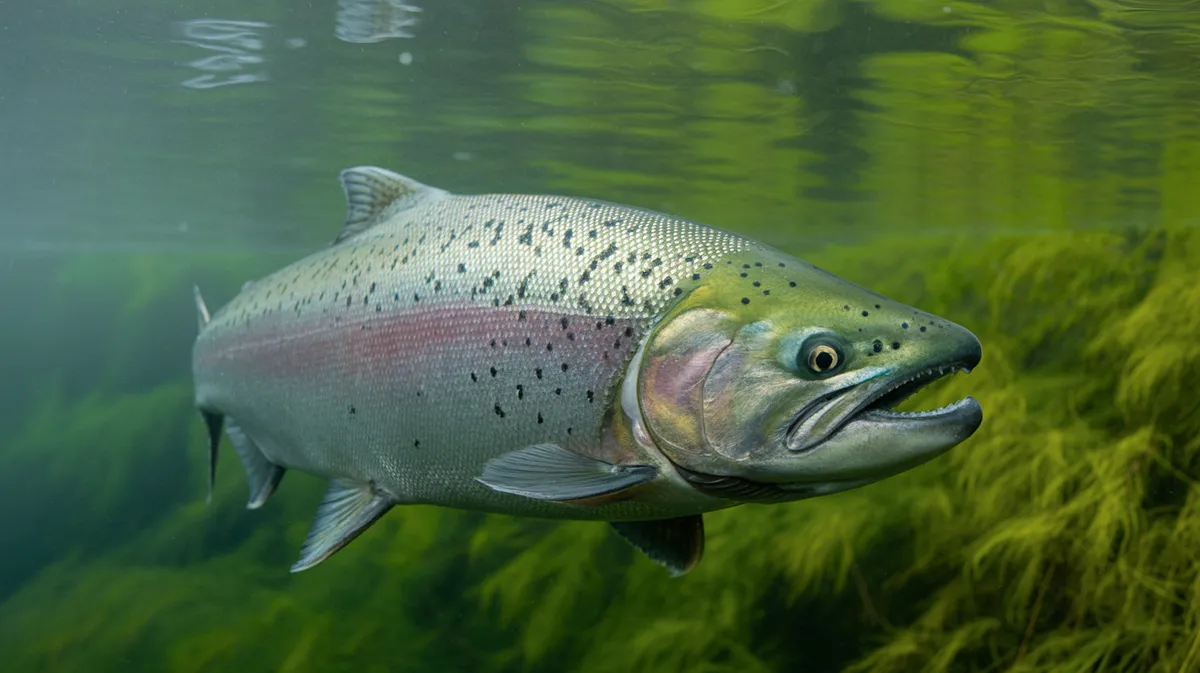
About the Chinook Salmon
The Chinook salmon, also known as king salmon, is the largest species in the Pacific salmon family. Recognized for its silvery body, black spots on the back and tail, and robust physique, it migrates vast distances from the ocean to freshwater rivers to spawn. Chinook salmon play a vital role in both marine and freshwater ecosystems, providing food for a wide range of predators. This iconic fish is highly valued for its commercial, recreational, and cultural significance, especially among indigenous peoples of the Pacific Northwest.
Fascinating facts
Epic Migration
Chinook salmon can migrate from the Pacific Ocean to freshwater streams over 2,000 miles inland to reach their spawning grounds.
Predator and Prey
They are a crucial food source for orcas, bears, sea lions, and many bird species along the Pacific coast.
Nutrient Source
After dying post-spawning, their decomposing bodies enrich river ecosystems, supporting plants and insects.
Detailed description
The Chinook salmon (Oncorhynchus tshawytscha) is the largest member of the Pacific salmon genus, with adults typically ranging from 70 to 120 cm in length and weighing between 9 and 23 kg, though exceptional individuals can exceed 45 kg. Their streamlined, fusiform bodies are adapted for long-distance migration, featuring a silvery coloration with distinctive black spots on the dorsal surface and both lobes of the caudal fin. During spawning, males develop pronounced secondary sexual characteristics, including a hooked snout (kype), enlarged teeth, and a darker, often reddish or olive coloration. Chinook salmon are anadromous, spending their early life in freshwater before migrating to the ocean, where they mature over 1–8 years (most commonly 3–5 years) before returning to their natal streams to spawn. They are powerful swimmers, capable of navigating strong currents and leaping significant obstacles during their upriver migration. Their life cycle is semelparous, meaning most individuals die after a single spawning event. Chinook salmon are keystone species, transferring marine-derived nutrients into freshwater ecosystems, which supports a wide array of terrestrial and aquatic organisms. Their diet shifts from aquatic invertebrates and small fish in freshwater to a primarily piscivorous diet in the ocean, including herring, sand lance, and squid. The species exhibits considerable phenotypic plasticity, with populations adapted to diverse environmental conditions across the North Pacific Rim.
Did you know?
After spawning, all Chinook salmon die, providing vital nutrients to the river ecosystem.
Research & sources
Wikipedia summary
The Chinook salmon is the largest and most valuable species of Pacific salmon. Its common name is derived from the Chinookan peoples. Other vernacular names for the species include king salmon, quinnat salmon, spring salmon, blackmouth, and tyee salmon. The scientific species name is based on the Russian common name chavycha (чавыча).
Behaviour & social structure
Chinook salmon exhibit complex migratory and feeding behaviors. Juveniles, known as fry or parr, may spend several months to over a year in freshwater before smolting and migrating to the ocean. In the marine environment, Chinook are solitary or loosely aggregated, foraging actively in the water column and demonstrating diel vertical migration, often feeding at greater depths during daylight hours. Their feeding strategy is opportunistic, targeting schooling fish, crustaceans, and cephalopods. During the spawning migration, Chinook cease feeding and rely on stored energy reserves. Social interactions intensify at spawning grounds, where males compete for access to females through displays and physical contests. Females select nesting sites (redds) in gravel substrates and exhibit nest-guarding behavior until egg deposition is complete.
Reproduction & life cycle
Chinook salmon spawn in freshwater streams and rivers, with timing varying by population and latitude—ranging from spring to late autumn. Females excavate nests (redds) in gravel beds using vigorous tail movements. A single female may lay between 3,000 and 14,000 eggs, depending on her size. Males fertilize the eggs externally as they are deposited. Incubation lasts from 80 to 150 days, influenced by water temperature. After hatching, alevins remain in the gravel, absorbing yolk sacs before emerging as fry. Parental care is limited to nest construction and initial guarding; adults die soon after spawning, contributing nutrients to the ecosystem. Some populations exhibit 'stream-type' (extended freshwater residence) or 'ocean-type' (rapid downstream migration) life histories, reflecting local adaptation.
Adaptations & survival
Chinook salmon possess several adaptations for their anadromous lifestyle. Physiologically, they undergo smoltification, a complex process involving morphological, behavioral, and biochemical changes that prepare juveniles for the transition from freshwater to saltwater. Their powerful musculature and high aerobic capacity enable long-distance migration and upstream navigation. The development of a kype and increased aggression in males during spawning enhances reproductive success. Their olfactory system is highly developed, allowing precise homing to natal streams for spawning. Chinook also exhibit plasticity in life history traits—such as age at maturation and migration timing—enabling populations to exploit a wide range of habitats and environmental conditions.
Cultural significance
Chinook salmon hold profound cultural, spiritual, and economic significance for Indigenous peoples of the Pacific Northwest, including the Chinookan, Salish, and Tlingit nations. They feature prominently in traditional ceremonies, art, and oral histories, symbolizing abundance, renewal, and the interconnectedness of ecosystems. Historically, Chinook salmon were a staple food source, preserved by smoking or drying for winter sustenance. Today, they remain central to commercial and recreational fisheries, supporting local economies and culinary traditions. The species also serves as a flagship for conservation efforts and environmental education.
Recent research
Recent research has focused on the genetic structure and adaptive variation among Chinook salmon populations, using genomic tools to inform conservation and management. Studies have revealed fine-scale local adaptation in migration timing, thermal tolerance, and disease resistance. Ongoing work investigates the impacts of climate change on migration phenology and survival, as well as the ecological consequences of hatchery-wild interactions. Stable isotope analysis is used to trace marine-derived nutrient flows into freshwater systems. There is increasing interest in the role of Chinook salmon as prey for endangered Southern Resident killer whales (Orcinus orca), highlighting the species' ecological importance.
Videos
Habitat
Freshwater rivers and streams (for spawning), coastal oceans



Conservation
The Chinook Salmon is currently classified as Least Concern on the IUCN Red List.
Threats & challenges
Chinook salmon face numerous threats, including habitat loss and degradation (due to dam construction, logging, agriculture, and urbanization), overfishing, climate change (altering stream temperatures and flow regimes), and competition or predation from introduced species. Ocean conditions influenced by phenomena such as El Niño and the Pacific Decadal Oscillation can impact marine survival rates. Hatchery supplementation, while supporting fisheries, can reduce genetic diversity and fitness of wild populations. Some populations, particularly in the southern part of their range, are listed as threatened or endangered, while others remain relatively stable. Conservation efforts focus on habitat restoration, improved fish passage, and management of harvest and hatchery practices.
Taxonomy
Scientific name
Oncorhynchus tshawytscha
- Kingdom
- Animalia
- Phylum
- Chordata
- Class
- Actinopterygii
- Order
- Salmoniformes
- Family
- Salmonidae
- Genus
- Oncorhynchus
- Species
- tshawytscha
Community notes
Share your observations about the Chinook Salmon.
No community notes yet. Be the first!
Discover more wildlife
More fascinating animals from the encyclopedia.