
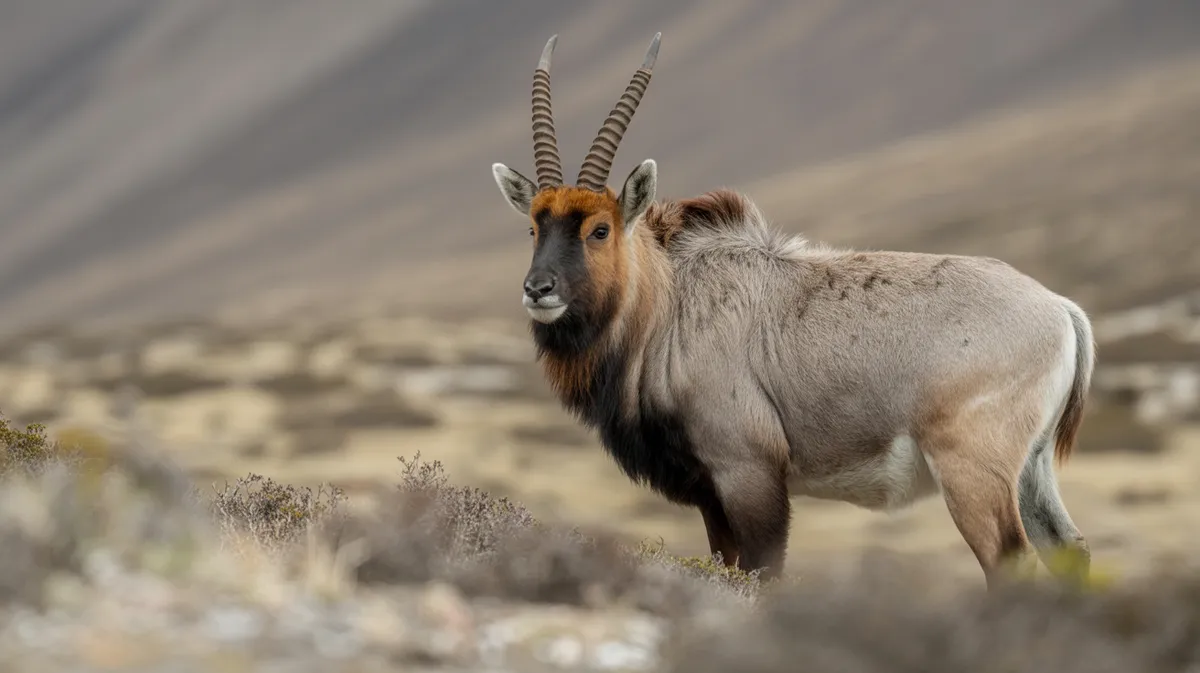
About the Chiru (Tibetan Antelope)
The chiru is being killed for the fineness of its underwool. Shahtoosh — literally "king of wools" — has fibres of around 7 to 10 microns, finer than cashmere, fine enough that the finished shawl can be pulled through a wedding ring, and the animal cannot be shorn or combed: it must be killed. Three to five chiru die for one shawl. Between the 1980s and 1990s, a fashion boom in Europe and America drove poaching that cut a population of perhaps a million down to somewhere in the tens of thousands. The trade was banned, enforcement on the Tibetan plateau became serious, and the chiru is one of the genuine recovery successes of recent conservation, with numbers back into the hundreds of thousands and its status downlisted in 2016. It is adapted to a brutal environment: it lives above 4,000 m, it has inflatable nasal sacs that warm and humidify the freezing thin air it breathes, and females migrate hundreds of kilometres each summer to traditional calving grounds.
Fascinating facts
Extreme Altitude Adaptation
Chiru live at some of the world's highest elevations, enduring thin air and frigid temperatures on the Tibetan Plateau.
Unique Wool
Their undercoat, shahtoosh, is incredibly fine and warm, once highly sought after for luxury shawls.
Epic Migration
Females undertake long seasonal migrations to give birth in safe, traditional calving grounds.
Detailed description
The Chiru (Pantholops hodgsonii) is a medium-sized antelope uniquely adapted to the harsh, high-altitude environments of the Tibetan Plateau, typically found at elevations between 3,250 and 5,500 meters. Adults stand about 83 cm at the shoulder and weigh between 26–40 kg, with males being larger than females. Their dense, pale fawn to cinnamon-colored coat consists of a remarkable underfur called shahtoosh, prized for its exceptional warmth and fineness. Males are distinguished by long, slender, black horns that can reach up to 60 cm, while females are usually hornless or possess very short horns. The face is marked with dark patches on the nose and cheeks, and both sexes have a short, bushy tail. Chiru have large nasal cavities and specialized blood vessels to warm cold air before it reaches the lungs, a crucial adaptation for survival in subzero temperatures and thin oxygen. Their limbs are long and slender, ending in broad hooves that aid in traversing rocky or snowy terrain. The species is highly migratory, with females undertaking long-distance seasonal migrations to remote calving grounds. Social structure varies seasonally: females and juveniles form large herds, while adult males are more solitary or form small bachelor groups outside the breeding season.
Did you know?
Despite living in such remote areas, the Chiru population declined drastically due to illegal hunting for their prized wool, leading to significant conservation efforts in recent decades.
Research & sources
Behaviour & social structure
Chiru are primarily diurnal, with peak activity during early morning and late afternoon. They graze on a variety of alpine grasses, sedges, and forbs, often moving considerable distances in search of sparse vegetation. During the non-breeding season, herds of females and young can number in the hundreds, providing safety in numbers against predators such as wolves and snow leopards. Males are more solitary, joining female groups only during the rut. Chiru are vigilant and rely on keen eyesight to detect threats across the open steppe. When alarmed, they flee in swift, bounding runs, capable of reaching speeds up to 80 km/h. Daily routines include alternating between grazing, resting, and moving to new feeding sites, with minimal shelter available in their open habitat.
Reproduction & life cycle
The breeding season, or rut, occurs from late November to early January. During this period, males compete for access to females by displaying and occasionally engaging in horn clashes. After mating, females undertake a remarkable migration—sometimes covering over 300 km—to isolated calving grounds, where they give birth in June or July. Gestation lasts approximately 6 months. Typically, a single calf is born, which remains hidden for the first few days of life to avoid predation. Mothers nurse and guard their young, returning to the main herds after a few weeks. Calves are weaned at 3–4 months and reach sexual maturity at 2–3 years.
Adaptations & survival
Chiru possess several remarkable adaptations for high-altitude survival. Their shahtoosh underfur is among the finest and warmest in the animal kingdom, providing insulation against temperatures that can plummet below -40°C. Enlarged nasal cavities and a dense network of capillaries pre-warm inhaled air and help conserve heat and moisture. Hemoglobin with a high affinity for oxygen allows efficient oxygen uptake in thin air. Their broad, splayed hooves provide stability on snow and loose gravel. Behaviorally, their migratory patterns reduce overgrazing and allow access to optimal calving sites, while herd formation offers protection from predators.
Cultural significance
The Chiru holds significant cultural value in Tibetan society, symbolizing endurance and the spirit of the plateau. Its shahtoosh wool has been highly prized for centuries, traditionally reserved for royalty and the elite, though modern trade is illegal. In Buddhist beliefs, the Chiru is sometimes associated with purity and resilience. Conservation campaigns have raised awareness of the animal's plight, making it a flagship species for high-altitude ecosystem protection in China and India.
Recent research
Recent genetic studies have clarified the Chiru's phylogenetic position, showing it is more closely related to goat-antelopes (Caprinae) than true antelopes. Satellite tracking of migratory females has revealed the extent and precision of their annual movements, informing the creation of protected migration corridors. Ongoing research focuses on the impacts of climate change on forage availability and the effects of infrastructure development on migration. Conservation genetics is also being used to monitor population health and genetic diversity, crucial for long-term survival.
Sources
Pantholops hodgsonii (Tibetan Antelope): Ecology, Adaptation, and Conservation
Schaller, G.B. & Liu, W. (2008)
scientificIUCN Red List of Threatened Species: Pantholops hodgsonii
IUCN SSC Antelope Specialist Group
conservationPantholops hodgsonii (Tibetan Antelope): Ecology, Adaptations, and Conservation
Schaller, G.B. & Ren, J. (2016)
scientificPantholops hodgsonii: The IUCN Red List of Threatened Species 2023
IUCN SSC Antelope Specialist Group
conservationVideos
Habitat
High-altitude plateau and steppe
 Polar and Subpolar Regions
Tundra
Cold, treeless regions with permafrost supporting specialized cold-adapted wildlife.
 Various Continental Regions
Grassland
Open areas dominated by grasses rather than trees, supporting numerous herbivores and their predators.
 Elevated Terrain
Mountain
High-altitude environments with varying climates and specialized wildlife adapted to rugged terrain and thin air.
Conservation
The Chiru (Tibetan Antelope) is currently classified as Near Threatened on the IUCN Red List.
Threats & challenges
The primary threat to Chiru has historically been poaching for shahtoosh wool, which is illegally woven into luxury shawls. This demand led to catastrophic population declines in the late 20th century, with numbers dropping below 75,000. Habitat fragmentation from infrastructure development (roads, railways), competition with domestic livestock, and climate change now pose additional challenges. Despite increased anti-poaching efforts and legal protections, illegal hunting persists. Current population estimates range from 100,000 to 150,000, but localized declines continue where enforcement is weak. The species is classified as Near Threatened by the IUCN, with ongoing conservation efforts focused on habitat protection and anti-poaching patrols.
Taxonomy
Scientific name
Pantholops hodgsonii
- Kingdom
- Animalia
- Phylum
- Chordata
- Class
- Mammalia
- Order
- Artiodactyla
- Family
- Antilopidae
- Genus
- Pantholops
- Species
- hodgsonii
Community notes
Share your observations about the Chiru (Tibetan Antelope).
No community notes yet. Be the first!
Discover more wildlife
More fascinating animals from the encyclopedia.