
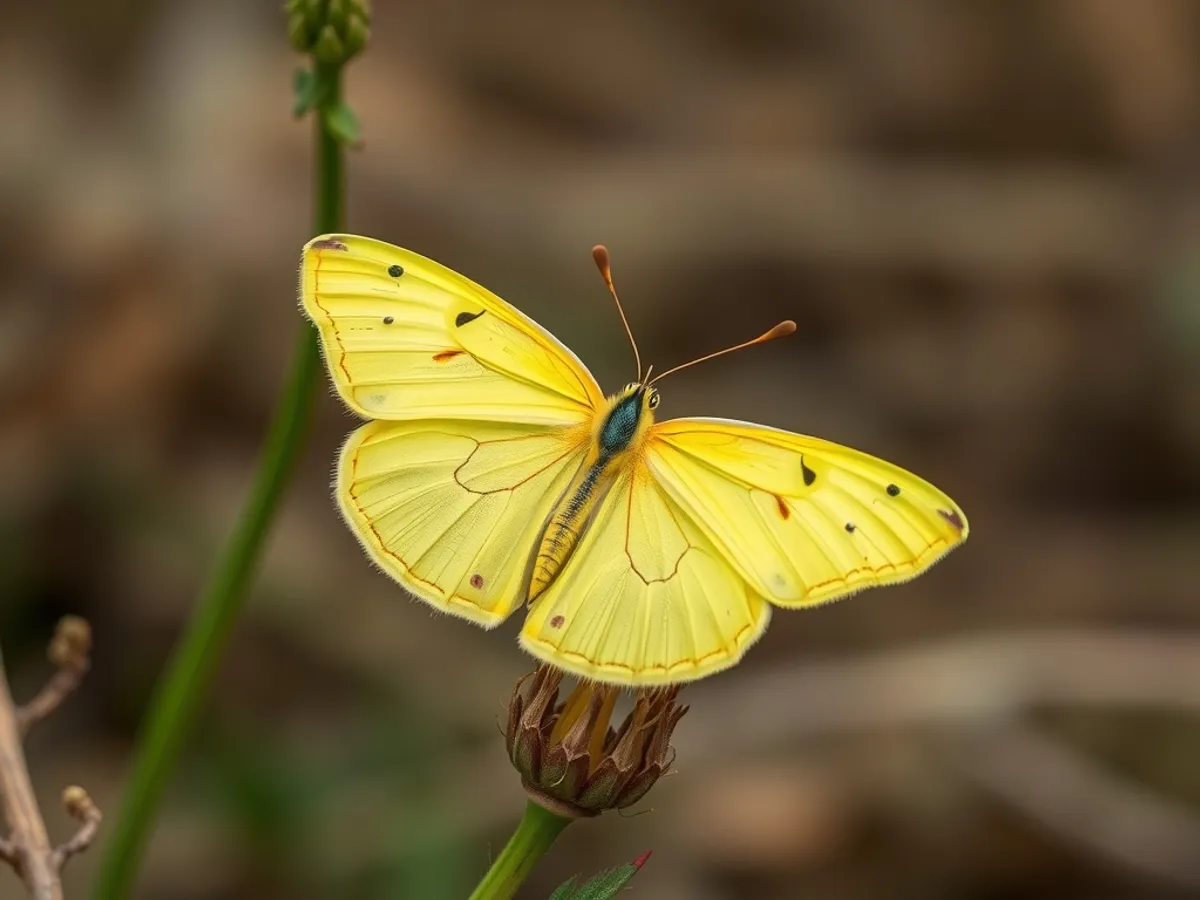
About the Cloudless Sulfur Butterfly
The Cloudless Sulfur Butterfly is a striking, medium to large butterfly known for its bright, lemon-yellow wings and swift, graceful flight. Commonly seen across the Americas, especially in open, sunny areas, it is easily recognizable by both its vivid coloration and its habit of migrating in large numbers. Adults feed primarily on nectar from a variety of flowers, while their caterpillars prefer plants in the pea family, especially senna. The species plays an important role as a pollinator and as part of the food web, serving as prey for birds and other predators.
Fascinating facts
Long-Distance Migrator
The Cloudless Sulfur Butterfly is capable of migrating long distances, especially in autumn when large numbers move southward.
Nectar Lovers
Adults feed on nectar from a variety of flowers, including lantana, hibiscus, and morning glory, making them important pollinators.
Host Plant Specialist
The caterpillars feed almost exclusively on senna plants, which provide the necessary chemicals for their development and defense.
Detailed description
The Cloudless Sulfur Butterfly (Phoebis sennae) is a large pierid butterfly, with adults typically exhibiting a wingspan ranging from 54 to 70 mm. Males are a vibrant, unmarked lemon-yellow, while females may be paler, sometimes with subtle spots or a whitish hue. The forewings are elongated and pointed, aiding in their rapid, erratic flight. The ventral side of the wings is paler and often marked with a single silver or white spot, providing camouflage when at rest among foliage. Antennae are clubbed, and the body is slender, covered in fine scales. The species is highly migratory, capable of covering hundreds of kilometers, and is often observed in large, directional flights during late summer and fall. Larvae are bright green with a thin yellow stripe, blending well with their host plants. The butterfly's life cycle includes egg, larva, pupa (chrysalis), and adult stages, with multiple generations per year in warmer climates. Adults are diurnal, most active during sunny, warm conditions, and are frequently seen visiting a wide range of nectar sources. Their ecological role as pollinators and as prey for birds, spiders, and other insects is significant in maintaining ecosystem balance.
Did you know?
Despite their delicate appearance, Cloudless Sulfur Butterflies can travel hundreds of miles during migration, even crossing the Gulf of Mexico.
Research & sources
Behaviour & social structure
Cloudless Sulfur Butterflies are solitary for much of their life but may aggregate in large numbers during migration or at communal nectar sources. Adults exhibit strong, purposeful flight, often at heights of 2–5 meters, and can be seen crossing open landscapes in search of mates or suitable host plants. Feeding behavior is characterized by rapid, probing visits to flowers such as lantana, hibiscus, and morning glory, with a preference for red, orange, and pink blooms. Males patrol territories and actively seek out females for mating. During the heat of midday, adults may rest on the undersides of leaves, adopting a vertical posture to minimize sun exposure. Larvae feed voraciously on senna and related legumes, sometimes causing noticeable defoliation. Both larvae and adults are subject to predation by birds, wasps, and spiders, and the species employs rapid flight and cryptic coloration as primary defenses.
Reproduction & life cycle
Reproduction in Phoebis sennae is primarily sexual, with courtship involving aerial chases and pheromonal signaling. Mating typically occurs shortly after emergence, with females laying single, spindle-shaped eggs on the undersides of host plant leaves, especially Senna spp. and Cassia spp. The incubation period for eggs is 3–5 days, depending on temperature. Larval development proceeds through five instars over 10–14 days, followed by pupation. The chrysalis is green and angular, resembling a leaf, and the pupal stage lasts 7–10 days. In tropical and subtropical regions, breeding is continuous year-round, while in temperate areas, it is restricted to warmer months, with up to 4–5 generations per year. There is no parental care beyond egg-laying; larvae are independent immediately upon hatching.
Adaptations & survival
The Cloudless Sulfur Butterfly exhibits several adaptations for survival. Its bright yellow coloration serves as both a warning and a form of camouflage among yellow flowers and senna leaves. The elongated forewings and powerful flight muscles enable long-distance migration and rapid escape from predators. Larvae possess cryptic coloration and feed on senna, which contains secondary compounds that may deter some predators. The species' ability to utilize a wide range of nectar sources and host plants allows it to thrive in diverse habitats. Diapause in the pupal stage enables survival during unfavorable conditions, particularly in northern parts of its range.
Cultural significance
Cloudless Sulfur Butterflies are often featured in educational materials and butterfly gardens due to their conspicuous color and migratory behavior. In some cultures, yellow butterflies symbolize hope, renewal, or good fortune. Their annual migrations are noted by naturalists and citizen scientists, contributing to public engagement with insect conservation. While there are no major traditional uses, their presence is considered a sign of healthy, biodiverse habitats.
Recent research
Recent studies have focused on the migratory mechanisms of Phoebis sennae, including the use of polarized light and geomagnetic cues for navigation. Genetic research has explored population structure across its vast range, revealing gene flow facilitated by migration. Ongoing work examines the impacts of climate change on phenology and distribution, with evidence suggesting northward range expansions in response to warming temperatures. Studies on larval host plant preferences contribute to understanding coevolutionary relationships between butterflies and legumes. Citizen science initiatives, such as butterfly counts and migration tracking, have provided valuable data on population trends and movement patterns.
Sources
Butterflies of North America: Phoebis sennae Species Account
Scott, J.A. (The Butterflies of North America) (1986)
scientificMigration and Population Genetics of the Cloudless Sulphur Butterfly (Phoebis sennae)
Wassenaar, L.I. & Hobson, K.A. (1998)
scientificVideos
Habitat
Open fields, gardens, roadsides, and disturbed areas
 Africa
Savanna
Grasslands with scattered trees, characterized by seasonal rainfall and home to diverse grazing animals and predators.
 Various Continental Regions
Grassland
Open areas dominated by grasses rather than trees, supporting numerous herbivores and their predators.
 Global
Forest
Wooded areas with significant tree cover and diverse plant and animal communities.
Conservation
The Cloudless Sulfur Butterfly is currently classified as Least Concern on the IUCN Red List.
Threats & challenges
Currently listed as Least Concern, the Cloudless Sulfur Butterfly faces localized threats from habitat loss due to urbanization, agriculture, and pesticide use, which can reduce host plant availability and directly harm larvae and adults. Climate change may alter migration patterns and the timing of breeding, potentially disrupting synchrony with host plant phenology. Despite these challenges, the species' wide distribution, high reproductive rate, and adaptability have allowed populations to remain stable or even expand in some areas. Road mortality during mass migrations and predation by introduced species are additional, though less significant, threats.
Taxonomy
Scientific name
Phoebis sennae
- Kingdom
- Animalia
- Phylum
- Arthropoda
- Class
- Insecta
- Order
- Lepidoptera
- Family
- Pieridae
- Genus
- Phoebis
- Species
- sennae
Community notes
Share your observations about the Cloudless Sulfur Butterfly.
No community notes yet. Be the first!
Discover more wildlife
More fascinating animals from the encyclopedia.