
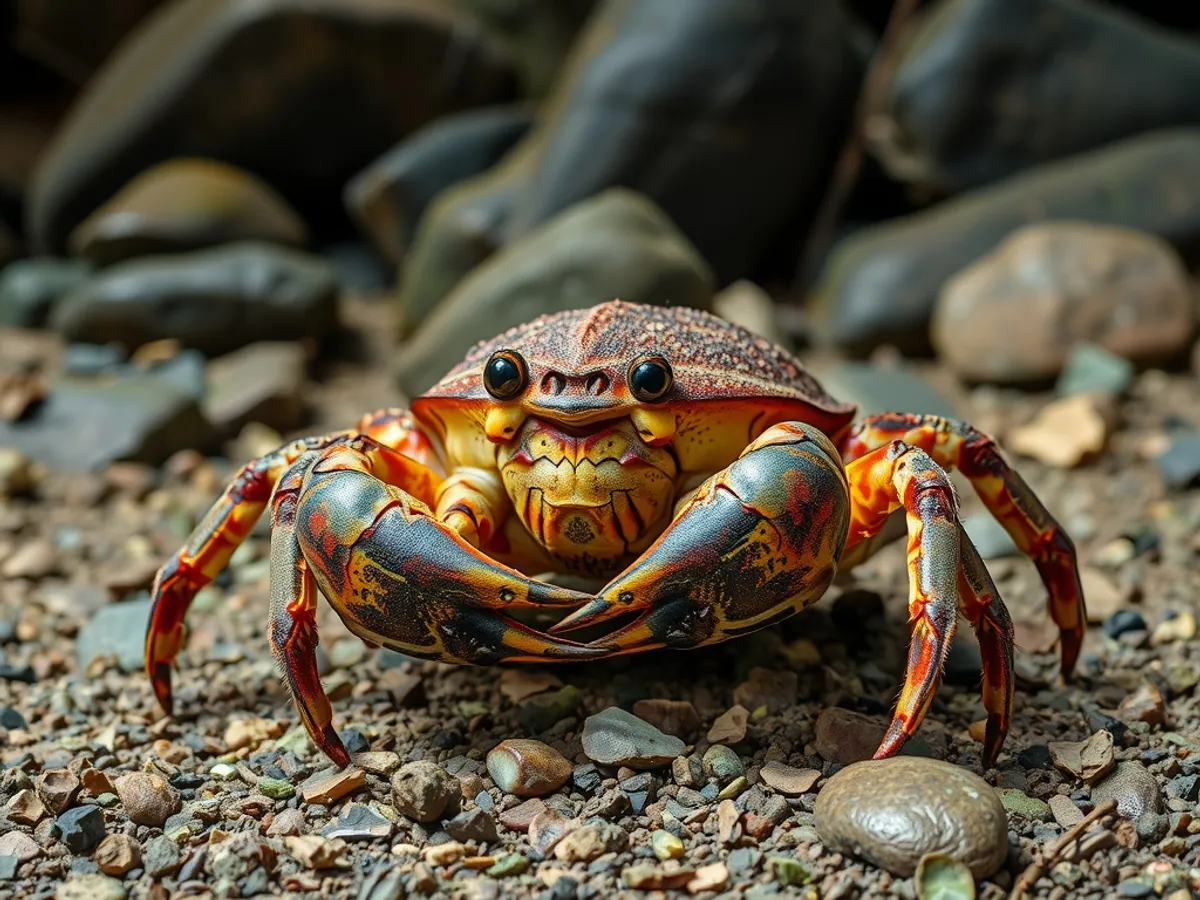
About the Coconut Crab
The coconut crab is the largest land arthropod alive, with a leg span approaching a metre, and it has committed to land so completely that it will drown if held underwater. It has abandoned gills for branchiostegal lungs and must breathe air, though it still needs to keep them damp. Its claws generate one of the strongest pinching forces measured in any animal — comparable, pound for pound, to the bite of a large predator — and it can indeed open a coconut, though usually by chipping away over hours or days, or by hauling one up a tree and dropping it. It also converged on insects in an unexpected way: having left the sea, it evolved insect-like olfactory organs and now smells its way to food across land. Young coconut crabs live in scavenged snail shells like hermit crabs, then discard them for good. They are long-lived, slow to mature, and famously drawn to shiny objects — hence the alternative name, robber crab.
Fascinating facts
World's Largest Land Crab
Coconut Crabs can have a leg span of up to 1 meter, making them the largest terrestrial arthropods.
Coconut Specialists
They are one of the few animals capable of opening coconuts, using their powerful pincers to crack through the tough shell.
Nocturnal Lifestyle
Coconut Crabs are mostly active at night, foraging for fallen fruit, carrion, and even other crabs.
Detailed description
The coconut crab (Birgus latro) is a remarkable terrestrial crustacean and the largest land-dwelling arthropod, with adults reaching a leg span of up to 1 meter and weighing as much as 4.1 kg. Its body is robust and heavily armored, with a tough exoskeleton that provides protection against predators and desiccation. The crab's most striking features are its massive chelae (claws), which can exert a force exceeding 3,300 newtons—strong enough to crack open coconuts, its namesake food source. Unlike most hermit crabs, adult coconut crabs do not use shells for protection, having evolved a hardened abdomen. Their coloration varies from blue to reddish-brown, often with lighter patches. Primarily nocturnal, they spend daylight hours hidden in deep burrows or crevices, emerging at night to forage. Coconut crabs are solitary and highly territorial, using chemical cues to communicate and avoid conflict. Their sense of smell is highly developed, enabling them to locate food over long distances. Reproduction involves a complex terrestrial and marine lifecycle, with females releasing eggs into the ocean, where larvae develop before returning to land. Adapted to a terrestrial lifestyle, they possess modified gills (branchiostegal lungs) that allow them to breathe air, but they must maintain moisture to survive. These crabs play a significant ecological role as scavengers and seed dispersers in their island habitats.
Did you know?
Despite being crustaceans, adult Coconut Crabs cannot swim and will drown if submerged in water for extended periods.
Research & sources
Wikipedia summary
The coconut crab is a terrestrial species of giant hermit crab, and is also known as the robber crab or palm thief. It is the largest terrestrial arthropod known, with a weight up to 4.1 kg (9 lb). The distance from the tip of one leg to the tip of another can be as wide as 1 m. It is found on islands across the Indian and Pacific Oceans, as far east as the Gambier Islands, Pitcairn Islands, and Caroline Island, and as far west as Zanzibar. While its range broadly shadows the distribution of the coconut palm, the coconut crab has been extirpated from most areas with a significant human population such as mainland Australia and Madagascar.
Behaviour & social structure
Coconut crabs are primarily nocturnal, emerging from their burrows or rock crevices after dusk to forage. Their diet is omnivorous and opportunistic, including fruits (notably coconuts and pandanus), seeds, carrion, smaller animals, and even other crabs. They are known for their ability to climb trees, sometimes up to 6 meters, to access food or escape predators. Foraging involves both tactile and olfactory cues, and they have been observed dragging large food items back to their burrows for consumption. Aggressive and solitary, coconut crabs maintain exclusive territories, using their powerful claws and chemical signals to deter intruders. Social interactions are generally limited to mating encounters or disputes over food. During the day, they remain hidden to avoid dehydration and predation, plugging burrow entrances with leaves or debris to maintain humidity.
Reproduction & life cycle
Coconut crabs reach sexual maturity at around 5 years of age, with some individuals living over 40 years. Mating typically occurs on land during the wet season, often between June and September, depending on location. Males approach receptive females and engage in a brief courtship before copulation, which can last several minutes. Females carry fertilized eggs (up to 100,000) attached to their abdominal pleopods for about a month. When the eggs are ready to hatch, females migrate to the shoreline, often timing their arrival with high tide, and release the eggs into the sea. The planktonic larvae (zoeae) undergo several molts over 3-4 weeks before settling on land as juveniles, at which point they temporarily use gastropod shells for protection. As they grow, they abandon the shells and develop a calcified abdomen. There is no parental care after egg release.
Adaptations & survival
Coconut crabs exhibit numerous adaptations for terrestrial life. Their branchiostegal lungs are specialized for breathing air, and they possess modified gills that require high humidity but not immersion. The exoskeleton is thick and calcified, reducing water loss and providing defense. Their chelae are among the strongest in the animal kingdom, enabling them to access hard-shelled food sources. Highly sensitive antennae and olfactory organs allow them to detect food and conspecifics over long distances. Their ability to climb trees is facilitated by strong, hooked legs. Behavioral adaptations include nocturnality to avoid heat and dehydration, and burrow construction for shelter and humidity regulation. Juveniles use shells for protection, a trait lost in adulthood as their own exoskeleton hardens.
Cultural significance
Coconut crabs hold a prominent place in the folklore and traditions of many Pacific and Indian Ocean island communities. They are often featured in local myths as symbols of strength, cunning, or greed, and are sometimes associated with supernatural powers. In some cultures, they are considered a delicacy and are hunted for food, while in others, taboos restrict their consumption. Their impressive size and strength have made them the subject of fascination and fear, and they are sometimes used in traditional medicine or as totems.
Recent research
Recent research has focused on the biomechanics of the coconut crab's claw strength, revealing it to be the strongest among terrestrial crustaceans. Studies on their olfactory system have shown convergent evolution with insects, allowing efficient detection of volatile compounds in air. Genetic analyses are providing insights into population structure and connectivity across their fragmented range, informing conservation strategies. Ongoing research is examining their role in island ecosystems, particularly in seed dispersal and nutrient cycling. There is also interest in their physiological adaptations to terrestrial life, including water balance and respiratory mechanisms.
Videos
Habitat
Coastal forests and rocky shorelines on Indo-Pacific islands

Conservation
The Coconut Crab is currently classified as Vulnerable on the IUCN Red List.
Threats & challenges
The coconut crab faces significant threats from habitat loss, overharvesting for food, and predation by introduced species such as rats, pigs, and humans. Their slow growth and late maturity make populations vulnerable to overexploitation. On many islands, coconut crabs have been extirpated due to human activity and habitat destruction. Climate change and sea-level rise also threaten their coastal habitats. As a result, the IUCN Red List classifies the species as Vulnerable, with declining populations in many parts of its range. Conservation challenges include enforcing harvest restrictions, protecting breeding habitats, and controlling invasive predators.
Taxonomy
Scientific name
Birgus latro
- Kingdom
- Animalia
- Phylum
- Arthropoda
- Class
- Malacostraca
- Order
- Decapoda
- Family
- Coenobitidae
- Genus
- Birgus
- Species
- latro
Where to see a coconut crab
2 zoos and aquariums in 2 countries are recorded as keeping this species.

Community notes
Share your observations about the Coconut Crab.
No community notes yet. Be the first!
Discover more wildlife
More fascinating animals from the encyclopedia.