
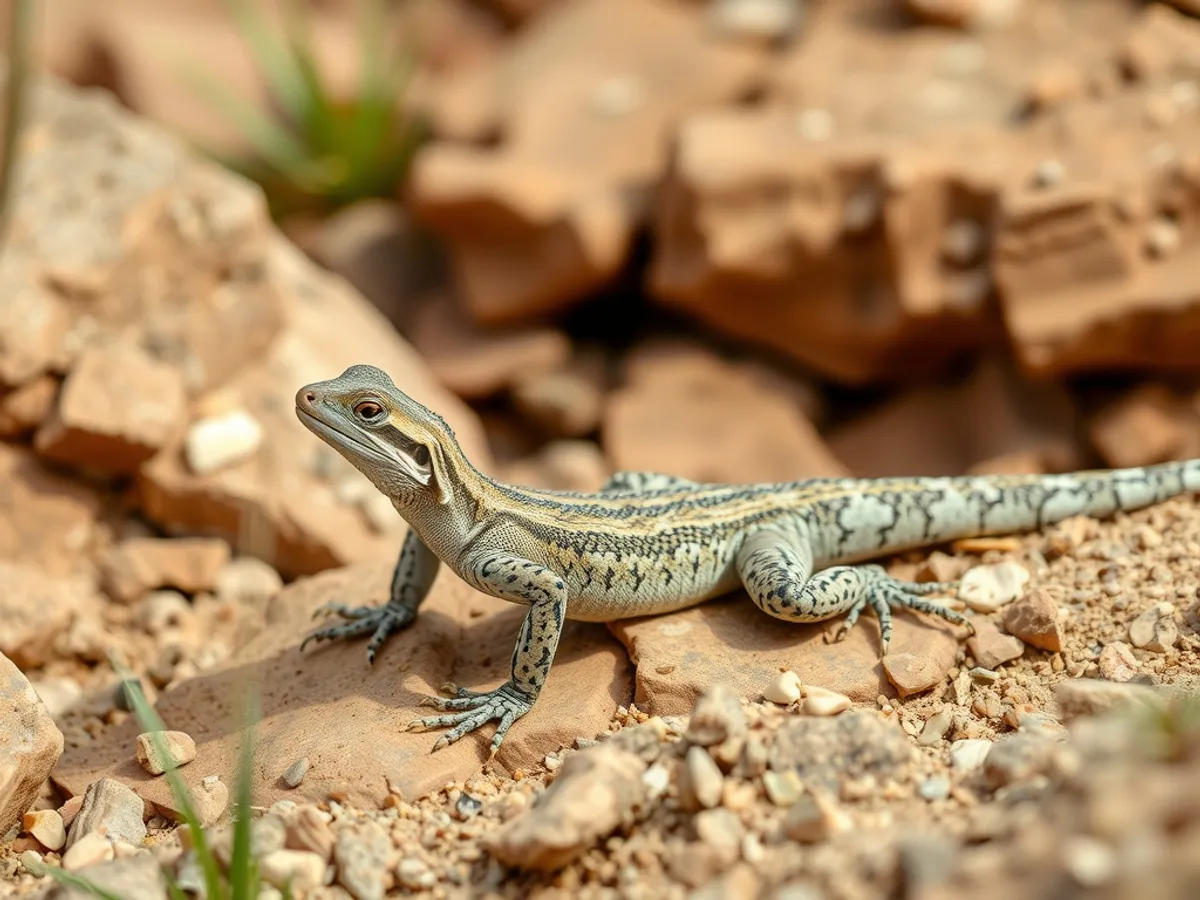
About the Collared Lizard
The collared lizard is a strikingly colorful reptile native to the arid and rocky regions of the central and southwestern United States and northern Mexico. Named for the distinctive black bands or 'collars' around its neck, this agile lizard is renowned for its ability to run on its hind legs at high speeds. Collared lizards exhibit pronounced sexual dimorphism, with males displaying brighter blue, green, and yellow hues compared to the more muted tones of females. They are diurnal and highly territorial, often basking on rocks to survey their domain. Their powerful jaws allow them to prey on a variety of insects and even small vertebrates.
Fascinating facts
Bipedal Sprint
Collared lizards are known for their ability to run quickly on just their hind legs, which helps them escape predators with bursts of speed.
Bright Colors
Males display vivid blue, green, and yellow coloration, especially during the breeding season, making them one of the most colorful North American lizards.
Versatile Predator
Their strong jaws allow them to eat not just insects, but also other lizards and even small rodents on occasion.
Detailed description
The collared lizard (Crotaphytus collaris) is a robust, medium-sized lizard, typically measuring 20–35 cm (8–14 in) in total length, with males generally larger than females. Its most distinctive feature is the presence of two black bands, or 'collars,' encircling the neck and shoulder region, which contrast sharply with the vivid blue, green, yellow, or orange coloration found primarily in males. The head is broad and triangular, with powerful jaws adapted for subduing prey. The limbs are long and muscular, enabling rapid bipedal locomotion—a unique adaptation among North American lizards. Collared lizards are diurnal and highly territorial, with males aggressively defending prominent basking sites atop rocks or boulders. Their keen vision aids in detecting both prey and rivals from a distance. During the breeding season, males display intensified coloration and engage in ritualized combat to establish dominance. The species is primarily insectivorous but opportunistically preys on smaller lizards and rodents. Collared lizards are well adapted to arid environments, relying on behavioral thermoregulation such as basking and seeking shade to maintain optimal body temperature. Their lifespan in the wild is estimated at 5–8 years, with predation and environmental factors influencing survival.
Did you know?
Unlike many lizards, collared lizards can bite through the exoskeletons of large insects and sometimes even consume other lizards.
Research & sources
Wikipedia summary
Collared lizard may refer to:Any member of the North America genus Crotaphytus Crotaphytidae, the family of collared lizards of which Crotaphytus is a member Oplurus cuvieri, a species native to Madagascar
Behaviour & social structure
Collared lizards are solitary outside of the breeding season, with individuals maintaining and defending territories that may overlap at the edges. Males are especially territorial, using visual displays such as head-bobbing, push-ups, and lateral body flattening to deter rivals and attract mates. They are active during the day, especially in the morning and late afternoon, spending midday hours sheltering from extreme heat. Hunting is primarily sit-and-wait, but they are capable of short, rapid pursuits, often running bipedally to chase down prey or escape predators. Their diet consists mainly of grasshoppers, beetles, spiders, and other arthropods, but they will also consume smaller lizards, including conspecific juveniles, and occasionally small mammals. Collared lizards use visual cues for communication and rely on their acute eyesight to detect movement. They are known to bask openly, using elevated rocks to survey their surroundings for both food and threats.
Reproduction & life cycle
Breeding occurs in late spring to early summer (typically May–June), triggered by increasing temperatures and photoperiod. Males become more vividly colored and actively court females through a series of displays and chases. After successful copulation, females lay a single clutch of 4–10 leathery eggs in a shallow nest excavated in sandy or loose soil, often in a sunny, well-drained location. Incubation lasts approximately 50–65 days, depending on environmental conditions, with hatchlings emerging in mid to late summer. There is no parental care; juveniles are independent from birth and must fend for themselves. Sexual maturity is reached within 1–2 years, depending on resource availability and climate.
Adaptations & survival
Crotaphytus collaris exhibits several remarkable adaptations for life in arid, rocky habitats. Its long, muscular hind limbs facilitate rapid bipedal running, allowing it to escape predators and pursue prey efficiently. The coloration provides both camouflage and a means of intraspecific communication, with males displaying brighter hues during the breeding season to signal fitness. The robust jaws and sharp teeth are specialized for capturing and subduing hard-bodied insects and small vertebrates. Behavioral thermoregulation, including basking and seeking shade, enables the lizard to maintain optimal body temperature in fluctuating desert climates. The ability to store fat in the tail provides an energy reserve during periods of food scarcity.
Cultural significance
The collared lizard holds cultural significance in several Native American traditions, particularly among the Hopi and other Puebloan peoples, where it is sometimes associated with agility, speed, and the sun. Its striking appearance has made it a symbol of the American Southwest, and it is the official state reptile of Oklahoma. The lizard occasionally appears in local folklore and is admired for its boldness and vibrant coloration. There are no known widespread traditional uses, but it features in educational and ecotourism programs highlighting desert biodiversity.
Recent research
Recent research has focused on the biomechanics of bipedal locomotion in collared lizards, revealing insights into the evolution of running in reptiles. Studies have also examined the role of coloration in sexual selection and territoriality, with findings indicating that brighter male coloration correlates with higher reproductive success. Genetic research has clarified the phylogenetic relationships within the genus Crotaphytus and the family Crotaphytidae, supporting the distinctiveness of C. collaris. Ongoing ecological studies are assessing the impacts of habitat fragmentation and climate change on population dynamics. Collared lizards are also used as model organisms for studying predator-prey interactions and behavioral ecology in arid environments.
Videos
Habitat
Rocky outcrops and arid grasslands
 Arid Regions
Desert
Arid lands with minimal rainfall, extreme temperatures, and specialized wildlife adapted to harsh conditions.
 Various Continental Regions
Grassland
Open areas dominated by grasses rather than trees, supporting numerous herbivores and their predators.
 Elevated Terrain
Mountain
High-altitude environments with varying climates and specialized wildlife adapted to rugged terrain and thin air.
Conservation
The Collared Lizard is currently classified as Least Concern on the IUCN Red List.
Threats & challenges
While currently listed as Least Concern by the IUCN, the collared lizard faces localized threats from habitat loss due to urbanization, agriculture, and mining activities that fragment rocky outcrops and grasslands. Road mortality and illegal collection for the pet trade may impact some populations. Climate change poses a potential long-term threat by altering habitat suitability and prey availability. Predators include birds of prey, snakes, and larger mammals. Despite these challenges, the species remains widespread and relatively stable across its range, thanks to its adaptability and broad distribution.
Taxonomy
Scientific name
Crotaphytus collaris
- Kingdom
- Animalia
- Phylum
- Chordata
- Class
- Reptilia
- Order
- Squamata
- Family
- Crotaphytidae
- Genus
- Crotaphytus
- Species
- collaris
Community notes
Share your observations about the Collared Lizard.
No community notes yet. Be the first!
Discover more wildlife
More fascinating animals from the encyclopedia.