
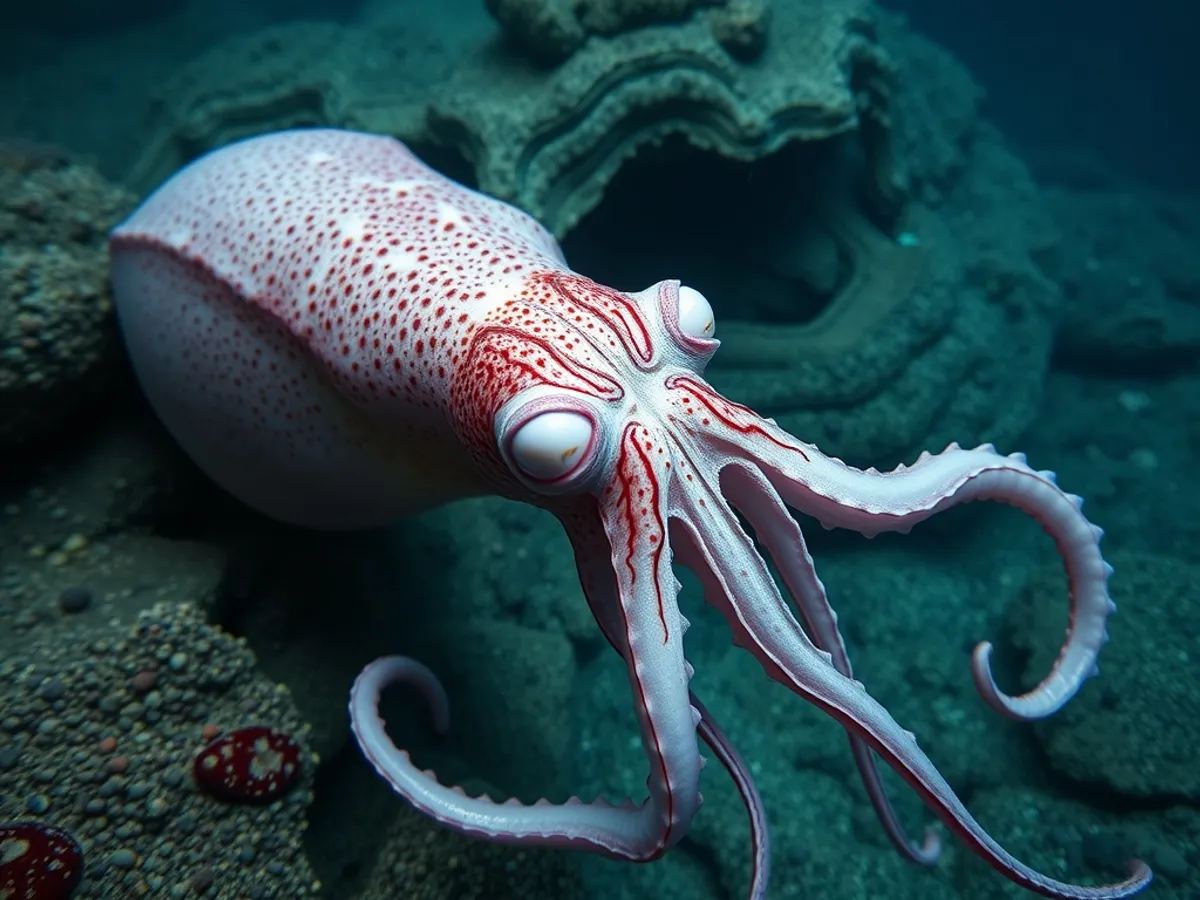
About the Colossal Squid
Mesonychoteuthis hamiltoni is the heaviest invertebrate known, with confirmed specimens near 495 kg — far bulkier than the longer, more slender giant squid. It lives in the freezing waters around Antarctica, and almost everything known about it comes from two sources: whole animals hauled up by Antarctic toothfish longliners, and beaks recovered from the stomachs of sperm whales. Its eyes are the largest of any animal that has ever lived, roughly 27 cm across with a built-in light organ, and the leading hypothesis is that they exist to spot the faint bioluminescent glow stirred up by an approaching sperm whale from over 100 m away. Its arms and the clubs at the ends of its tentacles carry swivelling, rotating hooks, a weapon the giant squid entirely lacks. Its flesh is buoyed by ammonium chloride solution held in the tissues, which keeps it neutrally buoyant but makes the body flabby and jelly-like, so it is almost certainly a slow ambush predator rather than a pursuit hunter. The 2007 capture of an intact 495 kg adult by the New Zealand vessel San Aspiring remains the reference specimen, thawed under supervision and now held in Wellington. No adult has ever been observed alive in its own habitat.
Fascinating facts
Giant Eyes
The colossal squid has the largest eyes of any animal, allowing it to detect faint light in the deep ocean.
Rotating Hooks
Unlike most squids, the colossal squid’s tentacles are armed with swiveling hooks to grip slippery prey.
Deep Dwellers
Colossal squids inhabit depths of 1,000 to 2,200 meters (3,300–7,200 feet) in the frigid Southern Ocean.
Detailed description
The colossal squid (Mesonychoteuthis hamiltoni) is the largest known invertebrate, notable not only for its immense size but also for its robust, muscular build. Adult specimens can reach mantle lengths of up to 2–4 meters, with total lengths (including tentacles) estimated at up to 10–14 meters, and weights recorded up to 495 kilograms, making it heavier and bulkier than the giant squid (Architeuthis dux). Its body is characterized by a thick, gelatinous mantle, large fins for slow, energy-efficient movement, and a short, broad head. The colossal squid possesses the largest eyes in the animal kingdom, measuring up to 27 cm (11 in) in diameter, an adaptation for detecting faint light in the deep sea. Its eight arms and two longer tentacles are lined with sharp, swiveling hooks—unique among cephalopods—which provide a formidable grip on prey. The beak is exceptionally strong, capable of slicing through tough tissue, and is among the largest of any cephalopod. Internally, the colossal squid has an ammonium-rich, buoyant tissue composition, allowing it to maintain neutral buoyancy in the cold, high-pressure depths of the Southern Ocean. Its skin contains chromatophores, but unlike some shallow-water relatives, it is not known for rapid color changes. The colossal squid is a solitary, deep-dwelling predator, rarely encountered by humans, and most knowledge comes from specimens recovered from sperm whale stomachs or deep-sea trawls.
Did you know?
Despite their gigantic size, colossal squids are believed to be relatively short-lived, possibly surviving only a couple of years.
Research & sources
Wikipedia summary
The colossal squid is a species of very large squid belonging to the family Cranchiidae, that of the cockatoo squids or glass squids. It is sometimes called the Antarctic cranch squid or giant squid and is believed to be the largest squid species in terms of mass. It is the only recognized member of the genus Mesonychoteuthis.
Behaviour & social structure
The colossal squid is a solitary and mostly sedentary predator, spending much of its life in the deep mesopelagic and bathypelagic zones (typically 1,000–2,200 meters deep). It is believed to be an ambush predator, using its large eyes to detect bioluminescent prey or movement in the darkness. When prey is detected, the squid uses a rapid strike with its tentacles, employing the swiveling hooks to grasp and immobilize fish such as Antarctic toothfish and other squid. Feeding is facilitated by its powerful beak and radula, which can process large, tough prey. There is little evidence of complex social behavior; individuals are thought to interact only during mating. The colossal squid is slow-moving, conserving energy in the cold, low-oxygen environment, and may spend long periods motionless, waiting for prey. Its daily activity patterns are poorly understood due to the inaccessibility of its habitat.
Reproduction & life cycle
Reproductive biology of the colossal squid remains poorly documented due to the rarity of mature specimens. Like other oegopsid squids, it is believed to have separate sexes and to reproduce via internal fertilization. Males possess a specialized arm, the hectocotylus, for transferring spermatophores (sperm packets) to the female. Mating likely occurs in the deep sea, with little to no courtship. Females are significantly larger than males, a common trait in deep-sea cephalopods. After fertilization, females are thought to release large numbers of eggs (potentially thousands) into the water column, where they develop planktonically. There is no evidence of parental care; the young are left to fend for themselves upon hatching. The timing and seasonality of breeding are unknown, but it may be influenced by environmental cues such as temperature and food availability.
Adaptations & survival
The colossal squid exhibits several remarkable adaptations for deep-sea survival. Its enormous eyes are adapted to maximize light capture, enabling it to detect faint bioluminescence and movement in near-total darkness. The swiveling hooks on its tentacles are a unique evolutionary feature, providing a secure grip on slippery or struggling prey. Its body contains high concentrations of ammonium ions, making it neutrally buoyant and allowing it to hover with minimal energy expenditure. The thick, muscular mantle and robust arms provide both protection and strength for subduing large prey. Slow metabolism and energy-efficient movement are crucial for survival in the cold, food-scarce Southern Ocean. The beak and radula are highly developed for processing large, tough prey. Its skin is less capable of rapid color change compared to shallow-water squids, reflecting the low importance of camouflage in the deep sea.
Cultural significance
While not as prominent in folklore as the giant squid, the colossal squid has captured the imagination of scientists and the public alike since its formal description in 1925. Its massive size and mysterious deep-sea lifestyle have contributed to its reputation as a 'sea monster' in modern media and popular science. The first intact specimen, recovered in 2007, garnered international attention and is now displayed at the Museum of New Zealand Te Papa Tongarewa. The colossal squid has become an icon of deep-sea exploration and a symbol of the mysteries that still remain in the ocean's depths.
Recent research
Recent research has focused on anatomical studies of rare specimens, particularly those recovered from deep-sea fisheries and sperm whale stomachs. The 2007 capture of a near-complete adult specimen provided unprecedented insights into the species' morphology, including detailed analysis of its eyes, beak, and tentacle hooks. Ongoing studies use stable isotope analysis to investigate its diet and trophic position in the Southern Ocean ecosystem. Advances in deep-sea imaging and remotely operated vehicles (ROVs) may eventually allow for direct observation of live colossal squid in their natural habitat, though this remains a significant technical challenge. Genetic studies are limited but suggest low genetic diversity, possibly due to the species' restricted range. The colossal squid remains a subject of fascination and a priority for deep-sea biological research.
Videos
Habitat
Deep Southern Ocean

Conservation
The Colossal Squid is currently classified as Least Concern on the IUCN Red List.
Threats & challenges
Currently, the colossal squid faces few natural predators aside from sperm whales, which are known to actively hunt them, as evidenced by squid beaks found in whale stomachs and scars on whale skin. Human impact is minimal due to the squid's deep-sea habitat, though incidental bycatch in deep-sea fisheries (notably for Antarctic toothfish) poses a localized risk. Climate change and ocean warming could potentially alter the squid's habitat and prey availability in the future, but current population trends are unknown due to the species' elusive nature. The IUCN lists the species as Least Concern, reflecting the absence of significant threats at present. However, the lack of comprehensive population data remains a challenge for effective conservation assessment.
Taxonomy
Scientific name
Mesonychoteuthis hamiltoni
- Kingdom
- Animalia
- Phylum
- Mollusca
- Class
- Cephalopoda
- Order
- Oegopsida
- Family
- Cranchiidae
- Genus
- Mesonychoteuthis
- Species
- hamiltoni
Community notes
Share your observations about the Colossal Squid.
No community notes yet. Be the first!
Discover more wildlife
More fascinating animals from the encyclopedia.