
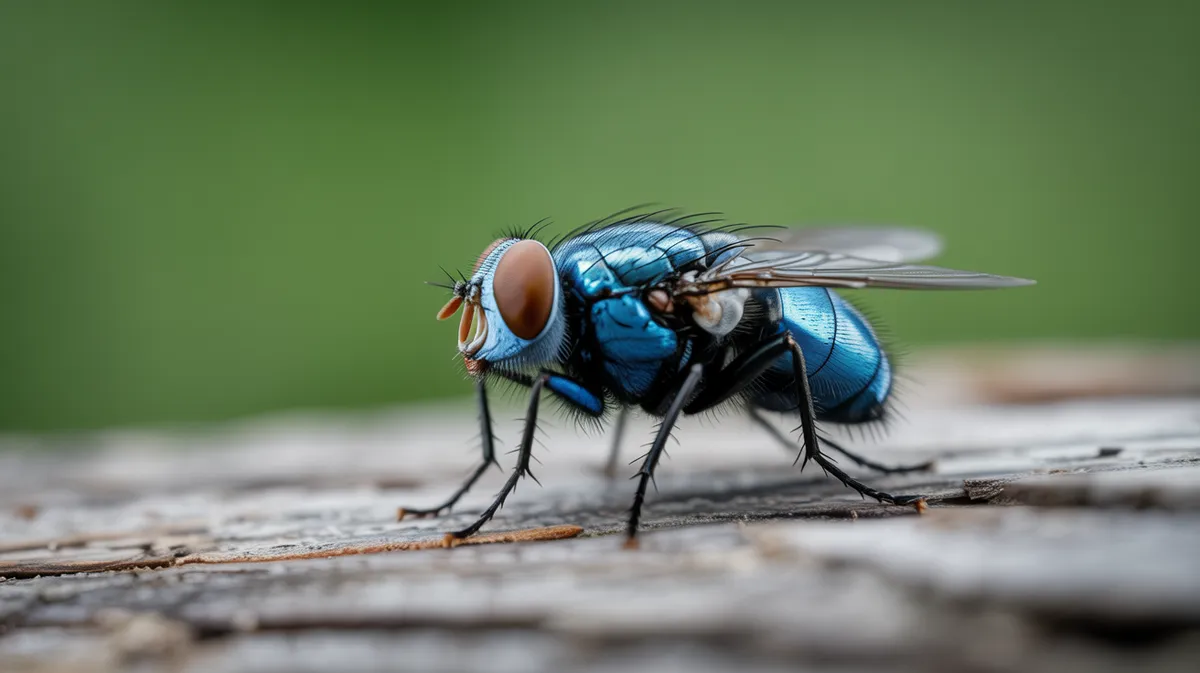
About the Common Blue Bottle Fly
The common blue bottle fly is a large, metallic blue fly frequently found near decaying organic matter and human habitation. Known for its iridescent coloration and robust body, this species plays a critical role in the decomposition process, aiding nutrient recycling in ecosystems. Blue bottle flies are also important in forensic entomology, as their larvae are among the first to colonize decomposing remains. Despite their sometimes unpleasant associations, they contribute to pollination and are a natural part of many terrestrial food webs.
Fascinating facts
Metallic Appearance
Their striking metallic blue coloration makes them easily recognizable among other fly species.
Forensic Importance
Blue bottle flies are crucial to forensic science, as their predictable life cycle helps estimate time of death in investigations.
Ecosystem Role
They accelerate decomposition and nutrient cycling by feeding on and breaking down dead animals and organic waste.
Detailed description
The Common Blue Bottle Fly (Calliphora vomitoria) is a robust dipteran insect, typically measuring 10–14 mm in length, with a striking metallic blue abdomen and a dull gray thorax covered in short, bristly hairs. Its compound eyes are large and reddish-brown, providing a wide field of vision crucial for detecting movement and locating food sources. The species possesses a pair of transparent wings with distinctive venation and club-shaped halteres that aid in balance during agile flight. Calliphora vomitoria is equipped with sponging mouthparts adapted for feeding on liquid or semi-liquid substances, including nectar, decaying organic matter, and animal secretions. The larvae (maggots) are creamy-white, legless, and highly efficient at breaking down carrion, playing a vital role in nutrient cycling. Adults are strong fliers, capable of traveling several kilometers in search of suitable breeding or feeding sites. The species is primarily solitary but may aggregate in large numbers where resources are abundant. Its life cycle is rapid, with development from egg to adult often completed in as little as two weeks under optimal conditions. This fly is also notable for its ecological versatility, thriving in diverse habitats ranging from urban environments to rural woodlands.
Did you know?
The common blue bottle fly is so attracted to decaying matter that it can detect odors from several kilometers away using specialized receptors on its antennae.
Research & sources
Behaviour & social structure
Calliphora vomitoria exhibits primarily crepuscular and diurnal activity, with peak foraging occurring during daylight hours. Adults are attracted to carrion, feces, and decomposing organic matter, which serve as both food sources and oviposition sites. They are opportunistic feeders, using their proboscis to sponge up fluids from a variety of substrates, including animal wounds and excrement. While generally solitary, blue bottle flies may congregate in large numbers at abundant food sources or breeding sites. Their flight is characterized by rapid, darting movements, and they are capable of detecting odors from long distances using highly sensitive olfactory receptors on their antennae. In addition to scavenging, adults may visit flowers for nectar, contributing to incidental pollination. Defensive behaviors include rapid escape responses and erratic flight patterns to avoid predation.
Reproduction & life cycle
Reproduction in Calliphora vomitoria is initiated by complex courtship behaviors, often involving visual and chemical cues. Mating typically occurs shortly after adult emergence, with females capable of storing sperm for multiple oviposition events. Females lay clusters of 150–300 eggs at a time, usually on decomposing animal remains or other protein-rich substrates. The eggs hatch within 8–24 hours, depending on temperature, and the larvae undergo three instar stages over 4–10 days. Larval development is temperature-dependent and accelerates in warmer conditions. After feeding, mature larvae migrate away from the food source to pupate in the soil or under debris, with the pupal stage lasting 6–12 days. There is no parental care; survival of offspring depends on the suitability of the oviposition site and environmental conditions. Multiple generations may occur annually, especially in temperate regions.
Adaptations & survival
Calliphora vomitoria is highly adapted for a scavenging lifestyle. Its acute olfactory system enables it to detect volatile compounds emitted by decaying matter from several kilometers away. The sponging mouthparts are specialized for ingesting liquid nutrients, while powerful enzymes in the larval gut facilitate rapid decomposition of animal tissues. The metallic blue coloration may serve as a warning to predators or aid in thermoregulation. Rapid development and high fecundity increase reproductive success in unpredictable environments. The species' ability to exploit a wide range of habitats and food sources, including human refuse, has facilitated its global distribution. Larvae can withstand moderate desiccation and low oxygen conditions, allowing them to thrive in buried or semi-enclosed carcasses.
Cultural significance
The blue bottle fly has long been associated with death and decay in various cultures, symbolizing mortality and the ephemeral nature of life. In forensic entomology, Calliphora vomitoria is a key indicator species for estimating post-mortem intervals, as its predictable colonization patterns on corpses provide valuable information for criminal investigations. Historically, maggots of this species have been used in maggot therapy to clean wounds, due to their ability to consume necrotic tissue while sparing healthy cells. The fly's presence in literature and art often evokes themes of transience and the natural cycle of life and death.
Recent research
Recent research on Calliphora vomitoria has focused on its forensic applications, with studies refining developmental timelines under various environmental conditions to improve accuracy in post-mortem interval estimations. Molecular analyses have explored population genetics and phylogeography, revealing significant genetic diversity across its range. Investigations into larval secretions have identified antimicrobial peptides with potential biomedical applications. Ongoing work examines the species' role in pathogen transmission, particularly in urban environments, and its interactions with other decomposer species. Advances in understanding olfactory receptor function may inform pest management strategies and forensic methodologies.
Videos
Habitat
Urban areas, woodlands, meadows, and near animal remains


Conservation
The Common Blue Bottle Fly is currently classified as Least Concern on the IUCN Red List.
Threats & challenges
Currently, Calliphora vomitoria faces few significant threats and maintains stable populations across its range. However, localized declines may occur due to intensive urban sanitation, reduced availability of carrion, and widespread use of insecticides. Climate change could alter developmental rates and geographic distribution, potentially affecting population dynamics. The species is not targeted by conservation efforts due to its abundance and ecological resilience. Human perception of blue bottle flies as pests can lead to control measures that may impact local populations, but overall, the species remains common and widespread.
Taxonomy
Scientific name
Calliphora vomitoria
- Kingdom
- Animalia
- Phylum
- Arthropoda
- Class
- Insecta
- Order
- Diptera
- Family
- Calliphoridae
- Genus
- Calliphora
- Species
- vomitoria
Community notes
Share your observations about the Common Blue Bottle Fly.
No community notes yet. Be the first!
Discover more wildlife
More fascinating animals from the encyclopedia.