
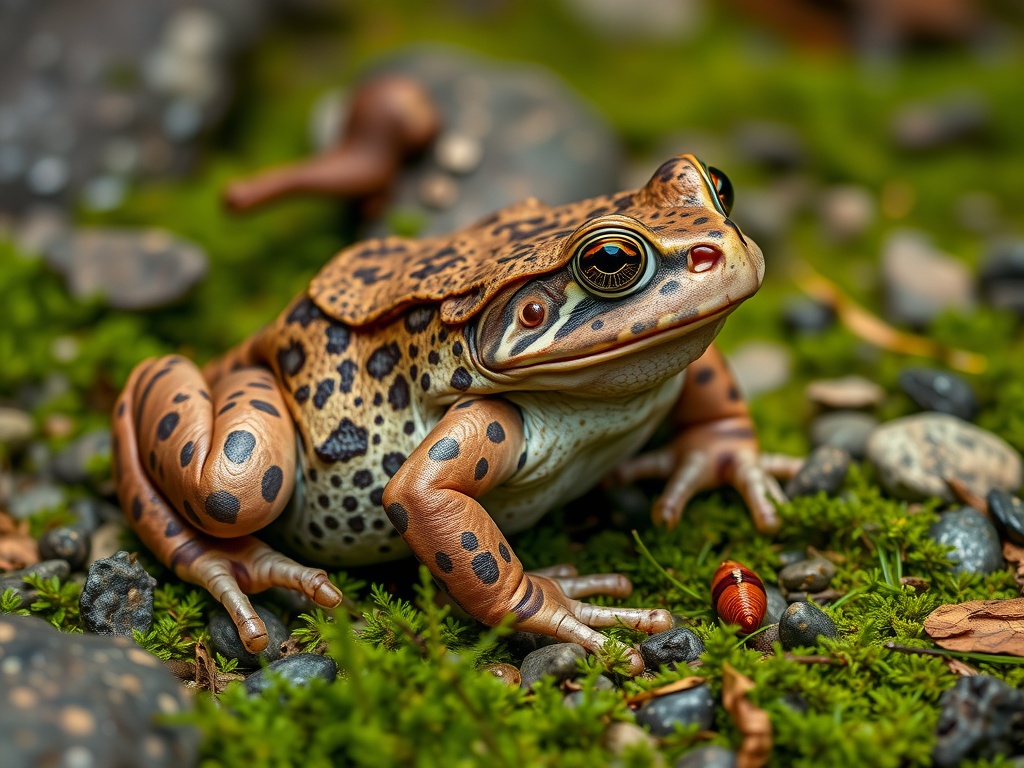
About the Common Midwife Toad
The Common Midwife Toad is a small, terrestrial amphibian native to much of Western and Central Europe. It is easily recognized by its warty, gray to olive-brown skin and distinctive high-pitched mating calls, especially during the night. Unlike most frogs and toads, males of this species carry fertilized egg strings wrapped around their hind legs until the tadpoles are ready to hatch, providing parental care unique among amphibians. This toad prefers damp, rocky areas in forests, grasslands, and sometimes gardens, where it hides during the day and becomes active at dusk.
Fascinating facts
Egg-Carrying Dads
Male midwife toads wrap fertilized egg strings around their hind legs and carry them for up to a month before depositing them in water for hatching.
Unique Calls
Their high-pitched, repetitive mating calls are easily mistaken for technological sounds, like an electronic beep.
Nocturnal Habits
Common Midwife Toads are primarily nocturnal, spending daylight hours hidden under stones or in burrows to avoid predators and dehydration.
Detailed description
The Common Midwife Toad (Alytes obstetricans) is a small, robust amphibian, typically measuring 40–55 mm in length, with females generally larger than males. Its skin is granular and warty, colored gray, olive, or brown, often with darker spots and a pale ventral surface. The head is broad with prominent, golden eyes featuring vertical pupils, an adaptation for nocturnal activity. Unlike many anurans, the tympanum (external eardrum) is not visible. Limbs are relatively short, and the toes are only partially webbed, reflecting its primarily terrestrial lifestyle. This species is renowned for its unique reproductive behavior: males carry fertilized eggs wrapped around their hind legs until hatching, a rare form of parental care among amphibians. The toad is mostly crepuscular and nocturnal, spending daylight hours hidden under stones, logs, or in burrows. Its call is a clear, bell-like 'peep' repeated at regular intervals, often heard during spring and summer nights. Tadpoles are large, reaching up to 80 mm, and may overwinter before metamorphosis, especially in cooler climates.
Did you know?
The Common Midwife Toad's reproductive strategy is so distinctive that its common name comes from the male's unusual role as an 'obstetrician.'
Research & sources
Wikipedia summary
The common midwife toad is a species of midwife frog in the family Alytidae. It is found in Belgium, France, Germany, Luxembourg, the Netherlands, Portugal, Spain, Switzerland, and the United Kingdom. Like other members of its genus (Alytes), the male toad carries the eggs around entwined on his back and thighs until they are ready to hatch.
Behaviour & social structure
Alytes obstetricans is primarily nocturnal, emerging at dusk to forage and call. It is a sit-and-wait predator, feeding on a variety of invertebrates such as insects, spiders, worms, and mollusks. The toad uses its sticky tongue to capture prey. During dry or hot periods, it remains hidden in moist microhabitats to avoid desiccation. Individuals are generally solitary outside the breeding season, though they may aggregate in suitable habitats. Territoriality is weak, but males may compete vocally for mates. The species exhibits site fidelity, often returning to the same breeding ponds or streams annually. When threatened, it may inflate its body and secrete a mild toxin from skin glands, deterring some predators.
Reproduction & life cycle
Breeding occurs from late March to July, depending on altitude and latitude. Males call from concealed positions to attract females. Amplexus is absent; instead, the female deposits a string of 40–70 eggs, which the male fertilizes externally and then winds around his hind legs. He carries the eggs for 3–6 weeks, keeping them moist by seeking damp environments, until the embryos are ready to hatch. The male then releases the eggs into shallow water, where the tadpoles emerge. Tadpoles may take several months to metamorphose, with some overwintering as larvae in colder regions. This reproductive strategy minimizes aquatic predation on eggs and is considered a significant evolutionary adaptation.
Adaptations & survival
The Common Midwife Toad exhibits several adaptations for terrestrial life, including granular skin that reduces water loss and partially webbed toes for maneuvering in rocky terrain. Its nocturnal habits help avoid dehydration and predation. The unique male brooding behavior protects eggs from aquatic predators and variable water conditions. Tadpoles are adapted for slow-moving or temporary waters, with large bodies and keratinized mouthparts for grazing on detritus and algae. The species can tolerate a wide range of temperatures and altitudes (up to 2400 m in the Pyrenees), and its cryptic coloration provides camouflage among leaf litter and stones.
Cultural significance
The Common Midwife Toad has intrigued naturalists since the 18th century due to its unusual reproductive behavior. Its bell-like call has been referenced in European folklore, sometimes associated with mysterious nighttime sounds. In some rural areas, the toad's presence is considered a sign of healthy environments. The species has also been used in educational settings to illustrate parental care and amphibian diversity. There are no known traditional medicinal or culinary uses.
Recent research
Recent research has focused on the impact of chytridiomycosis on Alytes obstetricans populations, with studies revealing genetic and immunological factors influencing susceptibility. Ongoing work investigates the species' acoustic communication, including the role of call structure in mate selection and territory establishment. Population genetics studies have revealed significant regional differentiation, likely due to limited dispersal and habitat fragmentation. Conservation programs are trialing probiotic treatments to enhance resistance to chytrid fungus. The species is also a model for studying the evolution of parental care in amphibians.
Sources
Alytes obstetricans (Common Midwife Toad): Taxonomy, Distribution and Conservation
Bosch J, Beebee T, Schmidt BR, Tejedo M, Martinez-Solano I, Salvador A, García-París M, Recuero Gil E, Arntzen JW, Diaz Paniagua C (2009)
scientificVideos
Habitat
Temperate forests, grasslands, and rocky areas near freshwater sources
 Various Continental Regions
Grassland
Open areas dominated by grasses rather than trees, supporting numerous herbivores and their predators.
 Elevated Terrain
Mountain
High-altitude environments with varying climates and specialized wildlife adapted to rugged terrain and thin air.
 Global
Forest
Wooded areas with significant tree cover and diverse plant and animal communities.
 Global
Freshwater
Lakes, rivers, and wetlands with diverse aquatic ecosystems.
Conservation
The Common Midwife Toad is currently classified as Least Concern on the IUCN Red List.
Threats & challenges
While classified as Least Concern by the IUCN, Alytes obstetricans faces several localized threats. Habitat loss due to urbanization, agriculture, and infrastructure development reduces suitable breeding and foraging sites. The species is highly susceptible to chytridiomycosis, a fungal disease caused by Batrachochytrium dendrobatidis, which has caused significant population declines in some regions. Road mortality, pollution, and introduced predators (such as fish and crayfish) also pose risks. Climate change may alter hydrological regimes, affecting breeding success. Conservation measures include habitat protection, disease monitoring, and captive breeding in severely affected populations.
Taxonomy
Scientific name
Alytes obstetricans
- Kingdom
- Animalia
- Phylum
- Chordata
- Class
- Amphibia
- Order
- Anura
- Family
- Alytidae
- Genus
- Alytes
- Species
- obstetricans
Community notes
Share your observations about the Common Midwife Toad.
No community notes yet. Be the first!
Discover more wildlife
More fascinating animals from the encyclopedia.