
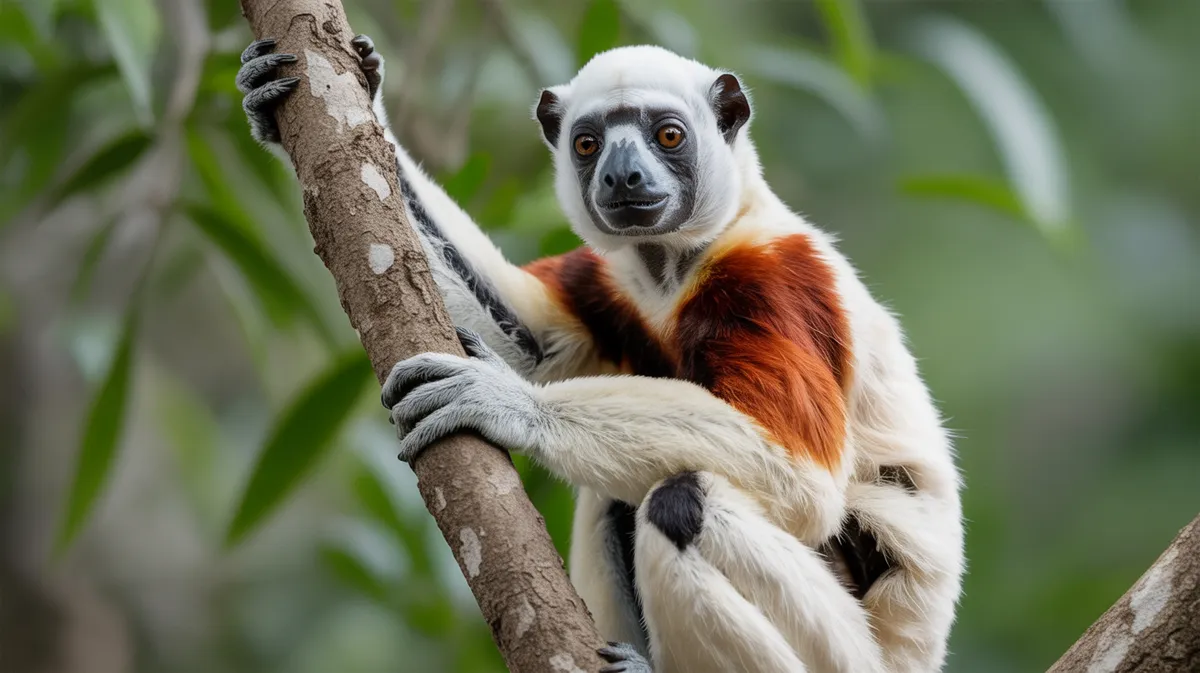
About the Coquerel's Sifaka
Propithecus coquereli is a large lemur of the dry deciduous forests of northwestern Madagascar, best known outside Africa as the animal that played Zoboomafoo. Its locomotion is the whole story: it is a vertical clinger and leaper, sitting upright against a trunk and launching with hugely elongated hind limbs to cross gaps of 6 m or more between trees, twisting in the air so it lands feet-first and upright on the next trunk. Those legs are so specialised for leaping that the animal cannot walk on all fours in any useful way, so on the rare occasions it has to cross open ground it stands up and bounds sideways in a series of arm-waving hops — the origin of the "dancing sifaka" footage. It is a folivore with a large fermenting caecum, eating leaves, flowers, bark and unripe fruit, and it can process seeds and plant toxins that would sicken most primates. As in nearly all lemurs, females are dominant over males and eat first, an unusual arrangement among primates. Its common name comes from its alarm bark, a hissing "shee-fak," and it is endangered, largely confined to fragments such as Ankarafantsika National Park.
Fascinating facts
Tree Dwellers
Coquerel's Sifakas are almost entirely arboreal, rarely descending to the ground except to cross open areas.
Dancing Lemur
Their signature 'dancing' leap enables them to move swiftly and gracefully between tree trunks and across the forest floor.
Matriarchal Society
Female sifakas hold the highest social rank and lead their group, a rare trait among primates.
Detailed description
Coquerel's sifaka (Propithecus coquereli) is a medium-sized lemur, with adults typically weighing between 3.5 and 4.3 kg and measuring about 45 cm in head-body length, with a tail nearly as long as the body. Its pelage is dense and silky, predominantly white with contrasting chestnut-brown patches on the chest, arms, and thighs. The face is bare and black, framed by a white ruff of fur. Adapted for an arboreal lifestyle, Coquerel's sifaka possesses long, powerful hind limbs and grasping hands and feet, allowing for extraordinary leaping distances of up to 10 meters between trees. This species is diurnal and highly social, living in matriarchal groups of 3 to 10 individuals, often composed of multiple adult females, males, and their offspring. Communication is complex, involving a repertoire of vocalizations (including the characteristic 'shi-fak' alarm call), scent marking, and visual signals. Their diet is primarily folivorous but includes a variety of leaves, flowers, fruit, seeds, and occasionally bark, with seasonal variation in food preference. Coquerel's sifakas are crucial for seed dispersal and maintaining forest health. Their home ranges can span 4 to 8 hectares, and they exhibit territorial behavior, defending core areas against neighboring groups. Lifespan in the wild is estimated at 18 to 20 years, though individuals in captivity may live longer.
Did you know?
Coquerel's Sifaka has a specialized digestive system that allows it to feed on tough, sometimes toxic leaves that other animals cannot eat.
Research & sources
Wikipedia summary
Coquerel's sifaka is a diurnal, medium-sized lemur of the sifaka genus Propithecus. It is native to northwest Madagascar. Coquerel's sifaka was once considered a subspecies of Verreaux's sifaka but was eventually granted full species status. It is listed as Critically Endangered on the IUCN Red List due to habitat loss and hunting.
Behaviour & social structure
Coquerel's sifakas are strictly diurnal, with activity peaking in the early morning and late afternoon. They spend most of their time foraging, resting, and engaging in social grooming (allogrooming), which reinforces group cohesion. Locomotion is primarily vertical clinging and leaping; on the ground, they move with a distinctive sideways hopping gait. Feeding behavior is selective, with individuals often traveling considerable distances to exploit seasonal food resources. Social interactions are shaped by a female-dominant hierarchy, with females having priority access to food and preferred resting sites. Vocal communication includes alarm calls for predators (such as raptors and fossas), contact calls, and aggressive or submissive signals. Scent marking with glandular secretions is used for territory demarcation and reproductive signaling. Aggressive encounters between groups are rare but may involve vocal displays and chasing.
Reproduction & life cycle
Coquerel's sifakas are seasonal breeders, with mating typically occurring between January and March, coinciding with the rainy season when food is most abundant. Females are receptive for only a few days each year, and competition among males can be intense. Gestation lasts about 162 days (5.5 months), with births peaking between June and July. Usually, a single infant is born, though twins are rare. Neonates cling to the mother's belly for the first month, then ride on her back as they grow. Weaning occurs at around 5 to 6 months of age, but juveniles remain dependent on the group for protection and learning social behaviors. Both males and females participate in infant care, with alloparenting observed in some groups. Sexual maturity is reached at about 2.5 to 3.5 years.
Adaptations & survival
Coquerel's sifaka exhibits several evolutionary adaptations for an arboreal, folivorous lifestyle. Its elongated hind limbs and flexible hip joints enable powerful, energy-efficient leaps between vertical supports. The hands and feet have opposable digits and rough pads for gripping branches securely. Dentition is specialized, with a toothcomb (forward-projecting lower incisors and canines) used for grooming and processing leaves. The digestive tract is adapted for fermenting fibrous plant material, with an enlarged cecum and colon. Behavioral adaptations include seasonal dietary shifts to exploit available resources and matriarchal social organization, which may enhance group stability and reproductive success. Their cryptic coloration provides camouflage in the dappled light of the forest canopy.
Cultural significance
Lemurs, including Coquerel's sifaka, hold significant cultural value in Malagasy folklore and tradition. They are often regarded as sacred animals (fady) in some regions, believed to be ancestral spirits or omens, which can afford them some protection. However, these taboos are not universal, and in areas where such beliefs are absent or eroding, sifakas may be hunted for food. Educational and ecotourism initiatives have begun to highlight the sifaka's ecological importance and promote conservation awareness among local populations.
Recent research
Recent research has focused on the genetic diversity of Coquerel's sifaka populations, revealing concerning levels of inbreeding in fragmented habitats. Long-term behavioral studies at sites such as Ankarafantsika National Park have provided insights into social dynamics, reproductive strategies, and the impact of habitat disturbance. Notably, studies have documented the species' resilience to moderate habitat change but also its sensitivity to severe fragmentation. Ongoing research includes the use of GPS telemetry to map home ranges and movement patterns, and the development of community-based conservation programs. Captive breeding and reintroduction efforts are being explored as potential tools to bolster wild populations.
Videos
Habitat
Dry deciduous forest

Conservation
The Coquerel's Sifaka is currently classified as Endangered on the IUCN Red List.
Threats & challenges
Coquerel's sifaka is classified as Critically Endangered by the IUCN, with populations declining due to extensive habitat loss from slash-and-burn agriculture, logging, and charcoal production. Fragmentation of the dry deciduous forests in northwestern Madagascar isolates populations, reducing genetic diversity and increasing vulnerability to stochastic events. Hunting for bushmeat and the illegal pet trade further threaten survival. Climate change may exacerbate food scarcity and habitat degradation. Current estimates suggest fewer than 10,000 mature individuals remain, with some subpopulations facing imminent extinction. Conservation challenges include limited protected areas, weak law enforcement, and socio-economic pressures on local communities.
Taxonomy
Scientific name
Propithecus coquereli
- Kingdom
- Animalia
- Phylum
- Chordata
- Class
- Mammalia
- Order
- Primates
- Family
- Indriidae
- Genus
- Propithecus
- Species
- coquereli
Where to see a coquerel's sifaka
4 zoos and aquariums in 1 country are recorded as keeping this species.
 Houston Zoo🇺🇸 Houston, United States
 Sacramento Zoo🇺🇸 Sacramento, United States
- 🦁The Maryland Zoo in Baltimore🇺🇸 Baltimore, United States
 Philadelphia Zoo🇺🇸 United States
Community notes
Share your observations about the Coquerel's Sifaka.
No community notes yet. Be the first!
Discover more wildlife
More fascinating animals from the encyclopedia.