
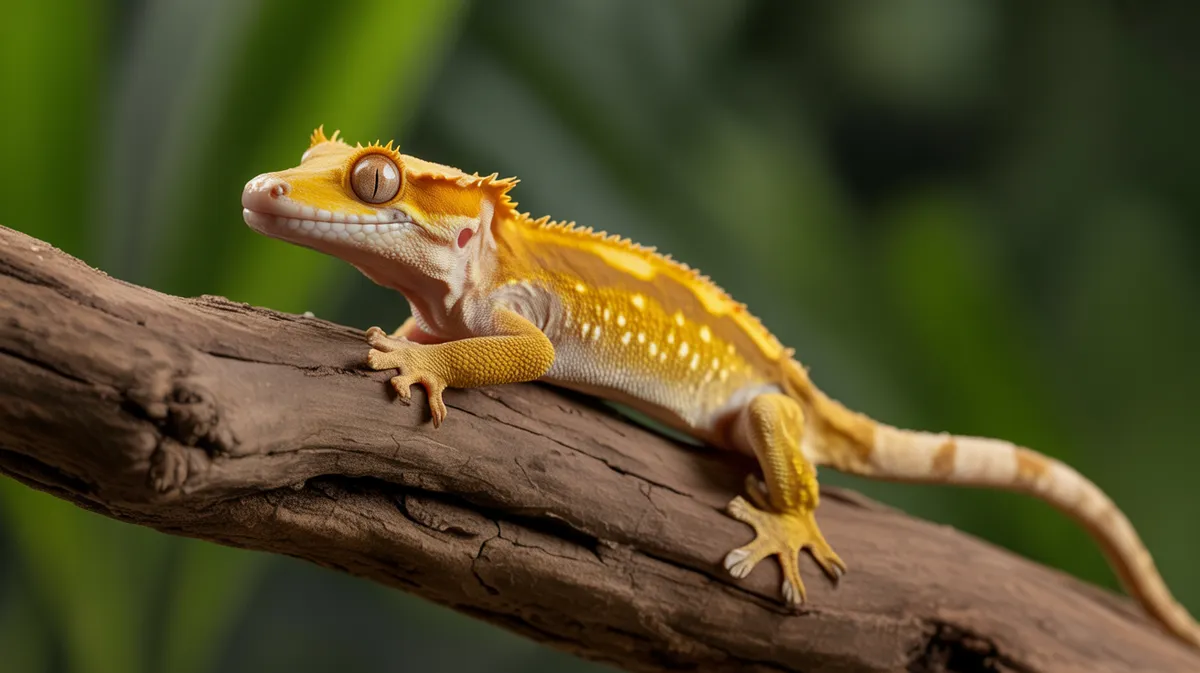
About the Crested Gecko
The crested gecko is a small, nocturnal lizard native to southern New Caledonia. Distinguished by its fringed crest running from each eye to the tail, this gecko displays a wide variety of colors and patterns. Once thought extinct, it was rediscovered in 1994 and has become a popular species in the reptile pet trade due to its docile nature and ease of care. Crested geckos are arboreal and possess specialized toe pads, enabling them to climb smooth surfaces with ease.
Fascinating facts
No Eyelids
Crested geckos lack eyelids and keep their eyes clean and moist by licking them with their tongues.
Arboreal Lifestyle
They are arboreal, spending most of their lives in trees, and have specialized toe pads that enable them to adhere to smooth vertical surfaces.
Colorful Varieties
Crested geckos display a remarkable variety of colors and patterns, including shades of red, orange, yellow, and gray, which are called 'morphs.'
Detailed description
The crested gecko (Correlophus ciliatus) is a medium-sized, arboreal lizard reaching an adult snout-to-vent length of 8–10 cm (3–4 in), with a total length including the tail of up to 20–25 cm (8–10 in). Its most distinctive feature is the series of soft, spiny projections, or 'crests,' that run from above the eyes—resembling eyelashes—down the sides of the head and along the back. The body is laterally compressed, aiding in maneuvering through dense foliage. The skin is soft and granular, displaying a remarkable array of color morphs and patterns, including shades of brown, red, orange, yellow, and cream, often with spots or stripes. Crested geckos possess large, lidless eyes with vertical pupils, enhancing night vision, and a prehensile tail that assists in climbing, though it can be shed (autotomy) as a defense mechanism and does not regenerate. Specialized toe pads covered in microscopic setae allow them to adhere to smooth vertical surfaces via van der Waals forces. Nocturnal by nature, they are most active at dusk and during the night, spending daylight hours hidden in foliage or bark crevices. Their omnivorous diet includes a variety of insects, nectar, and fruit. In the wild, they are solitary and territorial, with limited direct social interaction outside of breeding. Breeding occurs seasonally, with females laying clutches of two eggs in moist substrate. The species' rediscovery in 1994 led to its rapid rise in the pet trade, but wild populations remain vulnerable due to habitat loss and introduced predators.
Did you know?
Crested geckos were considered extinct until their rediscovery in 1994, making them a true 'Lazarus species.'
Research & sources
Wikipedia summary
The crested gecko, also known commonly as the eyelash gecko, is a species of lizard in the family Diplodactylidae. The species is native to southern New Caledonia. Originally described in 1866 by French zoologist Alphonse Guichenot, the species was thought to be extinct until it was rediscovered in 1994 during an expedition led by German herpetologist Robert Seipp. Along with several other New Caledonian gecko species, it is being considered for protected status by the Convention on the International Trade in Endangered Species of Wild Flora and Fauna.
Behaviour & social structure
Crested geckos are primarily nocturnal, emerging at dusk to forage and explore their arboreal habitat. They exhibit a sit-and-wait predatory strategy, remaining motionless before lunging at passing insects, but will also actively search for ripe fruit and nectar. Their feeding is facilitated by a long, protrusible tongue used for licking surfaces and gathering food. Social interactions are minimal outside of the breeding season; individuals are generally solitary and may display territorial behaviors such as tail waving, vocalizations (chirps, squeaks), and posturing when encountering conspecifics. During the day, they seek shelter in dense vegetation, bark crevices, or under leaves to avoid predators and desiccation. They are adept climbers, using their adhesive toe pads and prehensile tail for stability and navigation among branches. Stress behaviors include tail dropping, color darkening, and rapid escape movements.
Reproduction & life cycle
Crested geckos reach sexual maturity at approximately 12–18 months of age. The breeding season in the wild typically coincides with the warmer, wetter months (November to March in New Caledonia). Courtship involves males approaching females with head bobbing and tail waving; receptive females allow copulation, which can last several minutes. Females lay clutches of two soft-shelled eggs every 30–45 days during the breeding season, burying them in moist substrate. Incubation lasts 60–120 days, depending on temperature (optimal range: 22–26°C/72–79°F). There is no parental care after egg laying; hatchlings are independent from birth, measuring about 5–6 cm (2–2.5 in) in total length. Sex determination is temperature-independent (genetic). In captivity, breeding success is high, contributing to the species' prevalence in the pet trade.
Adaptations & survival
Crested geckos exhibit several adaptations for arboreal life, including expanded toe pads with lamellae covered in microscopic setae, enabling adhesion to smooth surfaces via van der Waals forces. Their prehensile tail acts as a fifth limb for balance and grasping branches, though it can be voluntarily shed to escape predators (autotomy). The lack of eyelids is compensated by a transparent spectacle (brille) over the eyes, which they clean with their tongue. Their cryptic coloration and patterning provide camouflage among leaves and bark. Nocturnal habits reduce predation risk and water loss. The ability to metabolize both animal and plant matter (omnivory) allows dietary flexibility in fluctuating environments.
Cultural significance
Crested geckos have limited traditional significance in New Caledonian indigenous cultures, but their striking appearance and docile temperament have made them highly popular in the global reptile pet trade since the late 1990s. They are often featured in educational programs and reptile exhibitions, symbolizing the importance of biodiversity and conservation. Their rediscovery is sometimes cited as an example of 'Lazarus species' in popular science media, highlighting the potential for overlooked species to persist in isolated habitats.
Recent research
Recent research on Correlophus ciliatus has focused on adhesive mechanisms of their toe pads, providing insights into biomimetic applications for synthetic adhesives. Genetic studies have clarified their phylogenetic relationships within the Diplodactylidae family, supporting the reclassification from Rhacodactylus to Correlophus. Ongoing ecological studies in New Caledonia are examining population densities, habitat preferences, and the impact of invasive species. Captive breeding programs have enabled investigation into color morph genetics and developmental biology. Conservation research is assessing the effectiveness of protected areas and the potential for reintroduction into restored habitats.
Sources
Videos
Habitat
Tropical and subtropical forests


Conservation
The Crested Gecko is currently classified as Vulnerable on the IUCN Red List.
Threats & challenges
The primary threats to wild crested gecko populations are habitat destruction due to logging, wildfires, and land conversion for agriculture in southern New Caledonia. Invasive species, particularly rodents, feral cats, and fire ants (Wasmannia auropunctata), pose significant predation risks to eggs, juveniles, and adults. Climate change may exacerbate habitat loss and alter the availability of food resources. Although the species is widely bred in captivity, wild populations are considered Vulnerable by the IUCN, with a restricted range and ongoing decline in habitat quality. Illegal collection for the pet trade is now rare due to successful captive breeding, but continued habitat protection and monitoring are essential for long-term survival.
Taxonomy
Scientific name
Correlophus ciliatus
- Kingdom
- Animalia
- Phylum
- Chordata
- Class
- Reptilia
- Order
- Squamata
- Family
- Diplodactylidae
- Genus
- Correlophus
- Species
- ciliatus
Community notes
Share your observations about the Crested Gecko.
No community notes yet. Be the first!
Discover more wildlife
More fascinating animals from the encyclopedia.