
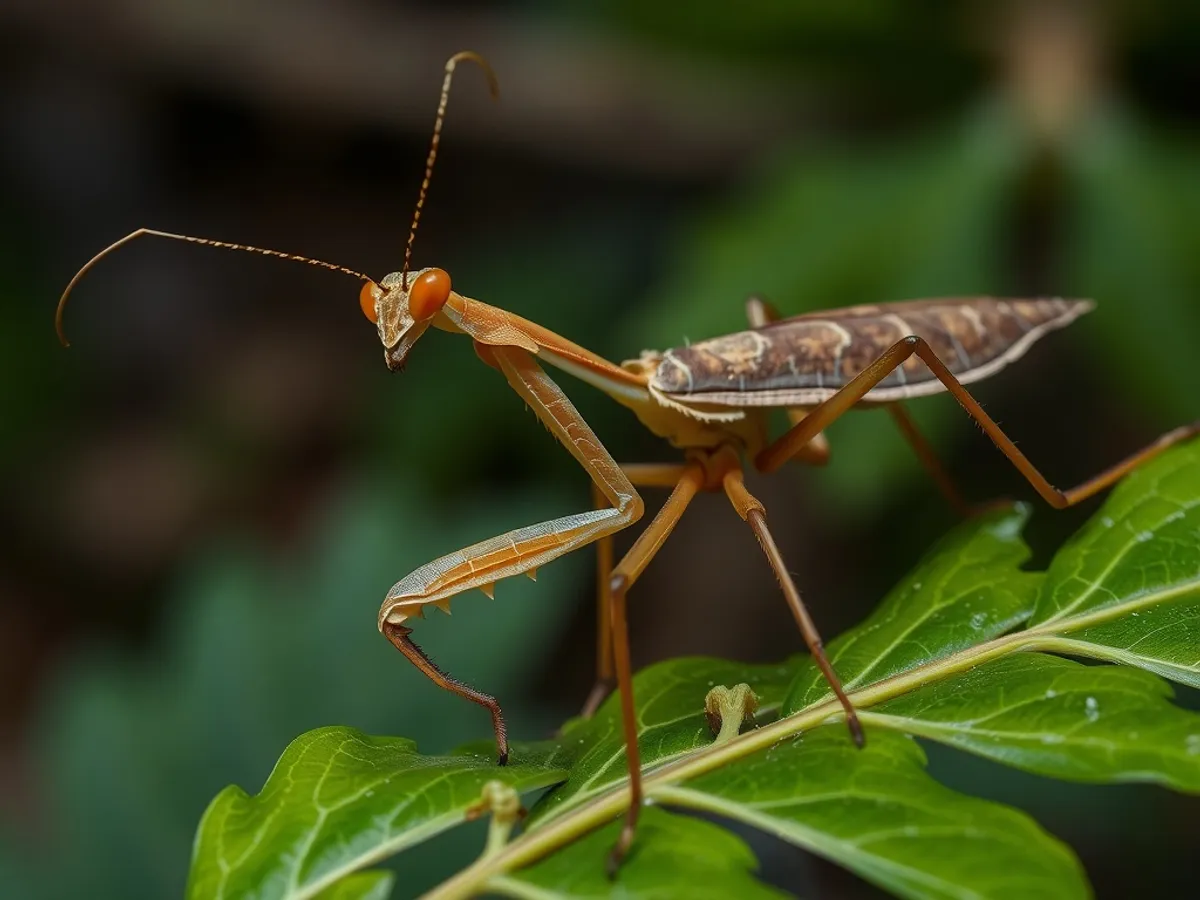
About the Dead Leaf Mantis
The dead leaf mantis, scientifically known as Deroplatys desiccata, is a remarkable species of praying mantis that is expertly camouflaged to resemble a dry, crumpled leaf. Native to Southeast Asia, this insect uses its leaf-like appearance to evade predators and ambush unsuspecting prey. Its body is broad and flat, with intricate brown coloration and vein-like markings that closely mimic a dead leaf, even curling its legs and rocking gently to enhance the illusion. Females are generally larger and broader than males, aiding in their mimicry and predatory success.
Fascinating facts
Leaf Mimicry Expert
The dead leaf mantis can contort its body and sway in the breeze to enhance its resemblance to a dead leaf, making it almost invisible to both predators and prey.
Ambush Predator
It patiently waits for insects such as flies, moths, or crickets to approach, then strikes with lightning-fast reflexes using its spiked forelegs.
Sexual Cannibalism
Females may eat the males after or even during mating, a behavior thought to provide nutritional benefits for egg development.
Detailed description
Deroplatys desiccata, commonly known as the dead leaf mantis, is a large and visually striking mantid species native to the humid tropical forests of Southeast Asia, including Malaysia, Indonesia, Sumatra, and Borneo. Adult females can reach lengths of 75–85 mm, while males are smaller, typically 65–70 mm, and more slender. The species exhibits extreme sexual dimorphism, with females possessing broader, leaf-shaped thoraxes and abdomens, which enhance their mimicry. Their coloration ranges from mottled brown to ochre, with intricate vein-like patterns and serrated edges on the pronotum and wings, closely resembling a desiccated leaf. The forelegs are raptorial, adapted for grasping prey, and the mantis can flatten its body and curl its legs to further its camouflage. Eyes are large and well-developed, providing acute vision for detecting prey and predators. The wings are functional in both sexes, but males are more adept fliers due to their lighter build. This species is primarily solitary and exhibits a sit-and-wait predatory strategy, relying on stealth and patience. When threatened, D. desiccata may display deimatic behavior, spreading its forelegs and wings to reveal dark eye spots, startling potential predators. Its life cycle includes egg, nymph, and adult stages, with nymphs undergoing several molts before reaching maturity.
Did you know?
Despite their intimidating appearance, dead leaf mantises are harmless to humans and are sometimes kept as unusual pets by insect enthusiasts.
Research & sources
Wikipedia summary
Dead leaf mantis is a common name given to various species of praying mantis that mimic dead leaves. It is most often used in reference to species within genus Deroplatys because of their popularity as exotic pets. Examples include D. desiccata, D. lobata, and D. philippinica. Other species to which the term may apply include Acanthops falcataria, A. falcata, and Phyllocrania paradoxa.
Behaviour & social structure
Dead leaf mantises are ambush predators, remaining motionless for extended periods while blending into leaf litter or low vegetation. They exhibit a characteristic rocking motion, mimicking the movement of dead leaves in the breeze, which serves both as camouflage and as a means to approach prey undetected. Their diet consists primarily of other insects, including flies, moths, crickets, and occasionally small vertebrates such as lizards or frogs. Hunting is typically crepuscular, with peak activity at dawn and dusk. Social interactions are minimal outside of mating, and individuals are highly territorial, with cannibalism observed, especially among nymphs or during courtship. When capturing prey, the mantis uses its spined forelegs to grasp and immobilize the victim before consuming it alive. Defensive behaviors include threat displays and, if necessary, rapid flight (especially in males).
Reproduction & life cycle
Mating in Deroplatys desiccata generally occurs during the wet season, when food is abundant. Courtship is cautious, as females are known to be aggressive and may cannibalize males before, during, or after copulation. Males approach females slowly, often pausing for long periods to avoid detection. After successful mating, the female deposits an ootheca (egg case) on twigs or leaves, which can contain 30–50 eggs. Incubation lasts 4–8 weeks, depending on temperature and humidity. Nymphs emerge simultaneously and are highly vulnerable to predation and cannibalism. There is no parental care post-oviposition. The species undergoes incomplete metamorphosis, with nymphs resembling miniature adults and molting 6–8 times before reaching maturity, a process that takes 4–6 months.
Adaptations & survival
The dead leaf mantis exhibits some of the most advanced cryptic adaptations among mantids. Its body morphology, coloration, and behavior are all specialized for leaf mimicry, providing both predatory advantage and protection from predators such as birds, reptiles, and small mammals. The serrated pronotum and wing margins, along with vein-like markings, enhance the illusion of a dead, curled leaf. Behavioral adaptations include the rocking motion and the ability to remain motionless for hours. The deimatic display, with sudden exposure of dark eye spots and expanded limbs, serves to startle and deter predators. Males have evolved lighter bodies and longer wings for dispersal and mate searching, while females prioritize camouflage and fecundity.
Cultural significance
While not deeply embedded in local folklore, the dead leaf mantis is admired for its remarkable camouflage and is a popular subject in entomological collections and educational programs. In the exotic pet trade, it is highly sought after for its unique appearance and relatively manageable care requirements. The species is sometimes featured in nature documentaries and art, symbolizing adaptation and the beauty of natural mimicry. There are no known traditional medicinal or ritual uses.
Recent research
Recent studies have focused on the biomechanics of leaf mimicry and the evolutionary pathways leading to such advanced crypsis. Research published in 2021 analyzed the genetic basis of morphological adaptations in Deroplatys species, revealing convergent evolution with unrelated leaf-mimicking insects. Behavioral ecology studies have examined the mantis's predatory efficiency and the effectiveness of its deimatic displays against various predators. Ongoing research includes the impact of environmental changes on developmental rates and reproductive success, as well as the potential for captive breeding to support conservation and reduce wild collection.
Videos
Habitat
Tropical forests and woodlands


Conservation
The Dead Leaf Mantis is currently classified as Least Concern on the IUCN Red List.
Threats & challenges
Currently, Deroplatys desiccata is classified as Least Concern, with stable populations across its range. However, habitat loss due to deforestation and land conversion for agriculture poses a potential threat to local populations. Collection for the exotic pet trade is monitored but not considered a major risk at present. Pesticide use and climate change may also impact prey availability and habitat suitability. Natural predators include birds, reptiles, and larger arthropods. Population trends are generally stable, but continued habitat monitoring is recommended.
Taxonomy
Scientific name
Deroplatys desiccata
- Kingdom
- Animalia
- Phylum
- Arthropoda
- Class
- Insecta
- Order
- Mantodea
- Family
- Deroplatyidae
- Genus
- Deroplatys
- Species
- desiccata
Community notes
Share your observations about the Dead Leaf Mantis.
No community notes yet. Be the first!
Discover more wildlife
More fascinating animals from the encyclopedia.