
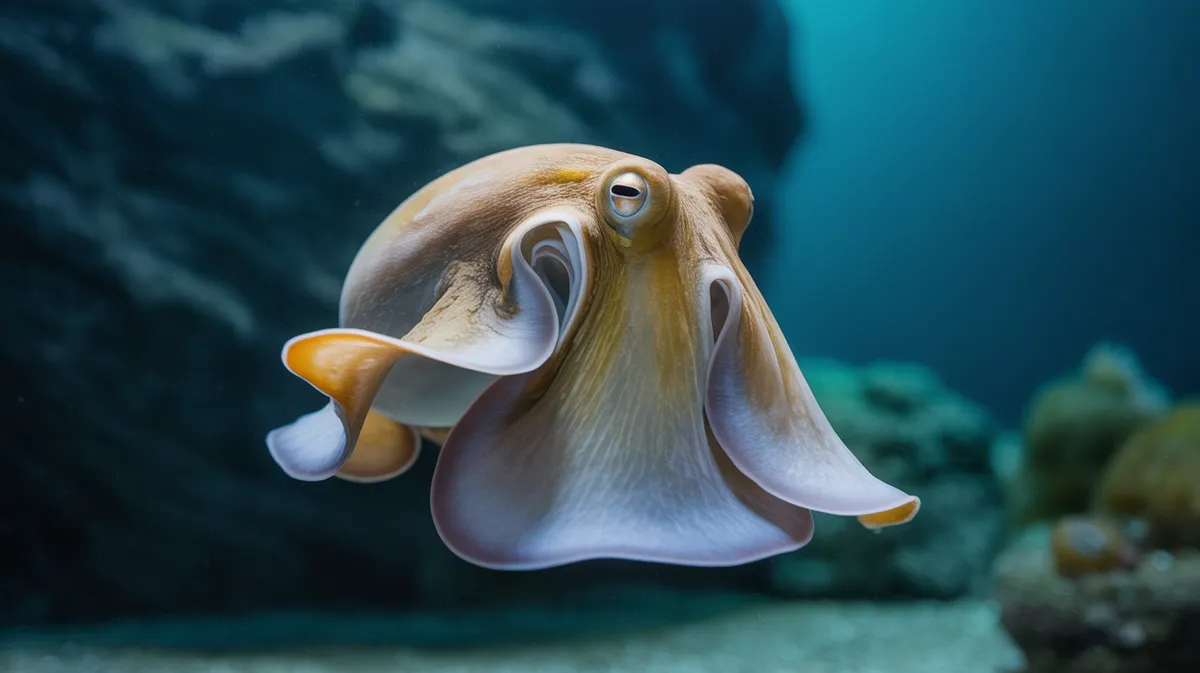
About the Dumbo Octopus
Grimpoteuthis is the deepest-living octopus known, recorded below 4,000 m and observed near 7,000 m — depths where no other octopus is found at all. It belongs to the cirrate octopuses, a lineage that abandoned almost everything we associate with the animals: it has no ink sac, because ink is useless in permanent darkness; it has a reduced radula and generally swallows small crustaceans and worms whole rather than drilling and biting them; and it retains an internal U-shaped cartilaginous shell remnant, which serves as the anchor for the two ear-like fins on the mantle that give it its nickname. Those fins, not jet propulsion, are its main means of travel — it flaps slowly, hovering above the sediment like a jellyfish, and it can also pulse the deep web that joins its arms to move in a soft medusoid contraction. Its arms carry paired cirri, fleshy filaments alongside the suckers thought to help waft food particles or sense prey. Because season means nothing at abyssal depths, reproduction is continuous: females carry eggs at every stage of development at once and cement them singly onto hard substrate such as a stone or a dead coral stalk, then abandon them. There is no brooding, no den, and no aggregation.
Fascinating facts
Extreme Depths
Dumbo octopuses are found deeper than most other octopus species, often below 3,000 meters, where sunlight never reaches.
Ear-like Fins
Their distinctive 'ears' are actually fins that allow them to steer and propel themselves through the water.
Unique Reproduction
Females can carry eggs at different stages of development, allowing them to reproduce whenever conditions are favorable.
Detailed description
The Dumbo octopus (Grimpoteuthis spp.) is a genus of deep-sea cirrate octopods distinguished by their semi-translucent, gelatinous bodies and a pair of prominent, ear-like fins that project from the mantle above each eye. These fins, used for slow, energy-efficient swimming, are supported by internal cartilaginous structures and are a key adaptation for life at extreme ocean depths, typically ranging from 400 to over 7,000 meters, with some records as deep as 7,900 meters. Adult Dumbo octopuses generally measure 20–30 cm in length, though some species can reach up to 1.8 meters. Their bodies lack the muscular rigidity of shallow-water octopuses, allowing them to withstand immense hydrostatic pressures. The arms are webbed, forming an umbrella-like structure that can be expanded for locomotion or to envelop prey. Skin coloration varies from pale white to reddish-brown, sometimes with iridescent hues, providing camouflage in the low-light environment. Unlike most octopuses, they lack an ink sac, as ink would be ineffective in the deep sea. Dumbo octopuses are solitary and exhibit low activity levels, conserving energy in the nutrient-scarce abyssal plains. Their large, well-developed eyes are adapted for maximizing light capture, though vision is likely limited. The internal shell, or fin support, provides structural integrity without adding significant weight.
Did you know?
Dumbo octopuses can swallow their prey whole, a rare feeding strategy among octopuses.
Research & sources
Wikipedia summary
Grimpoteuthis is a genus of pelagic cirrate (finned) octopods known as the dumbo octopus. The name "dumbo" originates from their resemblance to the title character of Disney's 1941 film Dumbo, having two prominent ear-like fins which extend from the mantle above each eye. There are 17 species recognized in the genus. The Dumbo octopus has a gelatinous body and uses fin propulsion for movement, which also helps it to conserve energy in its extreme deep-sea environment. These unique physical traits distinguish it from other octopuses, which primarily rely on jet propulsion. Prey include crustaceans, bivalves, worms and copepods. The average life span of various Grimpoteuthis species is 3 to 5 years.
Behaviour & social structure
Dumbo octopuses are primarily solitary, benthopelagic predators, spending much of their time hovering just above the seafloor or drifting with deep currents. They employ a combination of fin propulsion and gentle pulsing of their webbed arms to maneuver, rarely using jet propulsion except for rapid escape. Feeding is opportunistic; they detect prey such as polychaete worms, amphipods, copepods, isopods, and small bivalves using chemoreceptors on their arms. Prey is captured by enveloping it within the webbed arms and swallowing it whole, as Dumbo octopuses lack a radula (the rasping tongue found in other cephalopods). They are thought to be mostly inactive, conserving energy between infrequent feeding events. Social interactions are rare, with individuals only coming together for mating. There is no evidence of territoriality or complex social structures. Daily routines are poorly understood due to the difficulty of observing them in situ, but they are presumed to be largely governed by food availability and environmental conditions.
Reproduction & life cycle
Dumbo octopuses exhibit a unique reproductive strategy among cephalopods. Females are capable of carrying multiple eggs at different stages of development simultaneously, a condition known as continuous spawning. There is no defined breeding season; instead, females lay eggs year-round, likely as an adaptation to the unpredictable food supply of the deep sea. Eggs are relatively large (up to 18 mm in diameter) and encased in tough, protective shells, which are attached to hard substrates such as deep-sea corals or rocks. Fertilization is internal, with males transferring spermatophores to females via a modified arm (hectocotylus). There is no parental care; after laying, the eggs develop independently, with the hatchlings emerging as fully formed miniature adults, bypassing a planktonic larval stage. The estimated lifespan is 3–5 years, with sexual maturity reached in about 1–2 years, though precise data vary by species.
Adaptations & survival
Grimpoteuthis species are highly specialized for survival in the deep sea. Their soft, gelatinous bodies withstand extreme pressure and allow for neutral buoyancy. The large, ear-like fins provide efficient, low-energy locomotion, critical in the food-scarce abyss. The webbing between arms enables them to envelop prey and may assist in gliding. The absence of an ink sac reflects the futility of visual defenses in the perpetual darkness of their habitat. Bioluminescence is not present in Dumbo octopuses, unlike some other deep-sea cephalopods, but their subtle coloration and translucency aid in camouflage. Their metabolic rates are low, and they can survive long periods between meals. Sensory adaptations include large eyes for maximizing available light, and chemoreceptors for detecting prey in the dark.
Cultural significance
Dumbo octopuses have captured public imagination due to their distinctive appearance and the whimsical resemblance to the Disney character Dumbo. They are often featured in documentaries and educational materials as emblematic of the mysterious deep sea. There is no evidence of traditional human use, mythology, or symbolism associated with these animals, as their habitat precludes direct interaction with human cultures. However, their discovery and subsequent media coverage have contributed to increased interest in deep-sea biodiversity and conservation.
Recent research
Recent advances in deep-sea exploration, such as remotely operated vehicles (ROVs) and submersibles, have greatly expanded knowledge of Grimpoteuthis spp. Notable discoveries include the identification of new species, such as Grimpoteuthis imperator (2020), and detailed observations of locomotion and feeding behaviors. Molecular phylogenetics has clarified relationships within the Grimpoteuthidae family, revealing cryptic diversity. Ongoing research focuses on their reproductive biology, physiological adaptations to high pressure, and ecological roles in deep-sea food webs. The lack of a larval stage and continuous spawning are of particular interest to evolutionary biologists. Despite these advances, many aspects of their biology remain poorly understood due to the logistical challenges of deep-sea research.
Videos
Habitat
Deep ocean

Conservation
The Dumbo Octopus is currently classified as Least Concern on the IUCN Red List.
Threats & challenges
Currently, Dumbo octopuses face few direct anthropogenic threats due to their remote, deep-sea habitats. However, potential risks include deep-sea mining, bottom trawling, and climate change, which may alter deep ocean currents and food availability. The impact of microplastics and chemical pollutants at such depths is not well understood but is an emerging concern. Population trends are unknown due to the difficulty of surveying these animals, but they are presumed stable, and the IUCN currently lists them as Least Concern. Their specialized habitat makes them vulnerable to any significant environmental changes or habitat destruction.
Taxonomy
Scientific name
Grimpoteuthis spp.
- Kingdom
- Animalia
- Phylum
- Mollusca
- Class
- Cephalopoda
- Order
- Octopoda
- Family
- Opisthoteuthidae
- Genus
- Grimpoteuthis
- Species
- spp.
Community notes
Share your observations about the Dumbo Octopus.
No community notes yet. Be the first!
Discover more wildlife
More fascinating animals from the encyclopedia.