
About the Eastern Box Turtle
Terrapene carolina carries a door. Its plastron, the underside of the shell, has a hinge across the middle that lets the front and rear halves fold up against the carapace and seal the animal in completely, leaving no gap for a raccoon's teeth — a solution no other North American turtle has. It is a land turtle, not a pond turtle, despite being a member of the pond turtle family, and it lives in moist deciduous woodland eating mushrooms, berries, worms, slugs and carrion. It can consume fungi lethal to humans without harm, and there are long-standing accounts of people being poisoned by eating box turtles that had themselves eaten toxic mushrooms. The single most important fact about the species is behavioural rather than anatomical: an individual box turtle spends its entire life inside a home range of only a few hectares, knows it in detail, and if it is picked up and moved it will attempt to walk back, wandering for months or years and usually dying on a road or of starvation. Well-meaning people who "rescue" a turtle by relocating it are effectively killing it. Combined with decades of collection for the pet trade and with a lifespan that can exceed a century, this makes the box turtle a species that loses adults far faster than it can replace them.
Fascinating facts
Hinged Shell
The Eastern Box Turtle's plastron is hinged, allowing it to shut itself completely inside its shell for protection from predators.
Mushroom Eater
They are one of the few animals capable of eating poisonous mushrooms and can even accumulate toxins in their bodies, making them potentially dangerous to eat.
Strong Homing Instinct
If moved from their territory, Eastern Box Turtles will often spend years trying to return to their original home range.
Detailed description
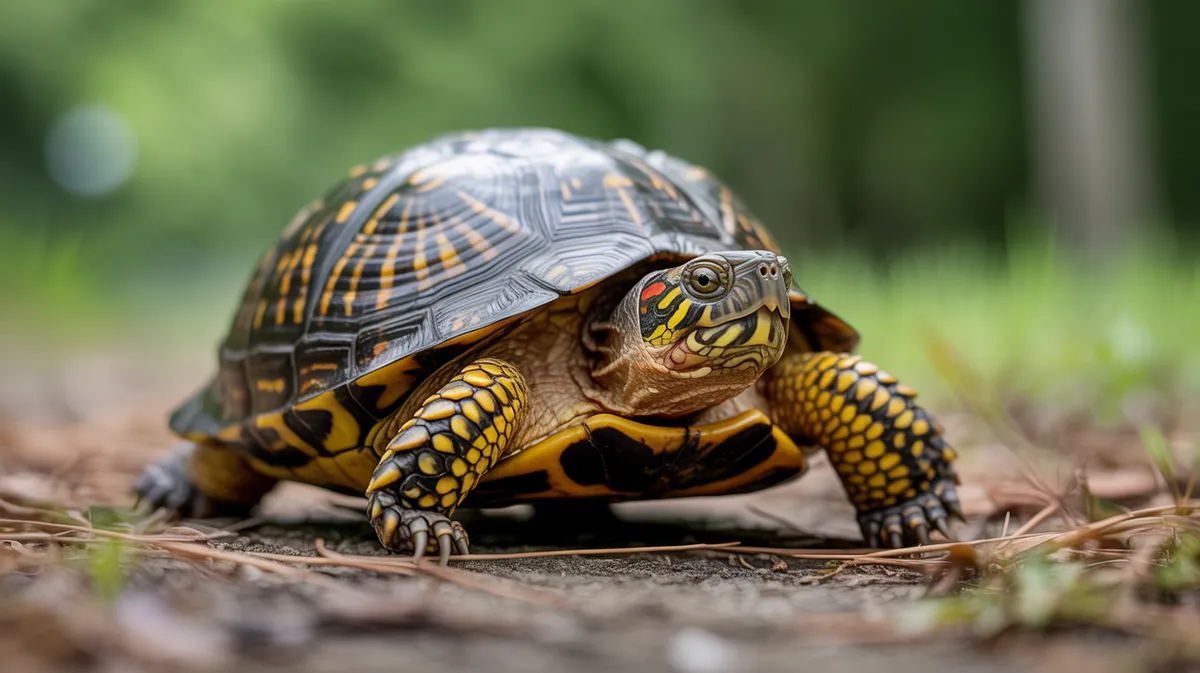
The Eastern Box Turtle (Terrapene carolina carolina) is a small to medium-sized terrestrial turtle, typically measuring 11–16 cm (4.3–6.3 in) in carapace length, with some individuals reaching up to 20 cm (7.9 in). Its highly domed, hinged shell (plastron) is a defining anatomical feature, allowing the turtle to close itself completely for protection against predators and desiccation. The carapace exhibits a striking mosaic of yellow, orange, or occasionally red markings on a dark brown or black background, with patterns unique to each individual. The skin is similarly marked, and males often display brighter coloration and red eyes, while females tend to have brown or yellow eyes. The limbs are sturdy and clawed, adapted for digging and traversing leaf litter. Eastern Box Turtles are primarily diurnal, spending much of their time foraging or basking in filtered sunlight. They are long-lived, with wild individuals commonly reaching 30–40 years, and some documented to exceed 60 years. Their sense of smell is highly developed, aiding in locating food and mates. Despite their terrestrial lifestyle, they require moist microhabitats and will soak in shallow water to maintain hydration and aid in shedding. During periods of extreme heat or drought, they may burrow into leaf litter or soil to avoid desiccation.
Did you know?
Eastern Box Turtles can survive with severe injuries, including broken shells, thanks to their slow metabolism and remarkable healing abilities.
Research & sources
Wikipedia summary
The eastern box turtle is a subspecies within a group of hinge-shelled turtles normally called box turtles. T. c. carolina is native to the Eastern United States.
Behaviour & social structure
Eastern Box Turtles are solitary and exhibit strong site fidelity, often remaining within a home range of 2–10 hectares throughout their lives. They are omnivorous opportunists, feeding on a wide variety of foods including earthworms, beetles, caterpillars, slugs, fungi, berries, fallen fruit, and occasionally carrion. Feeding activity peaks during the morning and after rainfall, when prey is more active and humidity is higher. They use a combination of olfactory and visual cues to locate food. Box turtles are known to exhibit seasonal activity patterns, with increased movement in spring and fall and reduced activity during hot summer months. In northern parts of their range, they enter brumation (a form of hibernation) from late autumn to early spring, burrowing into loose soil or under leaf litter. Social interactions are generally limited to mating encounters and occasional competition for food or basking sites. They communicate through body language and, during courtship, males may circle, bite, or nudge females.
Reproduction & life cycle
Eastern Box Turtles reach sexual maturity between 7 and 10 years of age. Mating typically occurs from April to October, with a peak in spring and early summer. Courtship involves the male pursuing the female, often with persistent nudging and biting. Females can store viable sperm for up to four years, allowing them to lay fertilized eggs from a single mating event. Nesting occurs in late spring to early summer, with females excavating shallow nests in sandy or loamy soil, often in open or edge habitats. Clutch size ranges from 2 to 8 eggs, with an average of 4–5. Incubation lasts 70–90 days, and the temperature of the nest determines the sex of the hatchlings (temperature-dependent sex determination). There is no parental care after egg-laying; hatchlings are independent upon emergence, usually in late summer or early fall. Juvenile survival is low due to predation and environmental hazards.
Adaptations & survival
The Eastern Box Turtle's hinged plastron is a key evolutionary adaptation, providing nearly complete protection from predators such as raccoons, skunks, and opossums. Their cryptic coloration and ability to remain motionless enhance camouflage in leaf litter. They possess a highly efficient renal system, allowing them to conserve water during dry periods. Behavioral adaptations include burrowing and estivating during extreme heat or drought, and brumating in colder climates. Their omnivorous diet allows flexibility in resource-poor environments. The ability to store sperm increases reproductive success in habitats where mates are scarce. Additionally, box turtles can tolerate ingestion of certain toxic mushrooms and plants that are harmful to other animals.
Cultural significance
Eastern Box Turtles have featured in Native American folklore and symbolism, often representing longevity, patience, and resilience. Some tribes considered them sacred or used their shells in ceremonial rattles. In early American natural history, they were among the first North American reptiles described by European scientists. Today, they are valued as educational ambassadors for conservation and are protected by law in many states. However, their popularity in the pet trade has contributed to population declines, highlighting the need for public education and responsible stewardship.
Recent research
Recent research has focused on the genetic diversity and population structure of Eastern Box Turtles, revealing significant genetic differentiation among regional populations, which has implications for conservation management. Studies using radio telemetry have provided insights into home range size, movement patterns, and habitat preferences, informing habitat restoration efforts. Research on disease ecology, particularly the impact of ranavirus and upper respiratory tract disease, is ongoing due to increasing reports of morbidity and mortality in wild populations. Conservation genetics and head-starting programs are being evaluated as tools to bolster declining populations. Climate change studies are examining the effects of shifting temperature regimes on sex ratios and hatchling survival.
Videos
Habitat
Deciduous and mixed forests, meadows, and moist grasslands
 Various Continental Regions
Grassland
Open areas dominated by grasses rather than trees, supporting numerous herbivores and their predators.
 Global
Forest
Wooded areas with significant tree cover and diverse plant and animal communities.
 Global
Freshwater
Lakes, rivers, and wetlands with diverse aquatic ecosystems.
Conservation
The Eastern Box Turtle is currently classified as Vulnerable on the IUCN Red List.
Threats & challenges
Major threats to Eastern Box Turtles include habitat loss and fragmentation due to urbanization, agriculture, and road construction. Road mortality is a significant cause of adult deaths, especially during the breeding season when turtles move across landscapes. Illegal collection for the pet trade and incidental capture in agricultural machinery further reduce populations. Predation on eggs and juveniles by mammals, birds, and reptiles is high. Climate change poses emerging risks by altering habitat suitability and disrupting sex ratios through temperature-dependent sex determination. Populations are declining throughout much of their range, and the species is listed as Vulnerable by the IUCN and included in CITES Appendix II, reflecting ongoing conservation concerns.
Taxonomy
Scientific name
Terrapene carolina carolina
- Kingdom
- Animalia
- Phylum
- Chordata
- Class
- Reptilia
- Order
- Testudines
- Family
- Emydidae
- Genus
- Terrapene
- Species
- carolina
Where to see an eastern box turtle
7 zoos and aquariums in 1 country are recorded as keeping this species.
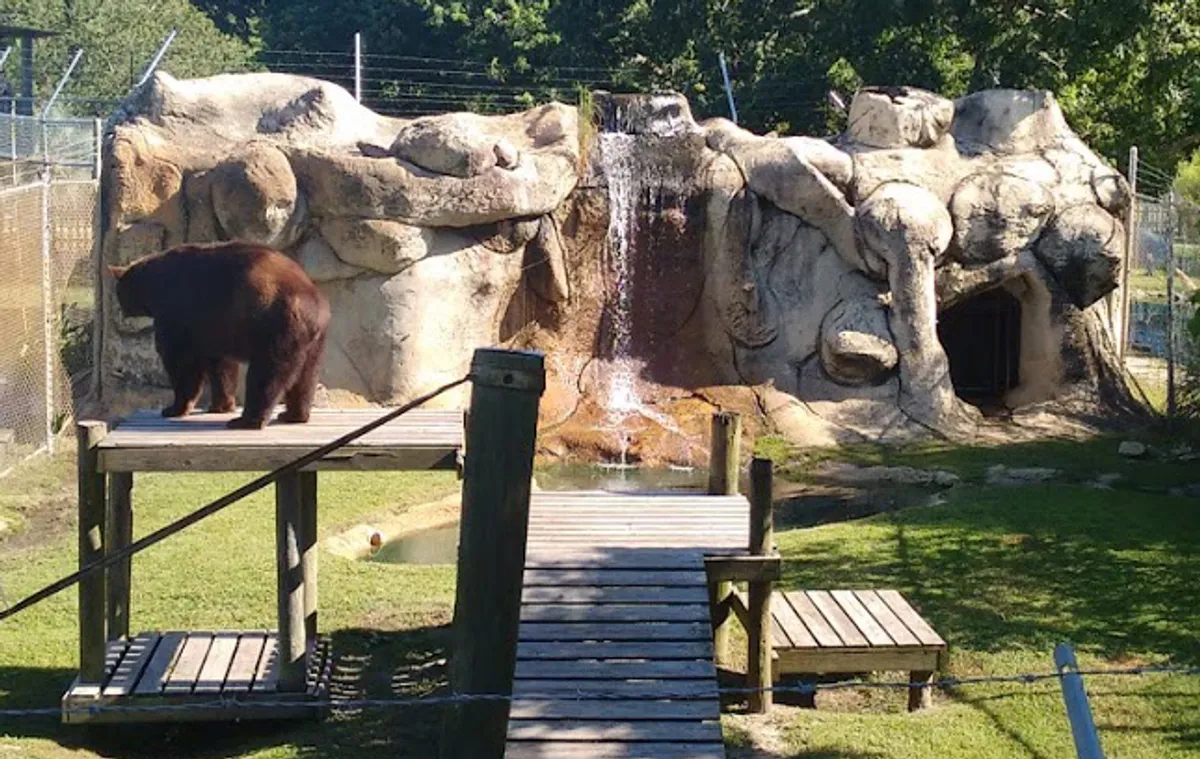 Alabama Gulf Coast Zoo🇺🇸 Gulf Shores, United States
- 🦁The Maryland Zoo in Baltimore🇺🇸 Baltimore, United States
 Oakland Zoo🇺🇸 United States
 Birmingham Zoo🇺🇸 United States
- 🦁Cheyenne Mountain Zoo🇺🇸 United States
Community notes
Share your observations about the Eastern Box Turtle.
No community notes yet. Be the first!
Discover more wildlife
More fascinating animals from the encyclopedia.