
About the Eastern Diamondback Rattlesnake
Crotalus adamanteus is the largest rattlesnake that has ever existed and the heaviest venomous snake in the Americas, with reliable records over 2.4 m and weights approaching 10 kg. Its life is tied to the longleaf pine savannas of the southeastern United States and, specifically, to the gopher tortoise: it shelters in tortoise burrows through cold snaps and heat, and the collapse of both longleaf pine and the tortoise has taken the rattlesnake down with them. The venom is a large-volume haemorrhagic cocktail that destroys tissue and blood vessels, and because the snake is big it can inject a very large dose, which is why its bite has one of the higher fatality rates of any North American snake if untreated. The rattle is worth understanding properly: it is made of interlocking keratin segments, and a new one is added every time the snake sheds — which may be two or three times a year and varies with how much it eats — so counting segments does not give the snake's age, and the end segments break off anyway. A diamondback strikes at roughly a third to half its body length and does not need to coil first. Rattlesnake roundups, in which snakes are gassed out of tortoise burrows for public killing events, have driven local extinctions and damaged the burrows of dozens of other species in the process.
Fascinating facts
Largest Rattlesnake
The Eastern Diamondback Rattlesnake holds the title of the largest rattlesnake species in the world by weight and length.
Powerful Venom
Its venom is highly potent and primarily hemotoxic, capable of causing significant tissue damage if untreated.
Habitat Specialist
This rattlesnake is closely associated with longleaf pine ecosystems, which have drastically declined, contributing to its vulnerable status.
Detailed description
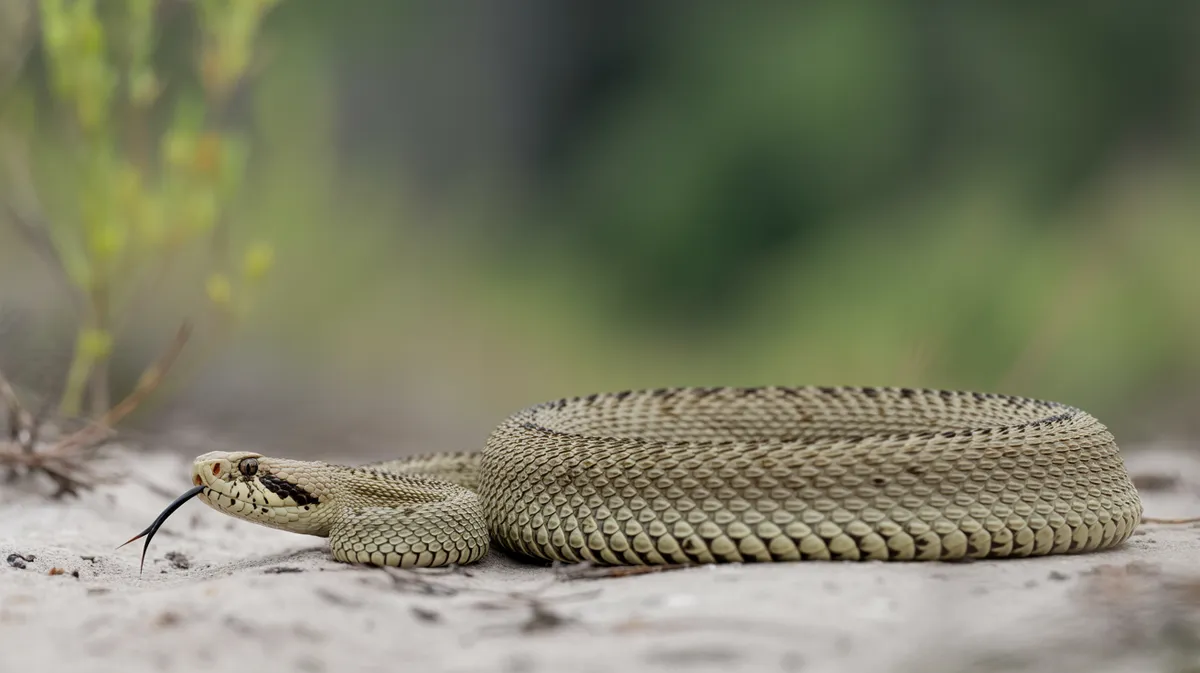
The Eastern Diamondback Rattlesnake (Crotalus adamanteus) is the largest rattlesnake species, with adults typically ranging from 90 to 185 cm (3 to 6 feet) in length, though rare individuals may exceed 2.4 meters (8 feet) and weigh up to 6.7 kg (15 lbs), making it one of the heaviest venomous snakes in the Americas. Its robust body is marked by a series of dark brown to black diamond-shaped dorsal blotches, each outlined with cream or yellow, set against a background of olive, brown, or grayish scales. The head is broad and triangular, with prominent heat-sensing loreal pits located between the eye and nostril, enabling precise detection of warm-blooded prey. The tail ends in a keratinous rattle, which is vibrated rapidly to produce a warning sound when threatened. The ventral surface is pale, usually cream or yellowish. The species is primarily terrestrial and rarely climbs, preferring to move through dense ground cover. Its eyes have vertically elliptical pupils, an adaptation for nocturnal and crepuscular activity. The Eastern Diamondback is solitary, except during the breeding season or when hibernating communally in burrows. Lifespan in the wild is estimated at 10–20 years, though predation and habitat loss can reduce longevity.
Did you know?
An adult Eastern Diamondback Rattlesnake can grow up to 2.4 meters (about 8 feet) long, making it the heaviest venomous snake in the Americas.
Research & sources
Wikipedia summary
The eastern diamondback rattlesnake is a species of pit viper in the family Viperidae. The species is endemic to the Southeastern United States. It is the largest rattlesnake species and one of the heaviest venomous snakes in the Americas. No subspecies are recognized.
Behaviour & social structure
Eastern Diamondbacks are ambush predators, relying on camouflage and patience to capture prey. They typically remain motionless, coiled near animal trails or burrow entrances, striking rapidly when a suitable mammal or bird comes within range. Their diet consists mainly of rabbits, rats, squirrels, and occasionally ground-dwelling birds. After envenomation, they often release prey and track it by scent. Activity patterns are influenced by temperature; they are primarily diurnal in cooler months and shift to nocturnal or crepuscular activity during the heat of summer. These snakes are generally sedentary, with home ranges averaging 8–49 hectares, and exhibit strong site fidelity. Social interactions are minimal outside of mating, though males may engage in ritualized combat during the breeding season. Defensive behaviors include coiling, rattling, and, if provoked, striking. Despite their potent venom and intimidating display, they are reclusive and rarely aggressive unless threatened or cornered.
Reproduction & life cycle
Eastern Diamondback Rattlesnakes are ovoviviparous, meaning females give birth to live young rather than laying eggs. Mating typically occurs from late summer to early fall (August–October), though some populations may breed in spring. Males may travel considerable distances in search of receptive females and may engage in combat with rivals, intertwining and pushing each other to establish dominance. After mating, females undergo a gestation period of approximately 5–7 months, often overwintering gravid and giving birth in late summer (July–September) the following year. Litters typically consist of 7–21 neonates, each measuring 30–38 cm (12–15 inches) at birth. Neonates are independent from birth and receive no parental care. Sexual maturity is reached at 3–4 years for males and 4–5 years for females.
Adaptations & survival
The Eastern Diamondback possesses several adaptations for survival in its environment. Its cryptic coloration and diamond pattern provide effective camouflage among leaf litter and sandy soils. The heat-sensing pits allow precise detection of endothermic prey, even in complete darkness. The rattle serves as an aposematic warning, deterring potential predators and reducing unnecessary conflict. Its venom is a complex mixture of hemotoxins, proteases, and enzymes, causing rapid immobilization and pre-digestion of prey. The snake's robust musculature enables powerful strikes and efficient burrowing into loose soil or occupying abandoned mammal burrows for shelter and thermoregulation. Seasonal shifts in activity patterns help avoid temperature extremes and predation.
Cultural significance
The Eastern Diamondback has long been a symbol of wilderness and resilience in the southeastern United States. Its image is featured in early American iconography, most notably the Gadsden flag ('Don't Tread on Me'), where it represents vigilance and a warning against oppression. In folklore, it is often portrayed as dangerous, though actual risk to humans is low with proper caution. Rattlesnake roundups, once common in the region, have contributed to negative perceptions and population declines, though some festivals have shifted toward conservation education. There is no significant traditional medicinal or culinary use, but its rattle and skin have sometimes been used in crafts and as curios.
Recent research
Recent research has focused on the genetic diversity and population structure of C. adamanteus, revealing significant fragmentation and isolation among remaining populations. Studies on movement ecology using radio telemetry have highlighted the importance of large, unfragmented habitats for sustaining viable populations. Venom composition has been analyzed for potential medical applications, including the development of novel anticoagulants and treatments for hypertension. Conservation research is ongoing, with efforts to model habitat suitability under climate change scenarios and to assess the effectiveness of prescribed fire and habitat restoration. Citizen science initiatives and telemetry studies continue to provide valuable data on distribution, demography, and threats.
Videos
Habitat
Dry pine forests, coastal scrub, and sandy woodlands
 Arid Regions
Desert
Arid lands with minimal rainfall, extreme temperatures, and specialized wildlife adapted to harsh conditions.
 Various Continental Regions
Grassland
Open areas dominated by grasses rather than trees, supporting numerous herbivores and their predators.
 Global
Forest
Wooded areas with significant tree cover and diverse plant and animal communities.
Conservation
The Eastern Diamondback Rattlesnake is currently classified as Vulnerable on the IUCN Red List.
Threats & challenges
Major threats to the Eastern Diamondback include habitat loss and fragmentation due to agriculture, urbanization, and forestry practices that eliminate longleaf pine ecosystems and associated ground cover. Road mortality is significant, especially in fragmented habitats. Persecution by humans, both intentional (due to fear or rattlesnake roundups) and incidental, has led to population declines. Fire suppression alters habitat structure, reducing suitable cover and prey availability. The species is listed as Vulnerable by the IUCN and as G3 (Vulnerable) by NatureServe, with populations declining across much of its historic range. Conservation challenges include maintaining large, contiguous tracts of suitable habitat, restoring fire regimes, and reducing direct human-caused mortality.
Taxonomy
Scientific name
Crotalus adamanteus
- Kingdom
- Animalia
- Phylum
- Chordata
- Class
- Reptilia
- Order
- Squamata
- Family
- Viperidae
- Genus
- Crotalus
- Species
- adamanteus
Where to see an eastern diamondback rattlesnake
6 zoos and aquariums in 1 country are recorded as keeping this species.
 Santa Barbara Zoological Gardens🇺🇸 Santa Barbara, United States
 North Carolina Zoo🇺🇸 Asheboro, United States
 Memphis Zoo🇺🇸 Memphis, United States
 Riverbanks Zoo🇺🇸 Columbia, United States
 Birmingham Zoo🇺🇸 United States
Community notes
Share your observations about the Eastern Diamondback Rattlesnake.
No community notes yet. Be the first!
Discover more wildlife
More fascinating animals from the encyclopedia.