
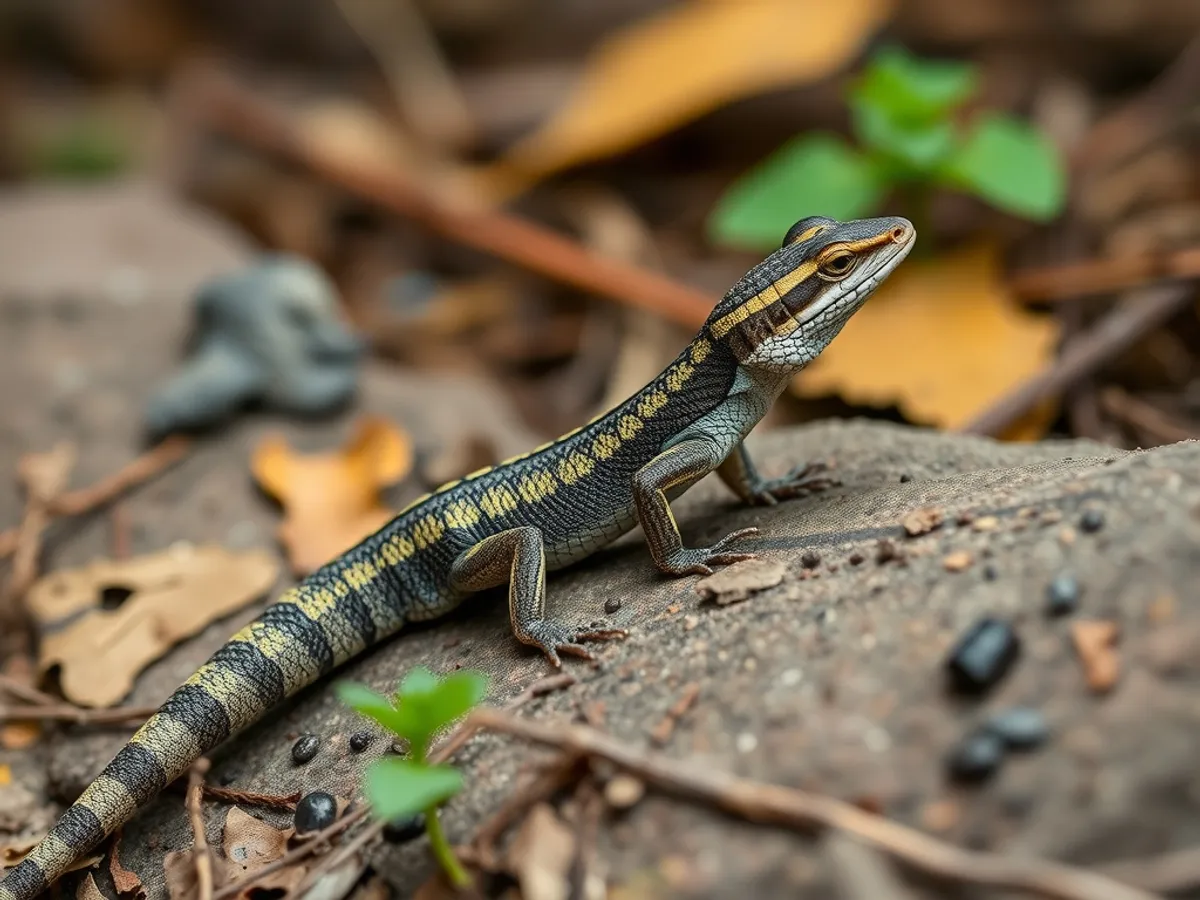
About the Eastern Fence Lizard
The Eastern Fence Lizard is a medium-sized spiny lizard native to the eastern and central United States. Characterized by rough, keeled scales and a gray to brown coloration, it often displays striking blue patches on the sides of its belly, especially in males. These lizards are diurnal and are frequently seen basking on logs, rocks, and fences, using their agility to escape predators. Their cryptic coloration helps them blend into their woodland and edge habitats, while their keen eyesight aids in hunting insects.
Fascinating facts
Blue Belly
Male Eastern Fence Lizards display vivid blue patches on their throats and bellies during the breeding season to attract females and deter rivals.
Arboreal Agility
These lizards are skilled climbers and can quickly ascend trees, logs, or fences to escape predators or search for food.
Fire Ant Defense
Eastern Fence Lizards have developed behavioral and physiological adaptations that reduce the impact of venomous fire ant stings.
Detailed description
The Eastern Fence Lizard (Sceloporus undulatus) is a robust, medium-sized lizard, typically measuring 10–19 cm (4–7.5 inches) in total length, with adult males averaging slightly smaller than females but displaying more vivid coloration. Its body is covered in rough, overlapping, keeled scales that provide a spiny texture, aiding in predator deterrence. Dorsal coloration ranges from gray to brown, often with wavy, crosswise bands or chevrons, which provide camouflage against tree bark and leaf litter. Males exhibit bright blue patches bordered by black on the sides of the belly and throat, especially prominent during the breeding season, while females and juveniles are more subdued in color. The head is triangular with a blunt snout and strong jaws, and the tail is long and tapering, accounting for nearly half of the total length. Eastern Fence Lizards are diurnal, relying on keen vision to detect movement and potential prey. They are agile climbers and can rapidly ascend vertical surfaces such as tree trunks or fence posts. When threatened, they employ a freeze-and-flee strategy, remaining motionless to blend in, then darting away with sudden bursts of speed. Their toes are equipped with sharp claws and adhesive pads, enhancing their climbing ability. This species is ectothermic, frequently basking in sunlight to regulate body temperature and retreating to shaded or sheltered areas to avoid overheating.
Did you know?
Eastern Fence Lizards have evolved resistance to the venom of invasive fire ants, allowing them to survive in areas where the ants have become established.
Research & sources
Wikipedia summary
The eastern fence lizard is a medium-sized species of lizard in the family Phrynosomatidae. The species is found along forest edges, rock piles, and rotting logs or stumps in the eastern United States. It is sometimes referred to as the prairie lizard, fence swift, gray lizard, gravid lizard, northern fence lizard or pine lizard. It is also referred to colloquially as the horn-billed lizard. One of its most notable behaviors is that of its escape behavior when encountering fire ants, which have been known to invade and negatively affect many of their populations.
Behaviour & social structure
Eastern Fence Lizards are primarily solitary, maintaining small home ranges and exhibiting territorial behavior, particularly among males during the breeding season. They are most active during warm daylight hours, spending mornings basking to elevate body temperature before foraging for prey. Their diet consists mainly of ants, beetles, spiders, grasshoppers, and other small arthropods, which they capture using rapid lunges and precise tongue strikes. Notably, they have developed a unique escape behavior in response to invasive red imported fire ants (Solenopsis invicta): when bitten, the lizard vigorously twitches and rubs its body against the ground to dislodge the ants, a behavior that has evolved in populations exposed to this threat. Social interactions are generally limited to mating displays and territorial disputes, with males performing head-bobs, push-ups, and displaying their blue ventral patches to assert dominance or attract females. They are vigilant and quick to retreat from predators, utilizing both speed and camouflage.
Reproduction & life cycle
Breeding occurs in spring, typically from April to June, with males establishing territories and courting females through visual displays. Copulation is brief, and females lay one to three clutches per season, each containing 3–16 leathery eggs, depending on the female's size and environmental conditions. Eggs are deposited in shallow nests dug in loose, sandy or loamy soil, often in sunny, well-drained locations to facilitate incubation. Incubation lasts approximately 55–75 days, with hatchlings emerging in late summer (July to September). There is no parental care post-oviposition; juveniles are independent from birth and must fend for themselves. Sexual maturity is reached within one to two years, depending on local climate and resource availability.
Adaptations & survival
Sceloporus undulatus exhibits several adaptations for survival in variable environments. Its cryptic coloration and patterning provide effective camouflage against predators such as birds, snakes, and mammals. The rough, keeled scales not only deter predation but also reduce water loss, an advantage in sun-exposed habitats. Behavioral thermoregulation—basking and seeking shade—enables precise control of body temperature, critical for digestion and activity. The species’ rapid escape response and ability to climb vertical surfaces enhance predator evasion. In regions invaded by fire ants, populations have evolved heightened twitching and grooming behaviors to remove attacking ants, an example of rapid behavioral adaptation to a novel threat. Additionally, the blue ventral patches in males serve as visual signals in intraspecific communication, aiding in mate attraction and territorial disputes.
Cultural significance
The Eastern Fence Lizard holds modest cultural significance, often featured in regional folklore and natural history education as a representative of native reptile fauna in the eastern United States. Its presence in gardens and on fences has led to various colloquial names, such as 'fence swift' and 'pine lizard.' It is sometimes used in classroom settings to teach about reptile biology, adaptation, and predator-prey dynamics. There are no known traditional medicinal or symbolic uses, but its role in controlling insect populations is appreciated by gardeners and farmers.
Recent research
Recent research has focused on the evolutionary response of Eastern Fence Lizards to invasive fire ants, documenting rapid behavioral and physiological adaptations, including increased limb length in some populations to facilitate faster escape. Studies have also examined the role of sexual selection in the development of blue ventral coloration and its impact on reproductive success. Genetic analyses have revealed significant geographic variation and the existence of multiple subspecies, prompting ongoing taxonomic revisions. Ecological research continues to monitor the effects of habitat fragmentation and climate change on distribution and reproductive timing. The species is also used as a model organism in studies of thermoregulation, stress physiology, and the impacts of environmental contaminants.
Videos
Habitat
Forests, woodlands, and field edges
 Various Continental Regions
Grassland
Open areas dominated by grasses rather than trees, supporting numerous herbivores and their predators.
 Elevated Terrain
Mountain
High-altitude environments with varying climates and specialized wildlife adapted to rugged terrain and thin air.
 Global
Forest
Wooded areas with significant tree cover and diverse plant and animal communities.
Conservation
The Eastern Fence Lizard is currently classified as Least Concern on the IUCN Red List.
Threats & challenges
While the Eastern Fence Lizard is currently classified as Least Concern by the IUCN, it faces several localized threats. Habitat loss due to urbanization, agriculture, and deforestation can fragment populations and reduce suitable basking and nesting sites. The introduction of invasive fire ants has led to increased mortality, particularly among juveniles, as the ants prey on eggs and hatchlings and can overwhelm adults. Pesticide use may reduce prey availability and pose direct toxic risks. Climate change could alter the availability of suitable microhabitats and shift the timing of reproductive cycles. Despite these challenges, the species remains widespread and adaptable, with stable populations across much of its range.
Taxonomy
Scientific name
Sceloporus undulatus
- Kingdom
- Animalia
- Phylum
- Chordata
- Class
- Reptilia
- Order
- Squamata
- Family
- Phrynosomatidae
- Genus
- Sceloporus
- Species
- undulatus
Community notes
Share your observations about the Eastern Fence Lizard.
No community notes yet. Be the first!
Discover more wildlife
More fascinating animals from the encyclopedia.