
About the Eastern Indigo Snake
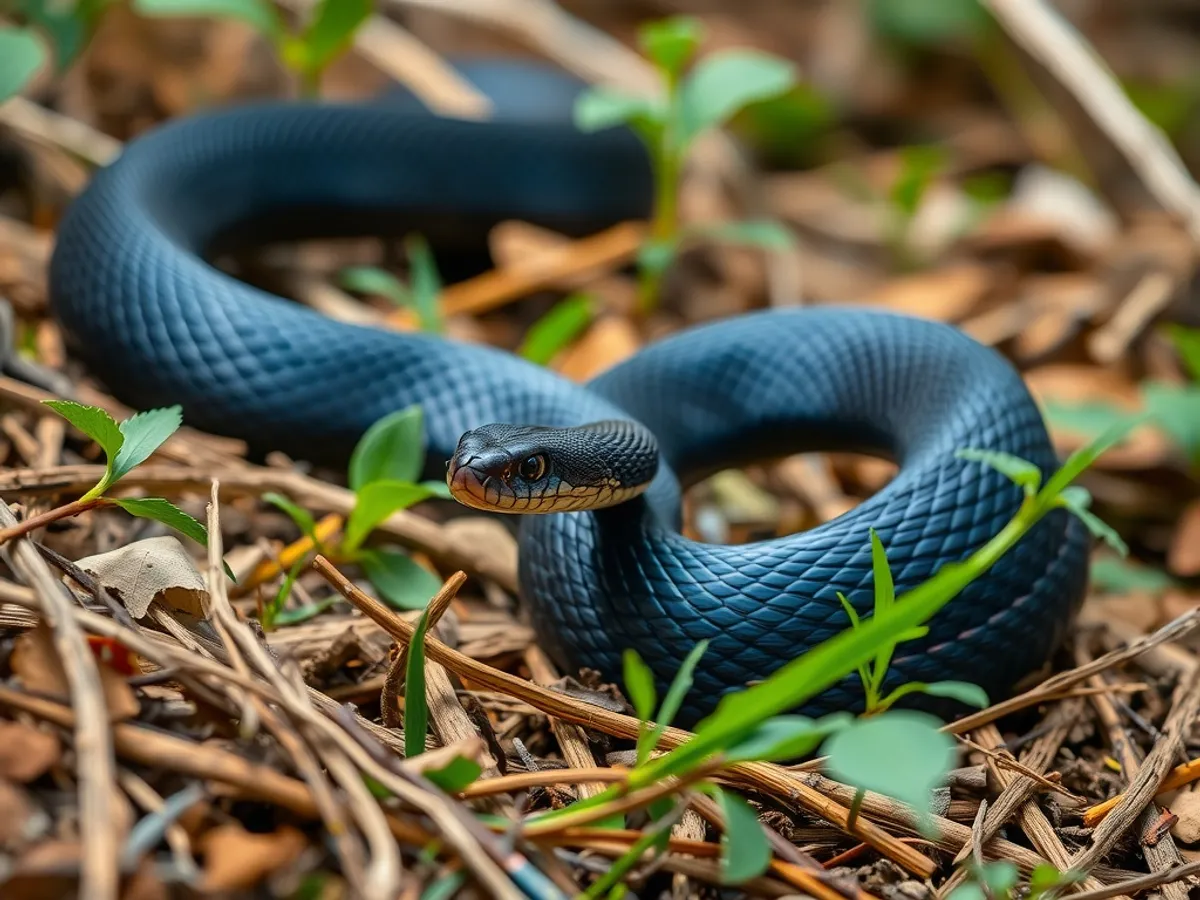
Drymarchon couperi is the longest native snake in the United States, reaching around 2.6 to 2.8 m, and it is glossy blue-black to the point that it flashes iridescent purple in sunlight. It is completely non-venomous and it eats venomous snakes. It does not constrict — it simply seizes prey, including full-grown rattlesnakes, in powerful jaws and chews and smashes it against the ground until it stops moving, then swallows it, and it has substantial resistance to pit viper venom. Its fate is bound to two other things: the longleaf pine savanna, which has been reduced to a tiny fraction of its original extent, and the gopher tortoise, whose deep burrows the indigo depends on for shelter through winter and fire. An indigo snake needs a very large home range, often hundreds of hectares, which is precisely what fragmentation destroys, and it is federally listed as threatened. It is active by day, wide-ranging, and unusually placid for a large snake, which historically made it a popular pet and a casualty of collection for the pet trade and for rattlesnake roundups, where gasoline pumped into tortoise burrows killed indigos along with the intended target. Reintroduction programmes are now releasing captive-bred indigos into restored longleaf habitat in Alabama and Florida.
Fascinating facts
Longest Native Snake
The Eastern Indigo Snake can grow over 2.7 meters (9 feet) long, making it the longest snake native to North America.
Venom Immunity
They are immune to the venom of native pit vipers, allowing them to prey on rattlesnakes and copperheads.
Habitat Specialists
They rely heavily on the burrows of gopher tortoises for shelter, especially in colder months.
Detailed description
The Eastern Indigo Snake (Drymarchon couperi) is a robust, large-bodied colubrid, typically ranging from 1.5 to 2.4 meters (5 to 8 feet) in length, with exceptional individuals exceeding 2.6 meters (8.5 feet), making it the longest native snake in North America. Its scales are smooth and glossy, imparting a striking iridescent blue-black sheen that is especially visible in sunlight. The head is broad and slightly distinct from the neck, with a rounded snout and large, dark eyes. Juveniles may display faint reddish or orange coloration on the chin, throat, and cheeks, which fades with maturity. The species is highly secretive and spends much of its time in underground refugia, such as gopher tortoise burrows, especially during cold or dry periods. Eastern Indigo Snakes are diurnal and highly mobile, with documented home ranges exceeding 100 hectares for adult males. They are solitary outside of the breeding season, exhibiting little territorial aggression except during male-male combat in the mating period. Their powerful jaws and muscular bodies allow them to subdue a wide range of prey, including venomous snakes, which they are immune to. The species is oviparous, with females laying clutches of 4–12 eggs annually. Adapted to a variety of habitats, they are most closely tied to the longleaf pine-wiregrass ecosystem but can also be found in flatwoods, hammocks, and riparian zones.
Did you know?
Despite their imposing size, Eastern Indigo Snakes are docile and rarely bite when handled.
Research & sources
Wikipedia summary
The eastern indigo snake is a species of large, non-venomous snake in the family Colubridae. Native to the southeastern United States, it is the longest native snake species in the country.
Behaviour & social structure
Eastern Indigo Snakes are primarily active during the day, with peak activity in the morning and late afternoon. They are active foragers, using both visual and chemical cues to locate prey, and will travel considerable distances in search of food or mates. Their diet is unusually broad for a snake and includes other snakes (even venomous species like rattlesnakes and copperheads), lizards, small mammals, birds, frogs, and eggs. They kill prey by grasping and crushing rather than constricting. During the cooler months, they rely heavily on the burrows of gopher tortoises (Gopherus polyphemus) and other animals for thermal regulation and protection from predators and fire. Social interactions are limited, but during the breeding season, males may engage in ritualized combat, intertwining and pushing each other to establish dominance. They are generally non-aggressive toward humans and will attempt to flee if threatened.
Reproduction & life cycle
Breeding occurs from October to March, with peak activity in late fall and early winter. Males actively seek out females, sometimes traveling long distances and competing with other males. Courtship involves tongue flicking and body alignment, and copulation may last several hours. Females lay a single clutch of 4–12 elongate, leathery eggs in late spring or early summer, often in abandoned burrows or under debris. Incubation lasts 90–120 days, depending on temperature, with hatchlings emerging in late summer or early fall. There is no parental care after egg-laying; hatchlings are independent from birth and must fend for themselves. Sexual maturity is reached at 3–4 years of age.
Adaptations & survival
Eastern Indigo Snakes exhibit several notable adaptations. Their smooth, iridescent scales reduce friction, aiding in rapid movement through dense vegetation and burrows. Their immunity to pit viper venom allows them to prey on dangerous snakes, giving them access to a unique food source. The use of gopher tortoise burrows as refugia is a key behavioral adaptation, providing stable microclimates and protection from fire and predators. Their large home ranges and high mobility enable them to exploit patchy resources in fragmented habitats. Their powerful jaws and muscular bodies are specialized for subduing large or defensive prey. Diurnality reduces competition with many sympatric snake species, which are primarily nocturnal.
Cultural significance
While not prominent in folklore or mythology, the Eastern Indigo Snake is valued by naturalists and conservationists as a flagship species for the longleaf pine ecosystem. Its presence is often seen as an indicator of healthy, functioning habitats. In some southeastern U.S. communities, it is respected for its role in controlling populations of venomous snakes. Educational programs frequently use the indigo snake to promote awareness of native wildlife and the importance of habitat conservation. There are no known traditional medicinal or utilitarian uses.
Recent research
Recent research has focused on the genetic structure of remaining populations, revealing significant fragmentation and the need for habitat corridors. Studies have documented the snake's reliance on gopher tortoise burrows, emphasizing the importance of multi-species conservation. Radio telemetry has provided insights into home range size, movement patterns, and habitat use, informing management strategies. Ongoing reintroduction projects in Alabama and the Florida Panhandle are being closely monitored for success, with early results showing promising survival and dispersal rates. There is also interest in the species' resistance to pit viper venom, with potential biomedical applications under investigation.
Sources
Drymarchon couperi (Eastern Indigo Snake): Natural History, Ecology, and Conservation
Stevenson, D.J., Hyslop, N.L., and Krysko, K.L. (2010)
scientificEastern Indigo Snake (Drymarchon couperi) Conservation Status
IUCN Red List of Threatened Species
conservationVideos
Habitat
Longleaf pine forests, sandhills, and scrublands


Conservation
The Eastern Indigo Snake is currently classified as Threatened on the IUCN Red List.
Threats & challenges
The primary threats to the Eastern Indigo Snake are habitat loss, fragmentation, and degradation, particularly the decline of longleaf pine ecosystems and the loss of gopher tortoise populations (whose burrows are essential refuges). Urbanization, agriculture, and fire suppression have reduced suitable habitat. Road mortality is a significant threat, as the snakes' large home ranges require frequent crossings of roads. Illegal collection for the pet trade and intentional killing due to mistaken identity with venomous snakes also contribute to declines. Populations have become highly fragmented, leading to reduced genetic diversity and increased vulnerability. Conservation efforts focus on habitat restoration, protection of gopher tortoise populations, and reintroduction programs.
Taxonomy
Scientific name
Drymarchon couperi
- Kingdom
- Animalia
- Phylum
- Chordata
- Class
- Reptilia
- Order
- Squamata
- Family
- Colubridae
- Genus
- Drymarchon
- Species
- couperi
Where to see an eastern indigo snake
3 zoos and aquariums in 1 country are recorded as keeping this species.
Community notes
Share your observations about the Eastern Indigo Snake.
No community notes yet. Be the first!
Discover more wildlife
More fascinating animals from the encyclopedia.