
Search the encyclopedia
110 animals
American Bison
Bison bison
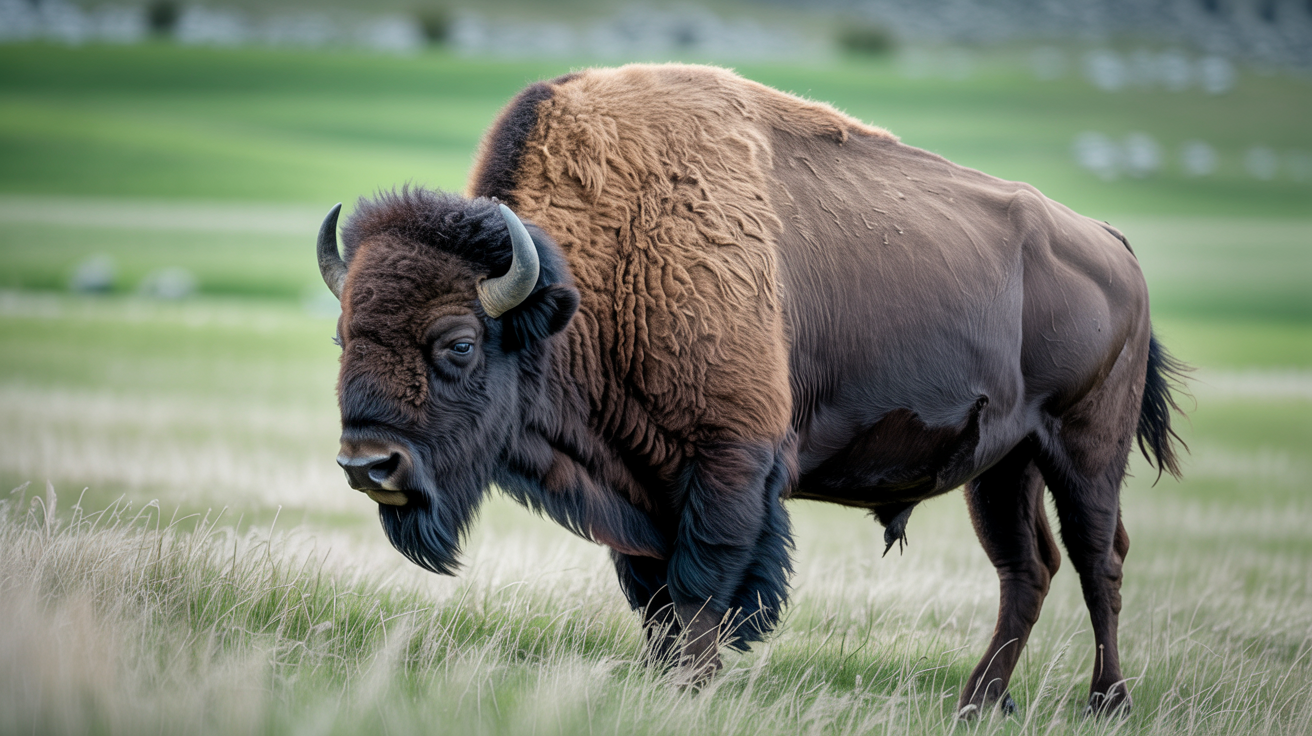
The American Bison (Bison bison), often misnamed as the buffalo, is a robust herbivore native to North America. Distinguished by its massive head, pronounced shoulder hump, and thick, shaggy mane, the bison is well-adapted to the continent's diverse climates. Historically, bison roamed the expansive 'great bison belt,' a vast grassland stretching from Alaska to the Gulf of Mexico and as far east as the Atlantic Seaboard. This range included diverse ecosystems, from the plains to woodlands, allowing bison to thrive in various habitats. Adult males, known as bulls, can weigh up to 2,000 pounds and stand over 6 feet tall at the shoulder, dwarfing their European counterparts. Their thick fur provides insulation against harsh winters, while their large heads and muscular necks enable them to plow through snow in search of forage. The bison's complex social structure includes matriarchal herds, which play a crucial role in maintaining genetic diversity and social learning among the species.
Andean Condor
Vultur gryphus
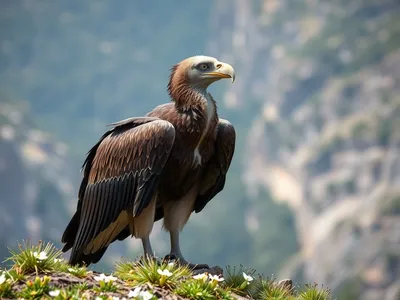
The Andean condor is among the largest flying birds on Earth, and almost everything about it is shaped by the problem of getting that mass airborne and keeping it there for free. Tracking studies found it spends barely one percent of its flight time flapping: it can cover more than a hundred kilometres and stay up for hours on a single takeoff, riding thermals and the updrafts deflected off mountain ridges, and flapping mainly in the awkward moments near the ground. Takeoff is the expensive part, which is precisely why condors roost on cliffs and high ledges — they need height, or wind, to launch at all. It is a scavenger that finds carcasses by sight rather than smell, often simply by watching other scavengers drop. Unusually among birds of prey, the sexes differ visibly: the male is the larger, and carries a fleshy caruncle on his head, inverting the usual raptor pattern in which the female is bigger. It is long-lived and slow to breed — a single chick every couple of years — and it is woven deeply into Andean culture, appearing on coats of arms and in origin myths across the range.
Atlantic wolffish
Anarhichas lupus
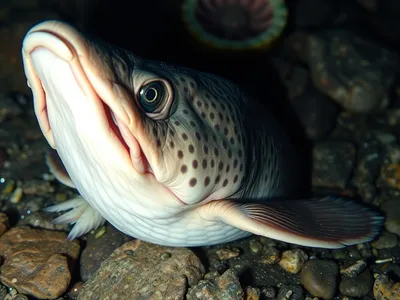
The Atlantic wolffish has a face like a nightmare for a good reason: it eats sea urchins, whelks, hermit crabs and scallops, and it needs to break them. Conical fangs at the front seize and wrench prey off the rock, and behind them, on the palate and in the throat, sit blunt crushing molars and bony plates that mill the shell to gravel. Those teeth wear out. Every year the wolffish sheds and regrows the entire set, and during the regrowth period it essentially stops feeding. It lives in cold, rocky North Atlantic dens, produces its own antifreeze glycoproteins, and does something almost no other bony fish of the region does: fertilisation is internal, and the male then guards the large clumped egg mass — sometimes for four months or more — fanning it and driving off intruders. That combination of a slow reproductive cycle, dependence on structured rocky bottom, and a habit of sitting still in a den made it catastrophically vulnerable to bottom trawling, which both kills the fish as bycatch and bulldozes its habitat.
Bactrian Camel
Camelus bactrianus
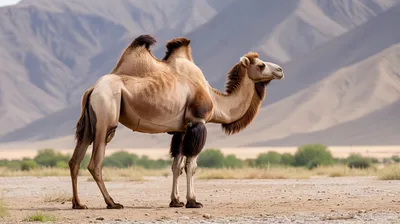
The two humps of a Bactrian camel are fat, not water — a strategic decision to store the body's insulation in two lumps on the back rather than spread beneath the skin, so that the rest of the body can radiate heat freely. A well-fed camel's humps stand firm; a starved one's flop over. The camel's water tricks are elsewhere. It can lose up to about 30 percent of its body water, a level that would kill most mammals through blood thickening, because its red blood cells are oval rather than round and unusually elastic — they resist rupturing when the animal rehydrates and can swell enormously. That is what lets a camel drink over 100 litres in a few minutes without its cells bursting. Nostrils close against blowing sand, double rows of eyelashes screen the eyes, and the woolly winter coat sheds in great hanging sheets in spring. The domestic Bactrian is common, but the wild Bactrian camel is now recognised as a separate species with only around a thousand individuals left in the Gobi.
Bee Hummingbird
Mellisuga helenae
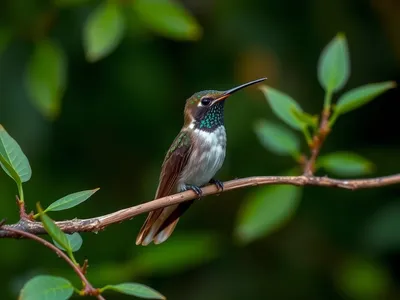
The bee hummingbird of Cuba is the smallest bird in the world: about 5 to 6 cm long, and weighing under 2 g — less than a US penny — with a nest the size of a thimble and eggs the size of a coffee bean. Everything about it is pushed against physiological limits. Its heart can beat over 1,200 times a minute, its wings beat up to about 80 times a second in a courting male, and it must consume roughly half its body mass in food each day and drink many times its own weight in nectar, because at that size the ratio of surface area to volume makes heat loss brutal. It cannot survive a night at that metabolic rate, so it enters torpor: the body temperature collapses, the heart rate drops to a fraction of normal, and the bird becomes cold and unresponsive on its perch until dawn. It is endemic to Cuba and the Isla de la Juventud, and it is so small that it is routinely mistaken for a large insect, which is exactly what its name records.

Beluga Whale
Delphinapterus leucas
The beluga is the only whale that can turn its head. In every other cetacean the neck vertebrae are fused into a rigid block; in the beluga they are not, so it can nod and look sideways — an adaptation for manoeuvring in the shallow, ice-choked coastal water and river estuaries where it feeds. The bulging melon on its forehead is a fatty organ, and unlike other whales the beluga can visibly deform it, changing its shape to focus and steer the beam of its echolocation clicks like a lens. It is so vocal that whalers called it the sea canary — clicks, whistles, chirps and squeals, audible through a boat's hull. It has no dorsal fin, which would be a liability under ice; in its place is a tough dorsal ridge, which it uses to break through thin ice from below to breathe. It moults each year, rubbing itself against gravel in river shallows, and it is born grey, whitening only as it matures.
Black Tree Monitor
Varanus beccarii
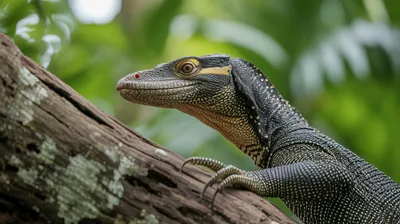
The Black Tree Monitor is a sleek, arboreal lizard native to the tropical rainforests of the Aru Islands in Indonesia. It is renowned for its jet-black coloration, long slender body, and prehensile tail, which aid in navigating the dense canopy. This species is highly agile, spending most of its life in trees where it hunts insects, small vertebrates, and eggs. Black Tree Monitors are known for their intelligence, curiosity, and striking appearance, making them a favorite among reptile enthusiasts. Their populations are threatened by habitat loss and collection for the pet trade.
Blacktip Reef Shark
Carcharhinus melanopterus
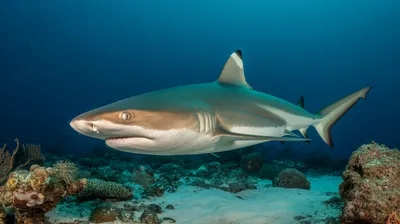
The blacktip reef shark is the shark most people have actually seen: a small, slender 1.6 m animal that patrols reef flats so shallow that its dorsal fin cuts clear of the water. It is startlingly parochial. Individuals have home ranges that can be under a square kilometre and they hold to them for years, and they will not cross deep open water, so populations on neighbouring atolls are genetically distinct despite being a short swim apart in a straight line. That makes them extremely vulnerable to local overfishing, because a wiped-out reef will not be repopulated from next door. It is placentally viviparous, giving birth to two to four live pups after a gestation of around a year, with an umbilical connection much like a mammal's. It is timid and almost never dangerous, and the handful of recorded bites are mostly on the ankles of people wading in murky shallows, where a foot looks like a fish.
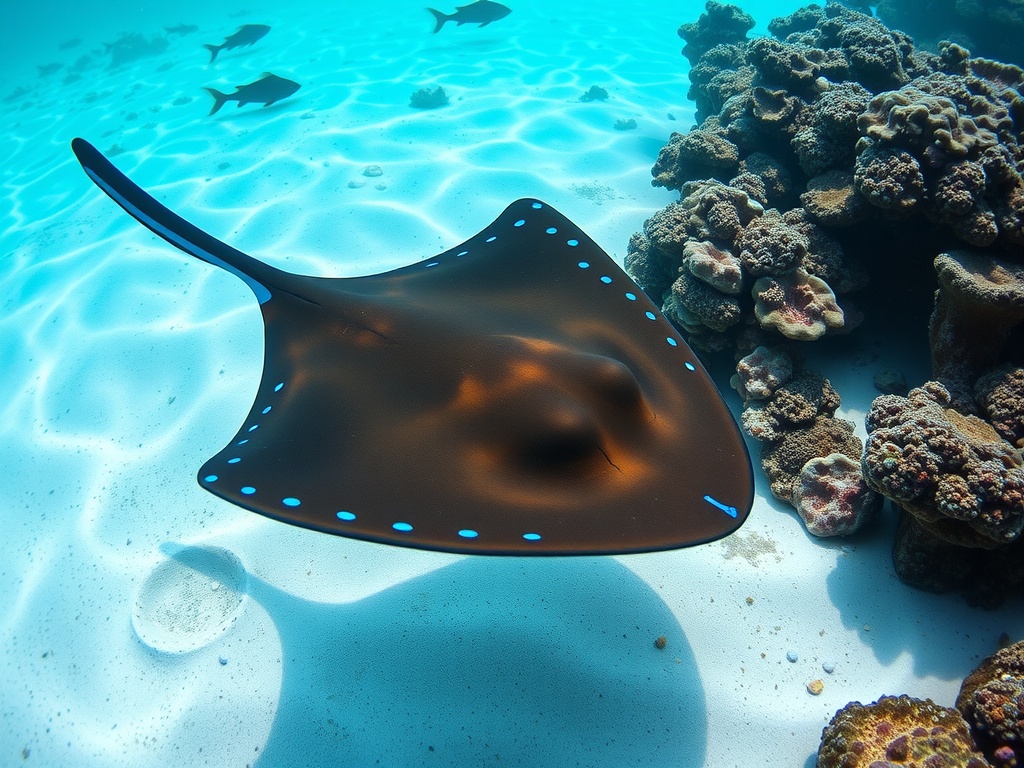
Bluespotted ribbontail ray
Taeniura lymma
The bluespotted ribbontail ray is a striking species of stingray known for its vivid blue spots and short, rounded pectoral disc. This ray inhabits shallow, sandy, and coral reef environments in the Indo-Pacific region, often hiding under ledges or within sandy patches. It is a bottom-dwelling carnivore, using its disc to stir up sand and uncover prey such as small fish, worms, and crustaceans. Despite its beautiful appearance, the bluespotted ribbontail ray is equipped with venomous spines on its tail for defense against predators.
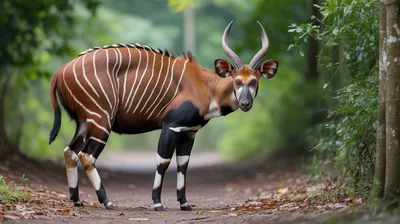
Bongo
Tragelaphus eurycerus
The bongo is the largest forest antelope in the world and a masterpiece of camouflage engineering. Ten to fifteen vertical white stripes on a deep chestnut coat break its outline in the dappled understorey, and unusually for an antelope, both sexes carry horns — a rarity that reflects a life spent in dense cover where a female cannot rely on running away and may have to fight. The horns are heavy and lyre-shaped, and they tilt backward along the neck, which is not decoration: it lets the animal run flat-out through tangled forest with its head raised without the horns snagging. Bongos strip bark, break branches with their horns to reach foliage, and dig for roots. They also eat charcoal from lightning-struck and burned trees, and chew bones, both apparently for minerals and to bind plant toxins. The mountain, or eastern, bongo of Kenya is one of the most endangered mammals on Earth, with well under 100 animals left in the wild, confined to a few Aberdare and Mau forest fragments.

Brown Hyena
Parahyaena brunnea
The brown hyena is the rarest of the hyenas, with perhaps 5,000 to 10,000 left, and it makes its living almost entirely by scavenging — it is a superb long-distance walker that can cover 30 km or more in a night, following scent to carrion it did not kill. Its shaggy dark coat and pale cream mane make it look nothing like a spotted hyena. Its strangest population lives on Namibia's Skeleton Coast, where brown hyenas subsist on Cape fur seal colonies, taking pups and scavenging carcasses along the surf line — the only hyena that regularly feeds on marine prey. Its communication system is a piece of chemical engineering: from the anal gland it deposits two separate pastes on grass stems, a white one and a black one, which decay at very different rates. A hyena sniffing a paste mark can therefore read not just who was here but roughly how long ago — a scent message with a built-in timestamp. Clans share a territory but forage alone.
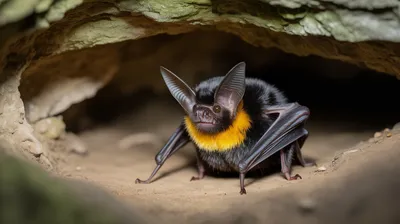
Bumblebee Bat
Craseonycteris thonglongyai
Kitti's hog-nosed bat, or bumblebee bat, weighs about 2 g and has a body 29 to 33 mm long — it is the smallest mammal in the world by body length, and it vies with the Etruscan shrew, which is fractionally lighter, for the title overall. It is so distinct that it is the sole member of its own family, Craseonycteridae, with no close relatives at all; a whole branch of the mammal tree that consists of one tiny animal. It was found only in 1973, in limestone caves in western Thailand, by the Thai zoologist Kitti Thonglongya, who died before he could publish the description. Its life is compressed into two short windows: it emerges for perhaps half an hour at dusk and again briefly at dawn, foraging around bamboo clumps and teak, hovering like a hummingbird to pluck insects and spiders directly off leaves. That hovering — expensive, precise flight — is what its pig-like nose and broad wings support. It roosts in a few dozen limestone caves in Thailand and southeast Myanmar and nowhere else on Earth.
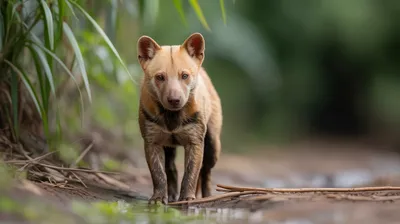
Bush Dog
Speothos venaticus
The bush dog looks like a mistake: a squat, short-legged, bear-faced animal with tiny ears and a stubby tail, which barely reads as a canid at all. It is nevertheless one of the most social dogs in the world, hunting in cooperative packs of up to a dozen through dense South American forest and swamp — and its build makes sense once you know what it does. Short legs and a compact body let it drive through thick undergrowth and into burrows that a long-legged canid could not enter, and its partially webbed feet make it an excellent swimmer: packs will herd pacas and agoutis into water, where the bush dog is the faster animal. Its teeth are those of a committed meat-eater, with fewer molars than most canids and a reduced crushing surface. In cover so dense that pack members constantly lose sight of each other, vision is useless for coordination, so bush dogs keep up an almost continuous stream of high whistles and squeaks — a contact language for a dog that cannot see its own pack.
California Newt
Taricha torosa
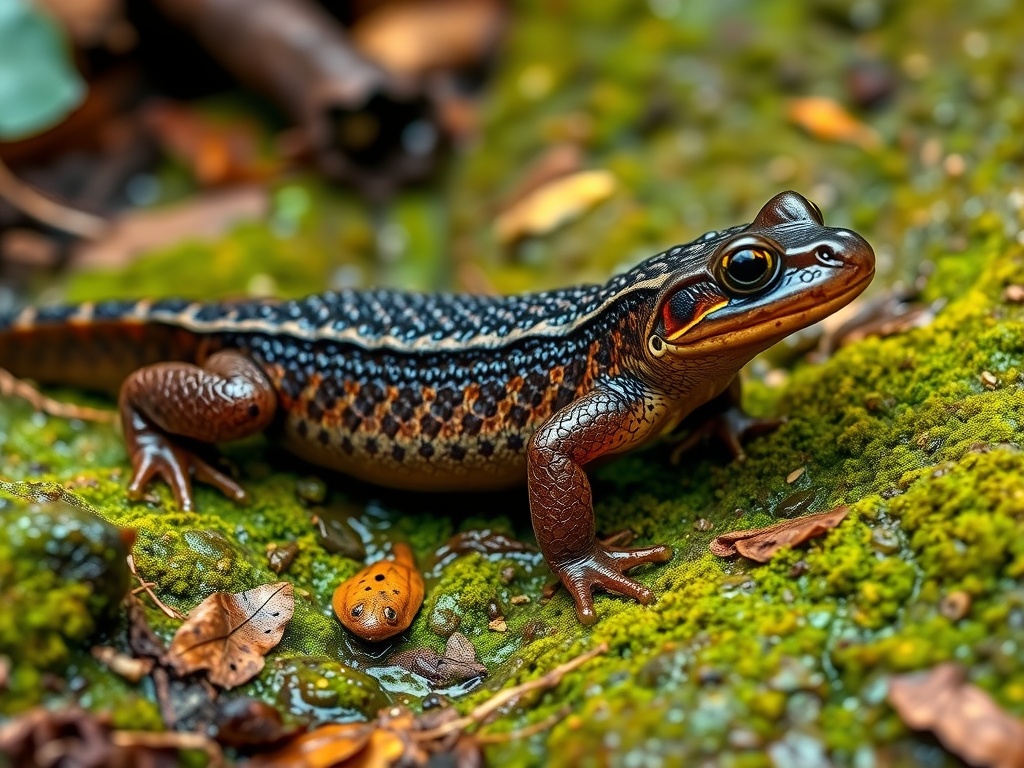
The California newt is a medium-sized amphibian native to California, recognized by its rough, warty skin and striking orange to brown coloration. It inhabits moist woodlands, chaparral, and forested areas, especially near streams and ponds during the breeding season. The newt is well adapted to both terrestrial and aquatic environments and is known for its potent skin toxin, which deters most predators. During the dry season, it retreats to moist refuges, becoming terrestrial until the rainy months trigger its migration to breeding pools.
Cherry Barb
Puntius titteya
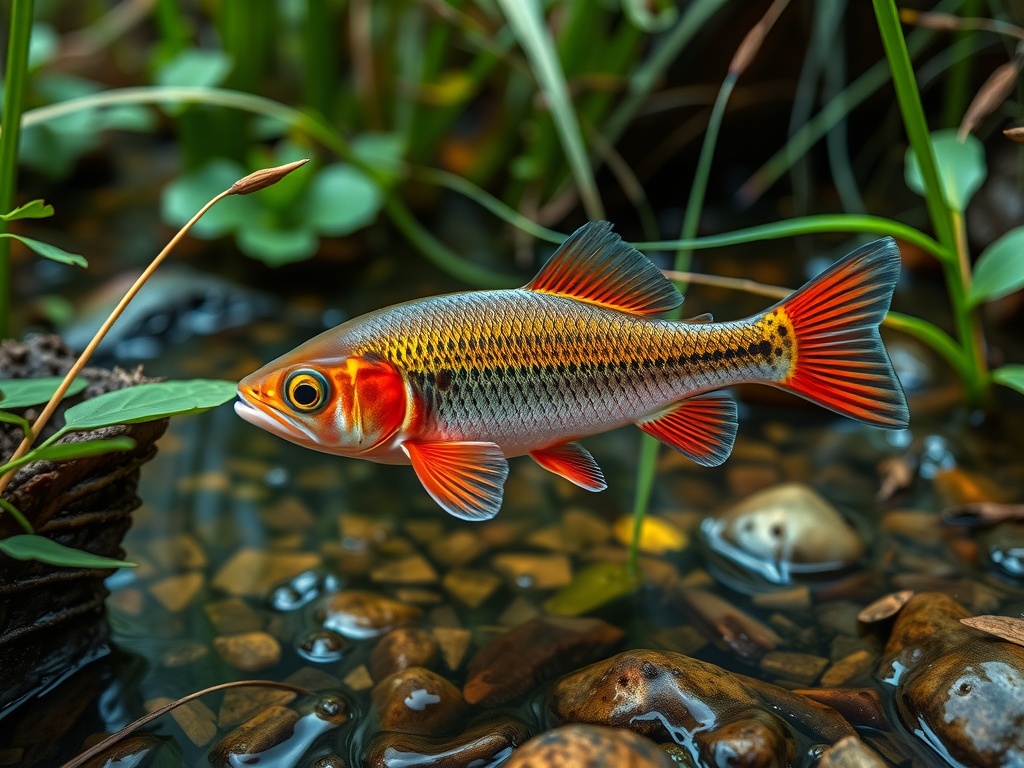
The Cherry Barb is a small, vibrant freshwater fish native to Sri Lanka, renowned for its striking red coloration, especially in males during breeding. This peaceful species is popular in home aquariums due to its attractive appearance, gentle temperament, and ease of care. Cherry Barbs prefer densely planted habitats with slow-moving or still waters and thrive in schools, which helps reduce their naturally shy behavior. They are hardy and adaptable, making them suitable for both novice and experienced aquarists.
Chiru (Tibetan Antelope)
Pantholops hodgsonii
The chiru is being killed for the fineness of its underwool. Shahtoosh — literally "king of wools" — has fibres of around 7 to 10 microns, finer than cashmere, fine enough that the finished shawl can be pulled through a wedding ring, and the animal cannot be shorn or combed: it must be killed. Three to five chiru die for one shawl. Between the 1980s and 1990s, a fashion boom in Europe and America drove poaching that cut a population of perhaps a million down to somewhere in the tens of thousands. The trade was banned, enforcement on the Tibetan plateau became serious, and the chiru is one of the genuine recovery successes of recent conservation, with numbers back into the hundreds of thousands and its status downlisted in 2016. It is adapted to a brutal environment: it lives above 4,000 m, it has inflatable nasal sacs that warm and humidify the freezing thin air it breathes, and females migrate hundreds of kilometres each summer to traditional calving grounds.
Coastal Giant Salamander
Dicamptodon tenebrosus
The Coastal Giant Salamander is the largest terrestrial salamander in North America, reaching lengths of up to 34 centimeters. It is notable for its robust body, broad head, and distinctive marbled or mottled brown and tan coloration. This species is semi-aquatic, spending its larval stage in cool, fast-flowing streams and transitioning to life on land as an adult, although some individuals remain aquatic for life. The Coastal Giant Salamander is found primarily in moist coniferous forests of the Pacific Northwest, where it hides under logs, rocks, and leaf litter.
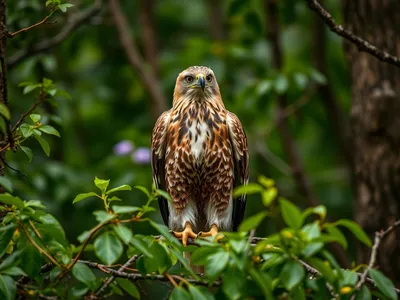
Crowned Eagle
Stephanoaetus coronatus
Stephanoaetus coronatus is Africa's most powerful eagle in the only sense that matters — the size of what it can kill. It weighs only 3-4 kg, less than a martial eagle, but it routinely takes monkeys, small antelope and bushbuck fawns, with confirmed prey up to around 20 kg, several times its own mass. It kills by driving its rear talon through the skull or spine, and its legs and feet are proportionally the heaviest of any African raptor. Because it hunts inside closed forest, it has short, broad wings and a long rudder-like tail, the same design as a goshawk scaled up, letting it accelerate through gaps rather than soar. Prey too heavy to carry is dismembered and cached in branches over several days. Its most remarkable claim is archaeological: the Taung Child, the Australopithecus skull that helped establish human origins in Africa, carries puncture marks in the eye sockets and damage to the skull base that match the feeding traces crowned eagles leave on modern monkeys, which means our early relatives were prey for this bird. Breeding is extraordinarily slow, with the chick dependent on its parents for up to eleven months, so a pair can usually only raise one youngster every two years.
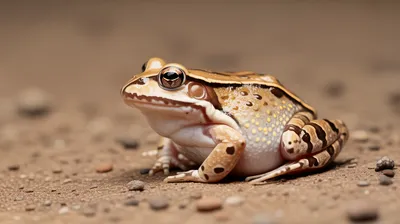
Desert Rain Frog
Breviceps macrops
The Desert Rain Frog is a small, round-bodied amphibian known for its squeaky vocalizations and distinctive appearance. It inhabits the sandy coastal dunes of Namibia and South Africa, where it burrows to avoid the harsh desert sun. This nocturnal frog has a translucent belly and short limbs, making it well adapted for digging and a fossorial lifestyle. Despite living in arid conditions, it relies on fog and dew for moisture rather than rainfall. Its unique croak, which resembles a squeaky toy, has gained it worldwide attention.
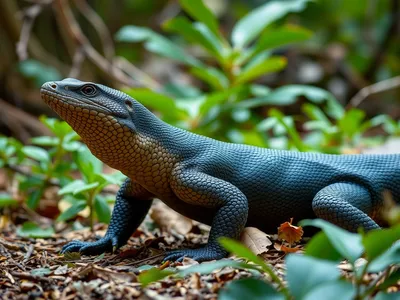
Dumeril's Monitor
Varanus dumerilii
Dumeril's Monitor is a large, semi-arboreal lizard native to the forests of Southeast Asia, particularly in Thailand, Malaysia, Sumatra, and Borneo. Recognizable by its robust build, olive to dark gray coloration, and creamy yellow spots and bands, this species is adept at both climbing and swimming. Dumeril's Monitors are typically shy and elusive, preferring humid lowland forests near water sources such as rivers and swamps. Their specialized diet and cryptic habits contribute to their mysterious reputation among herpetologists and reptile enthusiasts.
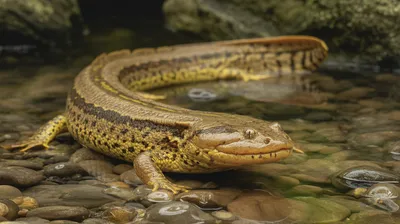
Eastern Hellbender
Cryptobranchus alleganiensis alleganiensis
Cryptobranchus alleganiensis is a giant aquatic salamander of Appalachian streams, reaching around 70 cm, and its whole body is an oxygen-absorbing surface. The loose, wrinkled skin along its flanks is thrown into deep folds that hugely increase surface area, and it is laced with capillaries — the animal takes in almost all of its oxygen straight through the skin, and its small lungs serve mostly for buoyancy. When oxygen runs low it rocks its body side to side to sweep stale water away from the skin folds and pull fresh water past them. This is why a hellbender cannot survive anywhere except cold, fast, boulder-strewn, highly oxygenated water, and why it is one of the best bioindicators in North America: silt from erosion clogs the gaps under the flat rocks it lives beneath, and dams and warming water strip the oxygen it depends on. Males excavate a nest cavity under a large flat stone, court a female into it, fertilise the eggs externally as she lays them, and then guard the clutch alone for weeks, fanning it — and eating some of it. Despite the nicknames snot otter, devil dog and Allegheny alligator, it is completely harmless, does not damage trout populations, and eats mainly crayfish.
Eastern Indigo Snake
Drymarchon couperi
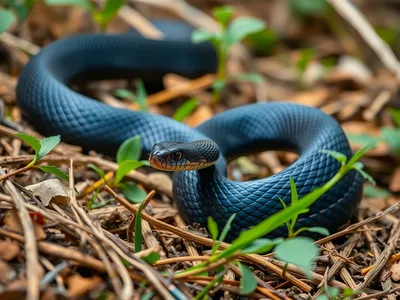
Drymarchon couperi is the longest native snake in the United States, reaching around 2.6 to 2.8 m, and it is glossy blue-black to the point that it flashes iridescent purple in sunlight. It is completely non-venomous and it eats venomous snakes. It does not constrict — it simply seizes prey, including full-grown rattlesnakes, in powerful jaws and chews and smashes it against the ground until it stops moving, then swallows it, and it has substantial resistance to pit viper venom. Its fate is bound to two other things: the longleaf pine savanna, which has been reduced to a tiny fraction of its original extent, and the gopher tortoise, whose deep burrows the indigo depends on for shelter through winter and fire. An indigo snake needs a very large home range, often hundreds of hectares, which is precisely what fragmentation destroys, and it is federally listed as threatened. It is active by day, wide-ranging, and unusually placid for a large snake, which historically made it a popular pet and a casualty of collection for the pet trade and for rattlesnake roundups, where gasoline pumped into tortoise burrows killed indigos along with the intended target. Reintroduction programmes are now releasing captive-bred indigos into restored longleaf habitat in Alabama and Florida.
Ecuadorian Poison Frog
Ameerega bilinguis
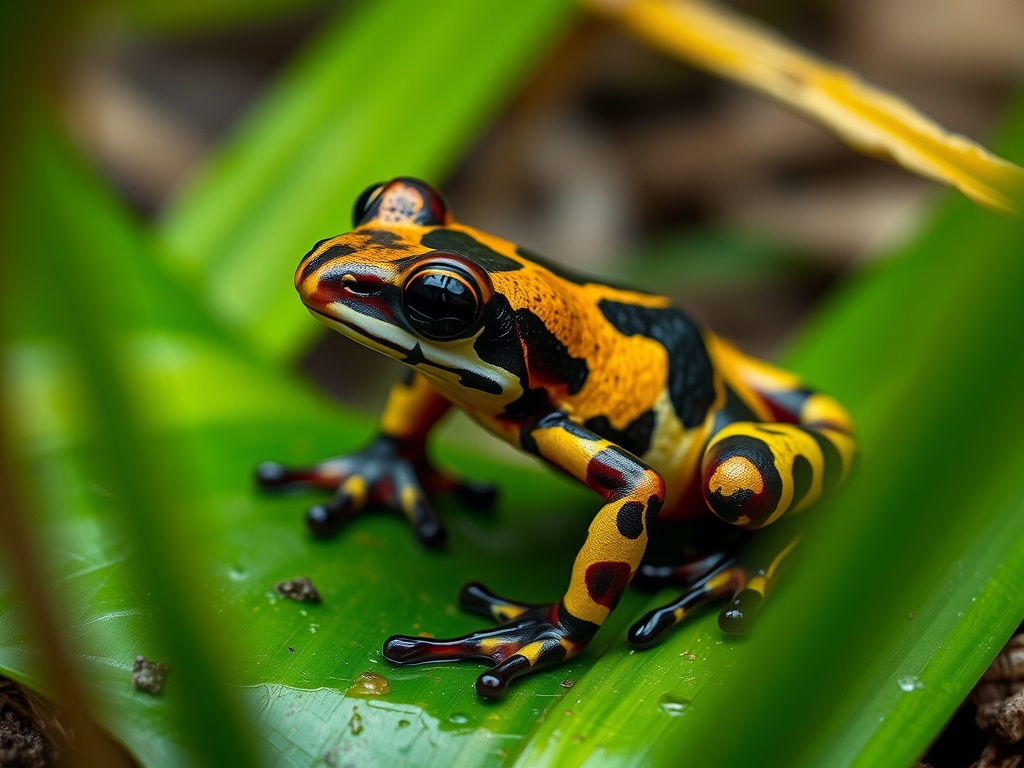
The Ecuadorian Poison Frog is a small, brightly colored amphibian native to the humid lowland and foothill forests of Ecuador and northern Peru. It is known for its striking black body adorned with vibrant blue or green markings, which serve as a warning to potential predators about its toxicity. This diurnal frog is often found near streams and in leaf litter, where it hunts for small invertebrates. The species is notable for its parental care, with males transporting tadpoles to water after hatching.
Elegant Tern
Thalasseus elegans
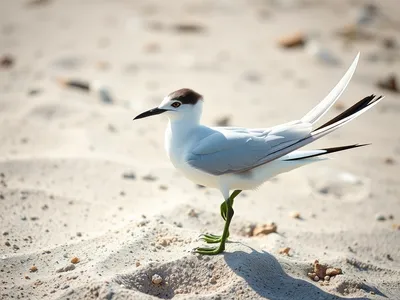
The Elegant Tern is a striking seabird known for its slender build, long, orange bill, and graceful flight. Adults display pale gray upperparts, white underparts, and a shaggy black crest during the breeding season, giving them a distinctive and 'elegant' appearance. Found primarily along Pacific coasts, they nest in dense colonies on sandy islands and forage over coastal waters for small fish. Their courtship displays include elaborate aerial acrobatics and distinctive calls. Elegant Terns are highly social, often forming large flocks outside the breeding season.