
About the Eastern Red-backed Salamander
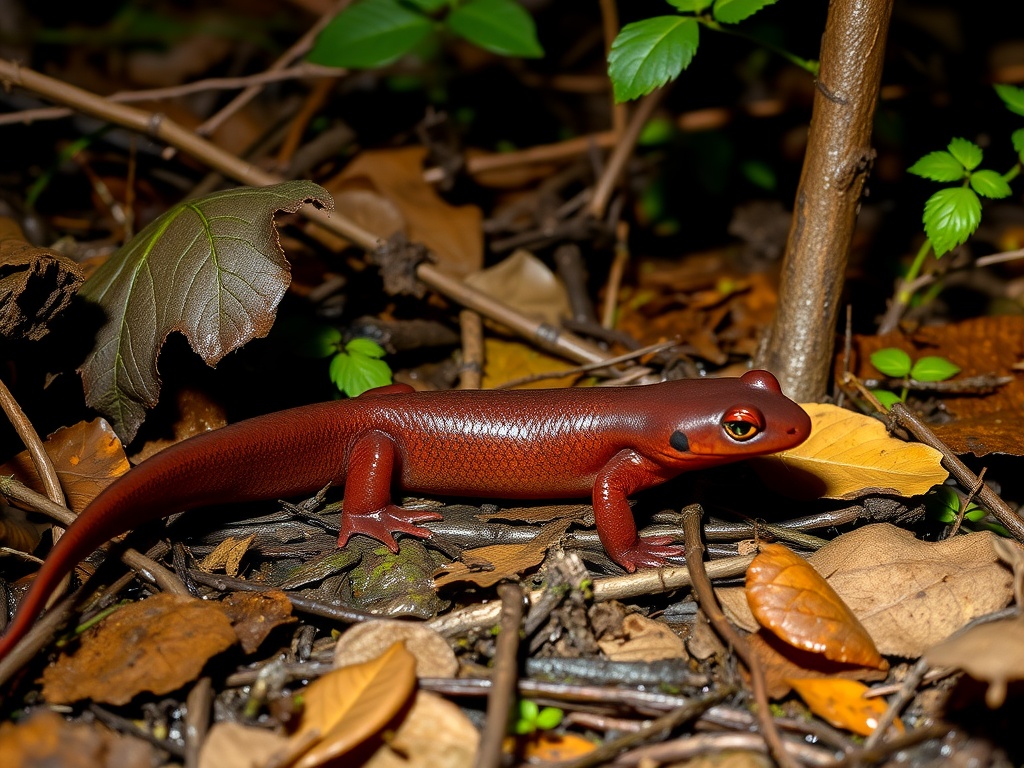
The Eastern Red-backed Salamander is a slender, lungless amphibian native to the forests of eastern North America. It is easily recognized by its two main color morphs: the 'red-backed' variety, which displays a reddish stripe down its back, and the 'lead-backed' morph, which is uniformly dark gray. This secretive salamander lives beneath logs, rocks, and leaf litter, thriving in moist, cool environments. Lacking lungs, it breathes entirely through its skin and the lining of its mouth, making it highly sensitive to environmental changes. The species plays an important role in forest ecosystems by regulating invertebrate populations and contributing to nutrient cycling.
Fascinating facts
Forest Dweller
This salamander is a key inhabitant of deciduous forests, where it spends its life hidden beneath logs and leaf litter.
Lungless Wonder
Eastern Red-backed Salamanders breathe through their skin and mouth lining instead of lungs, making them very sensitive to environmental pollutants.
Tail Autotomy
When threatened by predators, they can detach and regrow their tails as a means of escape.
Detailed description
The Eastern Red-backed Salamander (Plethodon cinereus) is a small, slender, terrestrial salamander, typically measuring 6.5–10 cm (2.5–4 in) in total length. Its most distinctive feature is the presence of two primary color morphs: the 'red-backed' morph, with a straight-edged reddish or orange dorsal stripe, and the 'lead-backed' morph, which is uniformly dark gray or black dorsally. Less common morphs, such as the 'erythristic' (entirely red or orange) and 'white-backed' forms, have also been documented. The skin is smooth and moist, critical for cutaneous respiration, as this species lacks lungs entirely. The tail is often slightly longer than the body and can be autotomized (self-amputated) as a defense mechanism. Eastern Red-backed Salamanders are nocturnal and highly secretive, spending daylight hours under rocks, logs, or within leaf litter to avoid desiccation and predation. They are territorial, especially during the breeding season, and use pheromonal and tactile cues to communicate. Their diet consists primarily of small invertebrates, including mites, springtails, ants, and beetles, which they capture using a projectile tongue. This species is entirely terrestrial throughout its life cycle, bypassing an aquatic larval stage, and exhibits direct development, with juveniles hatching as miniature adults. The Eastern Red-backed Salamander is a keystone species in forest ecosystems, influencing soil structure, invertebrate populations, and nutrient cycling.
Did you know?
Unlike most salamanders, the Eastern Red-backed Salamander does not have an aquatic larval stage; its young hatch directly into miniature adults.
Research & sources
Behaviour & social structure
Eastern Red-backed Salamanders are primarily nocturnal, emerging at night or during periods of high humidity to forage. They exhibit strong site fidelity, often returning to the same cover object after foraging excursions. Individuals maintain small, overlapping home ranges and defend territories, particularly during the breeding season, using a combination of physical displays and pheromonal marking via specialized glands on the chin (mental gland). Aggressive encounters may involve posturing, biting, and tail displays. Feeding is opportunistic, relying on a sit-and-wait strategy; they detect prey using chemosensory cues and capture it with a rapid, sticky tongue projection. During dry or cold conditions, they retreat deeper into the soil or seek moist refugia to prevent desiccation. Social interactions are generally antagonistic outside of courtship, and cannibalism of eggs or juveniles has been observed under resource-limited conditions.
Reproduction & life cycle
Breeding in Plethodon cinereus occurs annually, typically from late spring to early summer (May–July), though timing varies with latitude and elevation. Courtship is elaborate, involving tactile and chemical communication; the male courts the female by rubbing his snout on her body and performing a 'tail-straddling walk.' The male deposits a spermatophore, which the female picks up with her cloaca. Females lay 3–14 eggs in moist, protected sites such as under logs or within moss, often in communal nests. The eggs are attached to the substrate by a gelatinous stalk and guarded by the female for 6–9 weeks, during which she protects them from predators and desiccation. Embryos develop directly into miniature salamanders, bypassing a free-living larval stage. Juveniles are independent upon hatching and reach sexual maturity in 2–3 years.
Adaptations & survival
The Eastern Red-backed Salamander exhibits several adaptations for terrestrial life and survival in variable forest environments. Its lungless physiology (family Plethodontidae) allows efficient cutaneous respiration, but also restricts the species to moist microhabitats. The ability to autotomize the tail distracts predators and facilitates escape. Color polymorphism may provide camouflage in different substrates and microclimates, and some evidence suggests morphs may have differential thermal tolerances or predation risks. The species produces noxious skin secretions that deter some predators. Behavioral adaptations include nocturnality, site fidelity, and the use of pheromones for territory and mate recognition. Direct development eliminates dependence on aquatic habitats for reproduction, enhancing survival in fragmented or upland forests.
Cultural significance
The Eastern Red-backed Salamander holds limited direct cultural significance but is often cited in ecological and educational contexts as a model organism for studies of population ecology, territoriality, and evolutionary biology. Its presence is considered an indicator of forest health and ecosystem integrity. In some Native American traditions, salamanders in general are associated with water and transformation, though specific references to this species are rare. The salamander's resilience and adaptability have made it a symbol of environmental persistence in scientific literature.
Recent research
Recent research on Plethodon cinereus has focused on the ecological consequences of color polymorphism, with studies suggesting links to thermal physiology, predation, and microhabitat use. Genomic studies have provided insights into the mechanisms of direct development and lunglessness. The species is a model for studying the impacts of climate change on forest floor communities, as well as the effects of acid rain and soil chemistry on amphibian health. Ongoing research explores the salamander's role in regulating soil invertebrate populations and nutrient cycling. Notably, studies have shown that areas with abundant P. cinereus have slower leaf litter decomposition rates, highlighting their influence on ecosystem processes.
Sources
Ecology and behavior of the Eastern Red-backed Salamander (Plethodon cinereus)
David M. Green, in 'Amphibian Ecology and Conservation: A Handbook of Techniques' (2010)
scientificPlethodon cinereus: The IUCN Red List of Threatened Species 2015
IUCN SSC Amphibian Specialist Group
conservationVideos
Habitat
Deciduous and mixed forests with moist, shaded ground cover


Conservation
The Eastern Red-backed Salamander is currently classified as Least Concern on the IUCN Red List.
Threats & challenges
While currently listed as Least Concern, Eastern Red-backed Salamanders face several threats. Habitat loss and fragmentation from logging, urbanization, and agriculture reduce suitable moist microhabitats. Acid rain and soil acidification can negatively impact survival, as the species is sensitive to changes in soil pH and calcium availability. Climate change poses risks by altering moisture regimes and increasing the frequency of droughts. Road mortality and collection for the pet trade are minor but localized threats. Despite these pressures, the species remains abundant and widespread, with stable populations in many regions, likely due to its adaptability and direct development.
Taxonomy
Scientific name
Plethodon cinereus
- Kingdom
- Animalia
- Phylum
- Chordata
- Class
- Amphibia
- Order
- Caudata
- Family
- Plethodontidae
- Genus
- Plethodon
- Species
- cinereus
Community notes
Share your observations about the Eastern Red-backed Salamander.
No community notes yet. Be the first!
Discover more wildlife
More fascinating animals from the encyclopedia.