
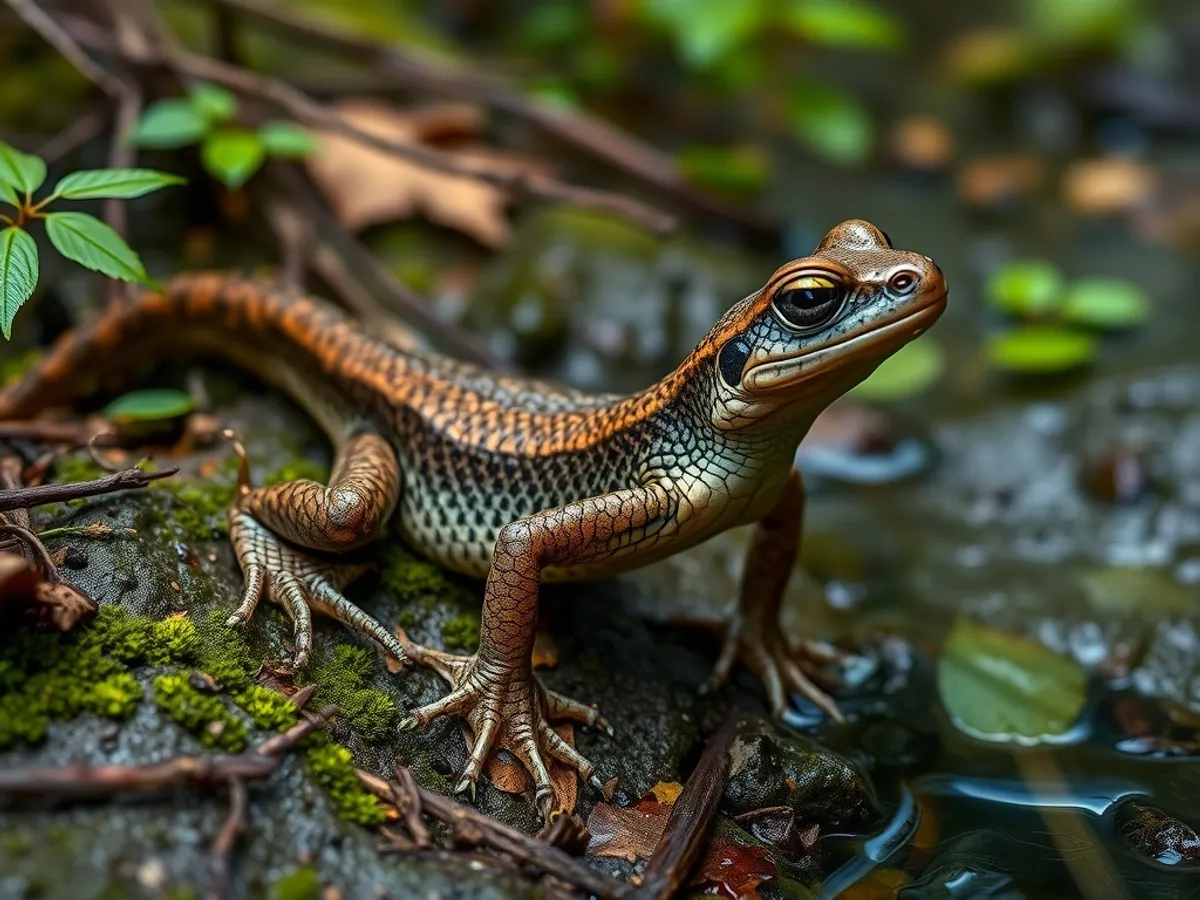
About the Emperor Newt
The Emperor Newt is a strikingly colored amphibian known for its vivid orange ridges and black body. Native to the mountainous regions of southwestern China, it inhabits moist forests near streams and pools. Its bright coloration serves as a warning for its potent toxins, making it one of the most toxic amphibians in the world. Despite its defensive chemicals, it is a slow-moving and generally docile species that spends much of its time hiding among leaf litter or under logs.
Fascinating facts
Vivid Warning Colors
The Emperor Newt's striking orange and black coloration warns potential predators of its potent toxins.
Highly Toxic
Its skin secretes tetrodotoxin, a powerful neurotoxin that can be lethal to many predators.
Mountain Dweller
This species is found at elevations between 1,000 and 2,500 meters in the forests of Yunnan, China.
Detailed description
The Emperor Newt (Tylototriton shanjing) is a robust, medium-sized salamander, typically reaching 13–18 cm in total length. Its most distinctive features are the vivid orange to yellow dorsal ridges and parotoid glands, which contrast sharply with its jet-black, granular skin. The skin texture is rough and warty, an adaptation for toxin secretion. The head is broad and flattened, with prominent, bony ridges and large, lidless eyes suited for low-light environments. Emperor Newts are primarily terrestrial outside the breeding season, seeking shelter under logs, rocks, and dense leaf litter in subtropical montane forests at elevations of 1,000–2,500 meters. They are crepuscular to nocturnal, emerging at dusk to forage. Their aposematic coloration warns predators of their potent tetrodotoxin-based skin secretions, which can cause severe irritation or even death in small vertebrates. Despite their toxicity, Emperor Newts are generally slow-moving and rely on stealth and camouflage when not displaying warning postures. During the wet season, they migrate to shallow pools and slow-moving streams to breed, exhibiting a strong site fidelity. Their life span in the wild is estimated at 10–15 years, with some individuals in captivity exceeding 20 years.
Did you know?
When threatened, the Emperor Newt can exude toxins through its skin, and the ribs can actually protrude through the skin to deliver poison directly.
Research & sources
Behaviour & social structure
Emperor Newts are solitary and territorial, especially during the non-breeding season. They are most active during humid, rainy nights, when they hunt for invertebrates such as earthworms, insects, snails, and occasionally small amphibians. Their hunting strategy is primarily ambush-based, relying on slow, deliberate movements and sudden lunges to capture prey with their sticky tongues. When threatened, they adopt a defensive posture by arching their bodies and elevating their tails, exposing their brightly colored dorsal glands. Social interactions are limited to the breeding season, when males and females congregate at aquatic sites. Outside of this period, individuals avoid each other and maintain overlapping but exclusive home ranges. Daily routines involve alternating periods of foraging, resting under cover, and occasional basking in humid microhabitats.
Reproduction & life cycle
Breeding occurs during the rainy season, typically from May to July. Males arrive at breeding sites first and engage in courtship displays, which include tail undulations and body arching to attract females. Fertilization is internal: the male deposits a spermatophore, which the female picks up with her cloaca. Females lay 30–100 eggs, attaching them singly or in small clusters to submerged vegetation or debris. The eggs incubate for 3–8 weeks, depending on water temperature. Larvae are fully aquatic, possessing external gills and a finned tail, and undergo metamorphosis after 3–4 months. There is no parental care after egg deposition. Juveniles remain near the water’s edge until their skin becomes more resistant to desiccation, after which they disperse into terrestrial habitats.
Adaptations & survival
The Emperor Newt’s most notable adaptation is its potent skin toxin, primarily tetrodotoxin, which deters most predators. The bright aposematic coloration serves as a visual warning. Its granular skin increases the surface area for toxin secretion and helps retain moisture in its humid environment. The robust, bony cranial ridges provide protection against predation and physical trauma. Behavioral adaptations include nocturnality and a secretive lifestyle, reducing exposure to diurnal predators and desiccation. During dry periods, they can enter a state of torpor, burrowing into moist substrates to conserve water. Their reproductive strategy—laying eggs in ephemeral pools—reduces predation risk for larvae.
Cultural significance
Emperor Newts are occasionally featured in local folklore as symbols of resilience and transformation, though they do not have a prominent role in traditional Chinese medicine due to their toxicity. In recent years, they have gained popularity in the exotic pet trade, which has increased international awareness but also conservation concerns. Their striking appearance has made them a subject of interest in nature documentaries and educational programs, highlighting the importance of amphibian conservation.
Recent research
Recent research has focused on the biochemical properties of Emperor Newt toxins, with studies revealing unique tetrodotoxin analogs not found in other amphibians. Ongoing ecological studies are investigating their microhabitat preferences, population genetics, and the impact of habitat fragmentation. Conservation biologists are developing captive breeding protocols to support ex-situ conservation and reduce pressure on wild populations. A 2021 study used environmental DNA (eDNA) sampling to detect Emperor Newt presence in fragmented habitats, providing a non-invasive method for monitoring populations. There is also interest in the evolutionary relationships within the Tylototriton genus, with molecular phylogenetics clarifying species boundaries and informing conservation priorities.
Sources
A review of the genus Tylototriton (Amphibia: Salamandridae) in China with description of a new species
Fei, L., Ye, C., & Jiang, J. (2006)
scientificTylototriton shanjing: The IUCN Red List of Threatened Species 2021
IUCN SSC Amphibian Specialist Group
conservationSystematics and Natural History of Tylototriton shanjing
Fei, L., Ye, C., & Jiang, J. (2012)
scientificTylototriton shanjing: The IUCN Red List of Threatened Species 2021
IUCN SSC Amphibian Specialist Group
conservationVideos
Habitat
Moist forested areas near streams and ponds
 Elevated Terrain
Mountain
High-altitude environments with varying climates and specialized wildlife adapted to rugged terrain and thin air.
 Global
Forest
Wooded areas with significant tree cover and diverse plant and animal communities.
 Global
Freshwater
Lakes, rivers, and wetlands with diverse aquatic ecosystems.
Conservation
The Emperor Newt is currently classified as Near Threatened on the IUCN Red List.
Threats & challenges
Major threats to the Emperor Newt include habitat loss from deforestation, agricultural expansion, and infrastructure development in southwestern China. Collection for the international pet trade has also contributed to population declines, as wild-caught individuals are highly sought after. Pollution of breeding sites and climate change, which alters rainfall patterns and water availability, further threaten their survival. Although locally common in some areas, their fragmented distribution and specialized habitat requirements make them vulnerable to rapid environmental changes. The IUCN lists the species as Near Threatened, with ongoing declines in some populations.
Taxonomy
Scientific name
Tylototriton shanjing
- Kingdom
- Animalia
- Phylum
- Chordata
- Class
- Amphibia
- Order
- Caudata
- Family
- Salamandridae
- Genus
- Tylototriton
- Species
- shanjing
Where to see an emperor newt
2 zoos and aquariums in 1 country are recorded as keeping this species.

Community notes
Share your observations about the Emperor Newt.
No community notes yet. Be the first!
Discover more wildlife
More fascinating animals from the encyclopedia.