
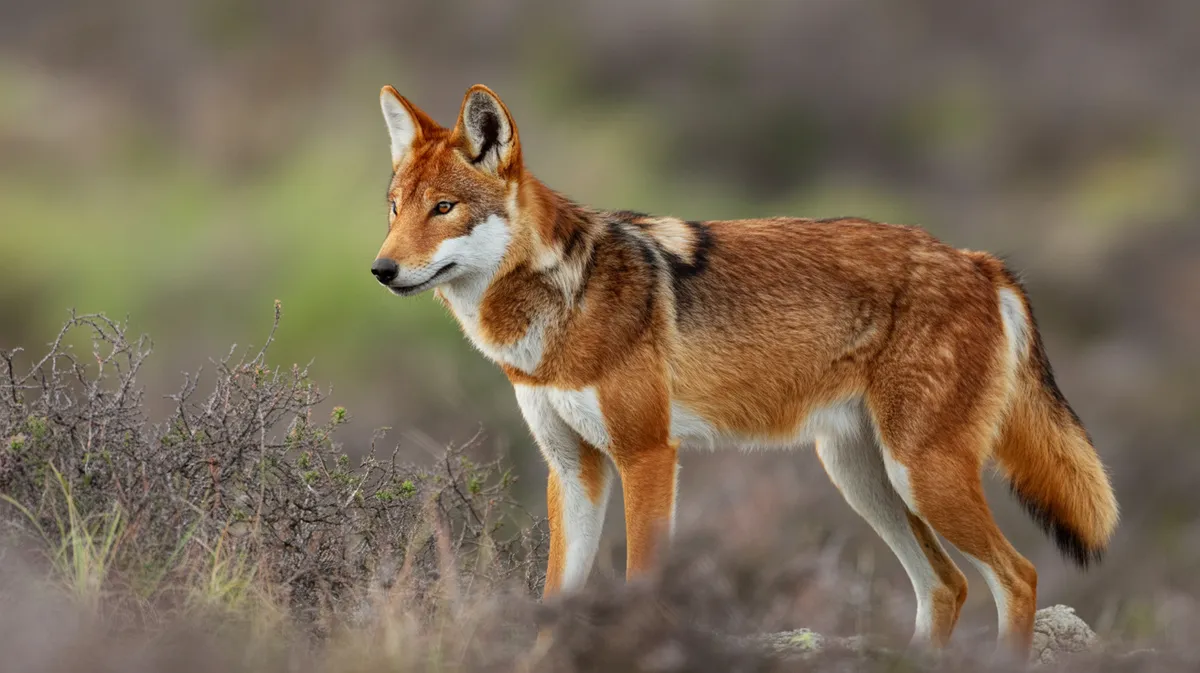
About the Ethiopian Wolf
Canis simensis is the rarest canid on Earth, with fewer than about 500 mature adults left, all of them confined to a handful of Afroalpine islands above roughly 3,000 m in the Ethiopian highlands — the Bale Mountains hold more than half of them. It looks like a long-legged, russet coyote, but it hunts like a fox: the long, narrow muzzle and widely spaced teeth are the equipment of a rodent specialist, and its whole diet is essentially the giant molerat and other highland rodents, stalked and dug out one at a time by a lone wolf. Yet it lives in tightly bonded social packs of up to a dozen. That combination is unusual and revealing — the pack exists not to hunt but to hold territory, patrolling and scent-marking a rodent-rich patch of moorland together at dawn and dusk, then dispersing to forage individually. Only the dominant female breeds, and the whole pack helps raise her pups. Its two great threats come from village dogs: rabies and canine distemper have repeatedly wiped out most of a population within weeks, and the response has been an oral vaccination programme delivering baited vaccine to wild wolves. Climate change is squeezing the Afroalpine habitat upward, with nowhere further to go.
Fascinating facts
High-Altitude Specialist
The Ethiopian Wolf is adapted to live above 3,000 meters (9,800 feet) in the cold, open Afroalpine regions of Ethiopia.
Rodent Expert
Over 90% of the Ethiopian Wolf’s diet consists of rodents, especially giant mole rats and grass rats.
Social Yet Solitary
While they live in packs for territory defense and breeding, Ethiopian Wolves usually hunt alone and rarely work together to catch prey.
Detailed description
The Ethiopian wolf (Canis simensis) is a medium-sized canid, with adults typically weighing 11–19 kg and measuring 84–100 cm in body length, with a bushy tail of 30–40 cm. Its striking appearance is characterized by a slender, elongated muzzle, long legs, and a dense, reddish-orange coat with white markings on the throat, chest, and underparts. The ears are large and pointed, aiding in thermoregulation and acute hearing. Adapted to the Afroalpine ecosystem, the Ethiopian wolf is built for speed and agility, enabling it to pursue small, fast-moving prey. Socially, these wolves live in cohesive family packs of 3–13 individuals, usually composed of a dominant breeding pair and their offspring. Despite their social structure, they hunt solitarily, primarily targeting endemic rodents such as the giant mole-rat (Tachyoryctes macrocephalus), which can comprise up to 50% of their diet. Packs cooperate in territory defense, pup rearing, and den maintenance. Reproduction is seasonal, timed to coincide with the end of the rainy season when prey is most abundant. The species is highly territorial, with home ranges averaging 6–13 km², marked and defended vigorously. Their vocal repertoire includes barks, yelps, and howls, used for communication within the pack and to deter rivals. The Ethiopian wolf is critically dependent on intact Afroalpine habitats above 3,000 meters, making it extremely vulnerable to environmental changes.
Did you know?
There are fewer than 500 Ethiopian Wolves left in the wild, making them one of the rarest canids on Earth.
Research & sources
Wikipedia summary
The Ethiopian wolf, also called the red jackal, the Simien jackal or Simien fox, is a canine native to the Ethiopian Highlands. In southeastern Ethiopia, it is also known as the horse jackal. It is similar to the coyote in size and build, and is distinguished by its long and narrow skull, and its red and white fur. Unlike most large canids, which are widespread, generalist feeders, the Ethiopian wolf is a highly specialised feeder of Afroalpine rodents with very specific habitat requirements. It is one of the world's rarest canids, and Africa's most endangered carnivore.
Behaviour & social structure
Ethiopian wolves exhibit a unique blend of solitary and social behaviors. While pack members share a communal den and cooperate in raising pups, hunting is almost exclusively a solitary activity, with individuals foraging during daylight hours (diurnal). Their hunting technique involves slow, methodical stalking and sudden pouncing to capture rodents from burrows. Packs maintain strict territorial boundaries, using scent marking and vocalizations to communicate presence and status. Social interactions within the pack are characterized by submissive and affiliative behaviors, such as muzzle licking and grooming, which reinforce social bonds. Dominance hierarchies are well established, with the alpha female and male monopolizing breeding. During the breeding season, pack cohesion increases, and subordinate members assist in guarding and provisioning the den. Ethiopian wolves are generally shy and avoid human contact, but may become more visible during the early morning and late afternoon when foraging activity peaks.
Reproduction & life cycle
Breeding in Ethiopian wolves is highly seasonal, typically occurring between October and January, aligning with the end of the rainy season. The dominant female is usually the sole breeder, while subordinate females are reproductively suppressed. After a gestation period of approximately 60–62 days, the alpha female gives birth to a litter of 2–6 pups in a concealed den, often located in rocky crevices or abandoned rodent burrows. Pups are altricial at birth, relying on the mother for warmth and nourishment. All pack members participate in pup rearing, providing food through regurgitation and guarding the den against predators. Pups are weaned at around 10 weeks and begin to accompany adults on short foraging trips by 3–4 months of age. Dispersal of young typically occurs at 1–2 years, with females more likely to remain in the natal pack and males dispersing to find new territories.
Adaptations & survival
The Ethiopian wolf exhibits several specialized adaptations for life in the Afroalpine environment. Its long limbs and slender body facilitate rapid pursuit of small, agile prey across open grasslands. The elongated muzzle and narrow jaws are adapted for probing rodent burrows and extracting prey. Thick, insulating fur protects against cold temperatures and high-altitude winds. Behavioral adaptations include diurnal activity patterns to maximize hunting efficiency and minimize competition with nocturnal predators. Social cooperation in territory defense and pup rearing enhances reproductive success in a challenging environment. The species’ highly specialized diet is an evolutionary response to the abundance of endemic rodents in its habitat, but also makes it vulnerable to fluctuations in prey populations.
Cultural significance
In Ethiopian folklore, the wolf is sometimes associated with cunning and is occasionally referenced in local proverbs and stories. However, it does not hold the same mythological or symbolic significance as larger carnivores like lions or hyenas. In some regions, the wolf is viewed with suspicion due to perceived threats to livestock, though actual depredation is rare. Conservation programs have increasingly engaged local communities, fostering a sense of pride and stewardship for this unique endemic species. The Ethiopian wolf has become a flagship species for Afroalpine conservation and is featured in national conservation campaigns and ecotourism initiatives.
Recent research
Recent research has focused on disease ecology, particularly the impact of rabies and canine distemper outbreaks, leading to the implementation of vaccination campaigns for both wolves and domestic dogs. Genetic studies have clarified the wolf’s evolutionary history, confirming its close relationship to the gray wolf complex but highlighting its long period of isolation and adaptation to high-altitude environments. Ongoing ecological studies monitor population dynamics, habitat use, and prey availability, informing adaptive management strategies. Conservation genetics research is assessing the extent of hybridization with domestic dogs and developing strategies to maintain genetic integrity. The Ethiopian Wolf Conservation Programme (EWCP) is a leading organization in both research and applied conservation.
Sources
Canis simensis (Ethiopian Wolf) – Mammalian Species
Claudio Sillero-Zubiri and David W. Macdonald (1997)
scientificCanis simensis: The IUCN Red List of Threatened Species 2021
IUCN SSC Canid Specialist Group
conservationVideos
Habitat
Afroalpine grassland and heathland


Conservation
The Ethiopian Wolf is currently classified as Endangered on the IUCN Red List.
Threats & challenges
The Ethiopian wolf faces a suite of severe threats, making it Africa’s most endangered carnivore. Habitat loss and fragmentation due to agricultural expansion, overgrazing, and human settlement are primary drivers of population decline. Infectious diseases, particularly rabies and canine distemper virus transmitted by domestic dogs, have caused catastrophic local die-offs. Hybridization with domestic dogs poses a genetic threat, potentially diluting the gene pool. Climate change is projected to further reduce suitable Afroalpine habitat, pushing populations into smaller, more isolated patches. Current estimates place the total population at fewer than 500 mature individuals, distributed across six isolated populations, with the largest in the Bale Mountains. Conservation efforts are challenged by limited resources, political instability, and the logistical difficulties of working in remote, high-altitude regions.
Taxonomy
Scientific name
Canis simensis
- Kingdom
- Animalia
- Phylum
- Chordata
- Class
- Mammalia
- Order
- Carnivora
- Family
- Canidae
- Genus
- Canis
- Species
- simensis
Community notes
Share your observations about the Ethiopian Wolf.
No community notes yet. Be the first!
Discover more wildlife
More fascinating animals from the encyclopedia.