
About the Eurasian Lynx
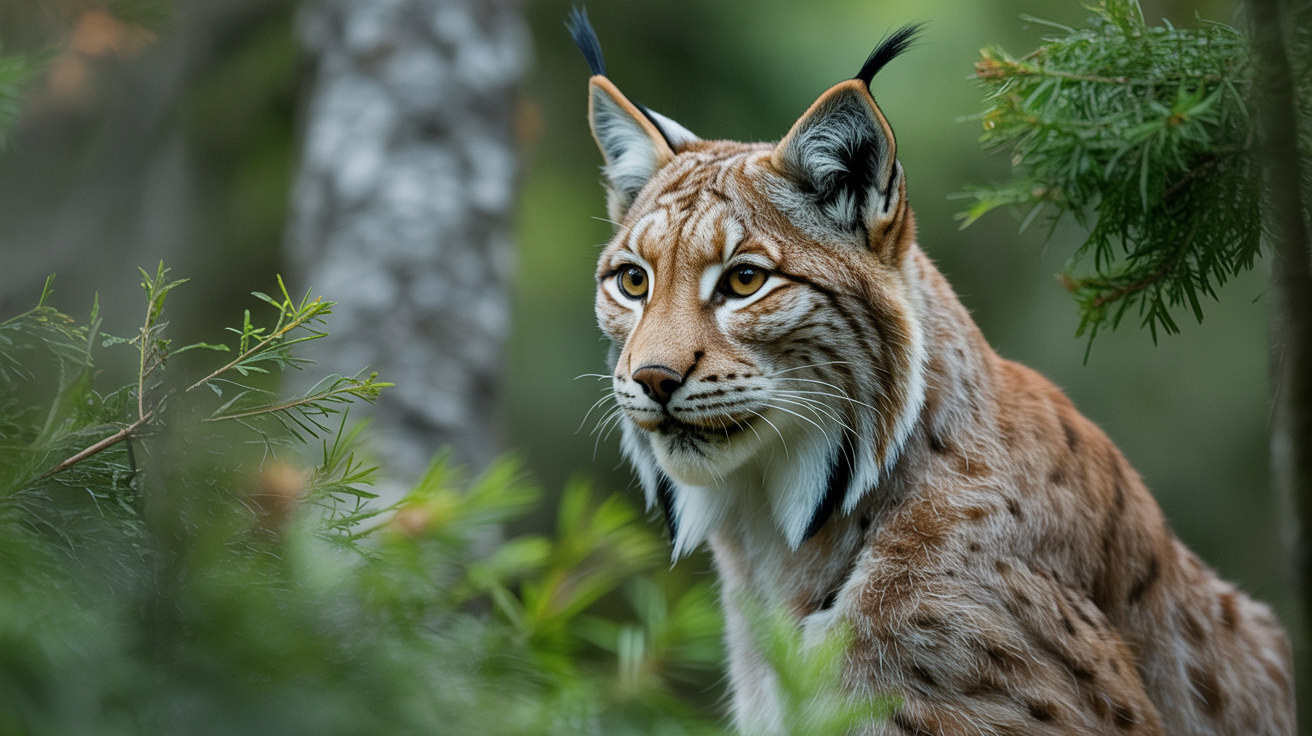
The Eurasian lynx is the largest of the four lynx species and Europe's third-largest predator, after the brown bear and the wolf. It is built for deep snow: its paws are exceptionally broad and splay on contact, working as snowshoes that keep it on a surface heavier prey like roe deer sink into — an advantage that makes winter its best hunting season rather than its hardest. The black ear tufts are not ornament; they are thought to work as antennae that sharpen its hearing, and lynx that lose them hunt less effectively. A wide facial ruff and large eyes support hunting at dawn and dusk, and it relies on a patient stalk and a short pounce rather than a chase, which its build cannot sustain. Unusually for a cat its size, it routinely kills prey substantially larger than itself, then caches the carcass and returns to it over several days. Solitary and famously elusive, it was hunted out of much of western Europe and has since been reintroduced in a number of countries.
Fascinating facts
Silent Hunter
Eurasian Lynxes are known for their stealthy hunting technique, often stalking their prey quietly before pouncing with explosive speed.
Tufted Ears
The lynx's characteristic black ear tufts improve its hearing and help it detect the slightest movements of prey.
Wide Range
This lynx species has one of the broadest ranges of any wild cat, spanning from Western Europe across Russia to Central Asia.
Detailed description
The Eurasian lynx (Lynx lynx) is the largest species within the genus Lynx, with adults typically weighing between 18 and 30 kg (40–66 lbs), though exceptionally large males can exceed 38 kg (84 lbs). Body length ranges from 80 to 130 cm (31–51 in), with a shoulder height of 60–75 cm (24–30 in). Its dense, soft fur varies seasonally from reddish or tawny in summer to a thicker, paler greyish coat in winter, often marked with dark spots or rosettes that provide camouflage in forested environments. Distinctive features include prominent black ear tufts, a ruff of facial fur, and a short, black-tipped tail. The Eurasian lynx is a solitary, territorial predator, primarily crepuscular and nocturnal, relying on stealth and acute senses to ambush prey. Its powerful limbs and large, furred paws enable efficient movement through deep snow and rugged terrain. The species occupies a broad range of habitats, from dense boreal and temperate forests to rocky alpine regions up to 5,500 meters (18,000 ft) elevation. As an apex predator, it plays a crucial ecological role in regulating populations of medium-sized ungulates and other prey, contributing to forest health and biodiversity.
Did you know?
The Eurasian Lynx was once extinct in parts of Western Europe but has been successfully reintroduced in several countries.
Research & sources
Wikipedia summary
The Eurasian lynx is one of the four extant species within the medium-sized wild cat genus Lynx. It is widely distributed from Northern, Central and Eastern Europe to Central Asia and Siberia, the Tibetan Plateau and the Himalayas. It inhabits temperate and boreal forests up to an elevation of 5,500 m (18,000 ft). Despite its wide distribution, it is threatened by habitat loss and fragmentation, poaching and depletion of prey.
Behaviour & social structure
Eurasian lynx are predominantly solitary, with individuals maintaining large, overlapping territories marked by scent and visual cues. Home range size varies widely, from 20 km² in prey-rich areas to over 400 km² in less productive regions. They are primarily crepuscular, with peak activity at dawn and dusk, but may be active at night or during the day depending on prey availability and human disturbance. The lynx is an ambush predator, relying on stealth and short bursts of speed to catch prey, which includes roe deer, chamois, red deer calves, hares, grouse, and other small mammals and birds. After a successful kill, the lynx often drags its prey to a secluded spot and covers it with leaves or snow, returning to feed over several days. Social interactions are limited outside of the breeding season, with vocalizations (yowls, growls, and purrs) and scent marking used for communication. Juveniles remain with their mother until late autumn or early winter, learning hunting skills before dispersing.
Reproduction & life cycle
The Eurasian lynx has a defined breeding season, typically from February to April. Females come into estrus once per year, with a receptive period lasting 3–7 days. Mating involves vocalizations and scent marking, and males may travel long distances to locate receptive females. After successful copulation, gestation lasts approximately 67–74 days. Females give birth in secluded dens, often in dense vegetation, rocky crevices, or fallen logs, producing litters of 1–4 kittens (most commonly 2–3). Kittens are born blind and helpless, weighing 240–300 grams (8.5–10.5 oz). Eyes open after 10–12 days, and weaning occurs at 2–3 months, though young may begin eating solid food as early as one month. The mother provides all parental care, teaching the kittens to hunt before they disperse at 10–11 months. Sexual maturity is reached at 2–3 years of age.
Adaptations & survival
The Eurasian lynx exhibits several adaptations for survival in cold, forested, and mountainous environments. Its thick, insulating fur and large, well-furred paws act as natural snowshoes, facilitating movement in deep snow. The short tail reduces heat loss and the risk of frostbite. Acute vision, including the ability to see well in low light, and exceptional hearing, aided by the ear tufts, enhance its ability to detect prey. Retractable claws and powerful forelimbs enable it to climb, leap, and subdue prey efficiently. Behavioral adaptations include solitary living to reduce competition for food and the use of stealth and ambush tactics in hunting. Seasonal coat color changes provide camouflage throughout the year.
Cultural significance
The Eurasian lynx holds a prominent place in the folklore and mythology of many Eurasian cultures, often symbolizing sharp vision, secrecy, and independence. In ancient Greek and Roman mythology, the lynx was associated with the ability to see through objects and was linked to the god Lynceus. In Slavic and Nordic traditions, it appears as a guardian of the forest and a symbol of wilderness. Historically, its fur was highly valued in the fur trade, contributing to population declines in some regions. Today, the lynx is a flagship species for forest conservation and ecological restoration projects across Europe.
Recent research
Recent genetic studies have revealed considerable subspecies diversity within the Eurasian lynx, with at least six recognized subspecies across its range. Ongoing research focuses on population genetics, dispersal patterns, and the effects of habitat fragmentation. GPS and radio telemetry studies have provided detailed insights into home range size, movement ecology, and habitat use. Reintroduction programs in Central and Western Europe are being closely monitored to assess genetic diversity, population viability, and ecosystem impacts. Studies on prey selection and lynx–ungulate dynamics are informing wildlife management and conservation strategies. Emerging research also investigates the effects of climate change on lynx distribution and prey availability.
Videos
Habitat
Temperate forest
 Polar and Subpolar Regions
Tundra
Cold, treeless regions with permafrost supporting specialized cold-adapted wildlife.
 Various Continental Regions
Grassland
Open areas dominated by grasses rather than trees, supporting numerous herbivores and their predators.
 Elevated Terrain
Mountain
High-altitude environments with varying climates and specialized wildlife adapted to rugged terrain and thin air.
 Global
Forest
Wooded areas with significant tree cover and diverse plant and animal communities.
Conservation
The Eurasian Lynx is currently classified as Least Concern on the IUCN Red List.
Threats & challenges
Despite its wide distribution, the Eurasian lynx faces significant threats, including habitat loss and fragmentation due to logging, agriculture, and infrastructure development. Poaching for fur and illegal hunting, especially in regions where lynx prey on livestock, remain persistent problems. Depletion of natural prey populations, particularly deer, can lead to increased conflict with humans. Road mortality and genetic isolation in fragmented populations also pose risks. While the species is classified as Least Concern globally, regional populations in Western and Central Europe are small, isolated, and vulnerable, often requiring active conservation measures such as reintroduction, habitat restoration, and anti-poaching efforts.
Taxonomy
Scientific name
Lynx lynx
- Kingdom
- Animalia
- Phylum
- Chordata
- Class
- Mammalia
- Order
- Carnivora
- Family
- Felidae
- Genus
- Lynx
- Species
- lynx
Where to see an eurasian lynx
11 zoos and aquariums in 7 countries are recorded as keeping this species.
 San Diego Zoo🇺🇸 San Diego, United States
 Tallinn Zoo🇪🇪 Tallinn, Estonia
 Alabama Gulf Coast Zoo🇺🇸 Gulf Shores, United States
 Birmingham Wildlife Conservation Park🇬🇧 Birmingham, United Kingdom
- 🦁Greater Vancouver Zoo🇨🇦 Canada
Community notes
Share your observations about the Eurasian Lynx.
No community notes yet. Be the first!
Discover more wildlife
More fascinating animals from the encyclopedia.