
About the European honey bee
A honey bee colony is best understood not as a group of insects but as a single distributed animal. A forager returning from a good food source performs a waggle dance on the vertical face of the comb, and the dance is symbolic: the angle of the waggle run relative to straight up encodes the direction of the food relative to the sun, and the duration of the waggle encodes the distance. It is a language, performed in the dark, on a vertical surface, describing a place the audience has never been — and there is almost nothing else like it outside our own species. The hive is climate-controlled: workers shiver their flight muscles to warm the brood nest and fan their wings or spread water to cool it, holding it near 35°C through winter and summer alike. A single worker produces roughly a twelfth of a teaspoon of honey in her entire life. Workers change roles with age — nurse, then builder, guard and finally forager — and the queen's pheromones keep the whole system in order.
Fascinating facts
Social Structure
European honey bee colonies can contain tens of thousands of individuals, each assigned specific roles such as queen, worker, or drone.
Honey Production
These bees produce honey by converting nectar through enzymatic activity and evaporation, storing it as a food source for the colony.
Waggle Dance
Worker bees perform a 'waggle dance' to inform others about the direction and distance to rich food sources.
Detailed description
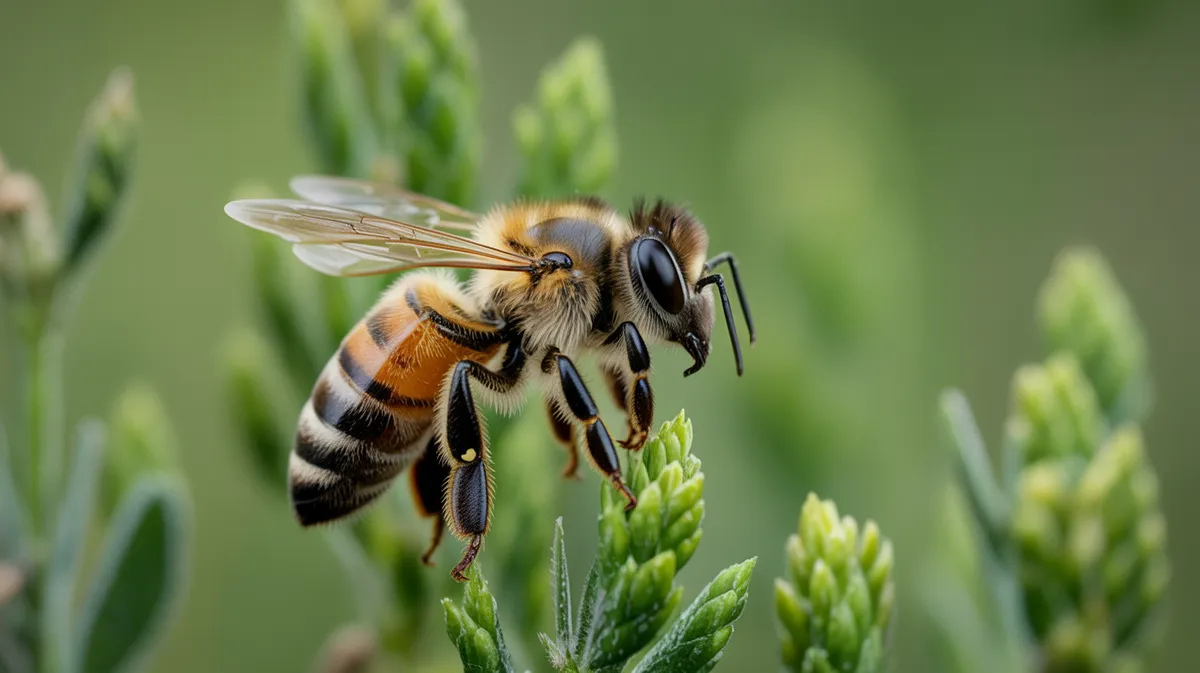
The European honey bee (Apis mellifera) is a medium-sized insect, typically measuring 12–15 mm in length, with a robust, hairy body exhibiting alternating bands of brown and black on the abdomen. Its head features large compound eyes and specialized mouthparts, including a long proboscis adapted for nectar collection. The species is eusocial, forming perennial colonies that can contain 20,000 to over 60,000 individuals during peak season. Colonies are organized into a strict caste system: a single fertile queen, thousands of sterile female workers, and several hundred male drones during the reproductive season. Workers perform age-related tasks, progressing from nursing larvae to foraging as they mature. Honey bees are renowned for their sophisticated communication, notably the 'waggle dance,' which conveys information about the direction and distance of food sources. Their nests, constructed from wax secreted by worker glands, consist of hexagonal cells used for brood rearing and food storage. Apis mellifera has a highly developed sense of smell and vision, enabling precise flower recognition and navigation over several kilometers. The species is capable of thermoregulation, maintaining brood nest temperatures between 32–36°C, even in cold climates. Their ability to produce, store, and regulate honey and pollen supplies allows them to survive adverse environmental conditions.
Did you know?
A single honey bee visits up to 5,000 flowers in one day while foraging for nectar and pollen.
Research & sources
Wikipedia summary
The western honey bee or European honey bee is the most common of the 7–12 species of honey bees worldwide. The genus name Apis is Latin for 'bee', and mellifera is the Latin for 'honey-bearing' or 'honey-carrying', referring to the species' production of honey.
Behaviour & social structure
European honey bees exhibit complex social behaviors, with division of labor based on age and physiological development. Young workers (nurse bees) care for brood, clean cells, and tend the queen, while older workers become foragers, collecting nectar, pollen, water, and propolis. Foraging bees display flower constancy, often visiting the same plant species during a foraging trip, which enhances pollination efficiency. Communication within the hive is highly developed: the waggle dance encodes spatial information about food sources, while pheromones regulate colony cohesion, reproductive status, and alarm responses. Defensive behaviors include coordinated stinging and alarm pheromone release when the hive is threatened. Daily activity is diurnal, with foraging peaking in the morning and early afternoon. Bees regulate hive temperature through fanning and water evaporation, and cluster together for warmth during cold periods.
Reproduction & life cycle
Reproduction in Apis mellifera centers on the queen, who mates during a single nuptial flight with 10–20 drones, storing sperm for her lifetime (up to 5 years). Drones are produced seasonally and die after mating. The queen lays fertilized eggs (female workers or future queens) and unfertilized eggs (males/drones) in wax cells. Worker bees rear new queens by feeding selected larvae royal jelly. Swarming, the natural reproductive process of the colony, occurs in spring or early summer when the old queen and a portion of the workers leave to establish a new nest, while a new queen emerges in the original colony. Brood development time varies: workers (21 days), queens (16 days), and drones (24 days). Parental care is provided by nurse bees, which feed and tend the developing brood.
Adaptations & survival
European honey bees possess numerous adaptations for survival. Their hairy bodies facilitate pollen collection and transfer, while specialized hind leg structures (pollen baskets or corbiculae) enable efficient transport. The proboscis is adapted for extracting nectar from diverse flower morphologies. Social organization and division of labor enhance colony resilience and productivity. Thermoregulation via collective fanning and clustering allows survival in temperate climates. Their ability to produce and store honey and pollen provides food security during periods of scarcity. Behavioral plasticity enables rapid adaptation to environmental changes, and their sophisticated navigation uses polarized light, the sun's position, and visual landmarks.
Cultural significance
Apis mellifera has profound cultural and economic importance. It is a symbol of industry, cooperation, and regeneration in many societies, appearing in ancient Egyptian, Greek, and Roman mythology. Honey and beeswax have been used for millennia in food, medicine, cosmetics, and religious rituals. The bee is an emblem in heraldry and a motif in art and literature. Modern agriculture relies heavily on managed honey bee pollination, contributing billions of dollars annually to global crop production. Beekeeping (apiculture) is a traditional practice with deep roots in rural economies and sustainable agriculture.
Recent research
Recent research has focused on honey bee health, genetics, and behavior. Genomic studies have revealed high genetic diversity and adaptation to local environments among subspecies. Investigations into the gut microbiome have highlighted its role in immunity and nutrition. Studies on pesticide impacts have led to regulatory changes in several countries. Advances in understanding bee communication, cognition, and learning have provided insights into insect neurobiology. Ongoing research aims to breed disease-resistant bees, improve hive management, and develop strategies to mitigate threats from pests and environmental stressors.
Sources
Videos
Habitat
Woodlands, meadows, grasslands, gardens, and agricultural areas


Conservation
The European honey bee is currently classified as Least Concern on the IUCN Red List.
Threats & challenges
European honey bees face multiple threats, including habitat loss, pesticide exposure (notably neonicotinoids), climate change, and competition with invasive species. Pathogens and parasites, such as Varroa destructor mites, Nosema spp. fungi, and viruses, are significant causes of colony losses. Colony Collapse Disorder (CCD), characterized by sudden worker disappearance, has been a major concern since the early 2000s, though its causes are multifactorial. Intensive agriculture reduces floral diversity and nesting sites, while global trade facilitates the spread of pests and diseases. Despite these challenges, Apis mellifera remains widespread, but local declines have prompted increased conservation and management efforts.
Taxonomy
Scientific name
Apis mellifera
- Kingdom
- Animalia
- Phylum
- Arthropoda
- Class
- Insecta
- Order
- Hymenoptera
- Family
- Apidae
- Genus
- Apis
- Species
- mellifera
Where to see an european honey bee
3 zoos and aquariums in 2 countries are recorded as keeping this species.
 Belfast Zoo🇬🇧 Belfast, United Kingdom
- 🦁Brandywine Zoo🇺🇸 Wilmington, United States
- 🦁Cheyenne Mountain Zoo🇺🇸 United States
Community notes
Share your observations about the European honey bee.
No community notes yet. Be the first!
Discover more wildlife
More fascinating animals from the encyclopedia.