
About the European Lobster
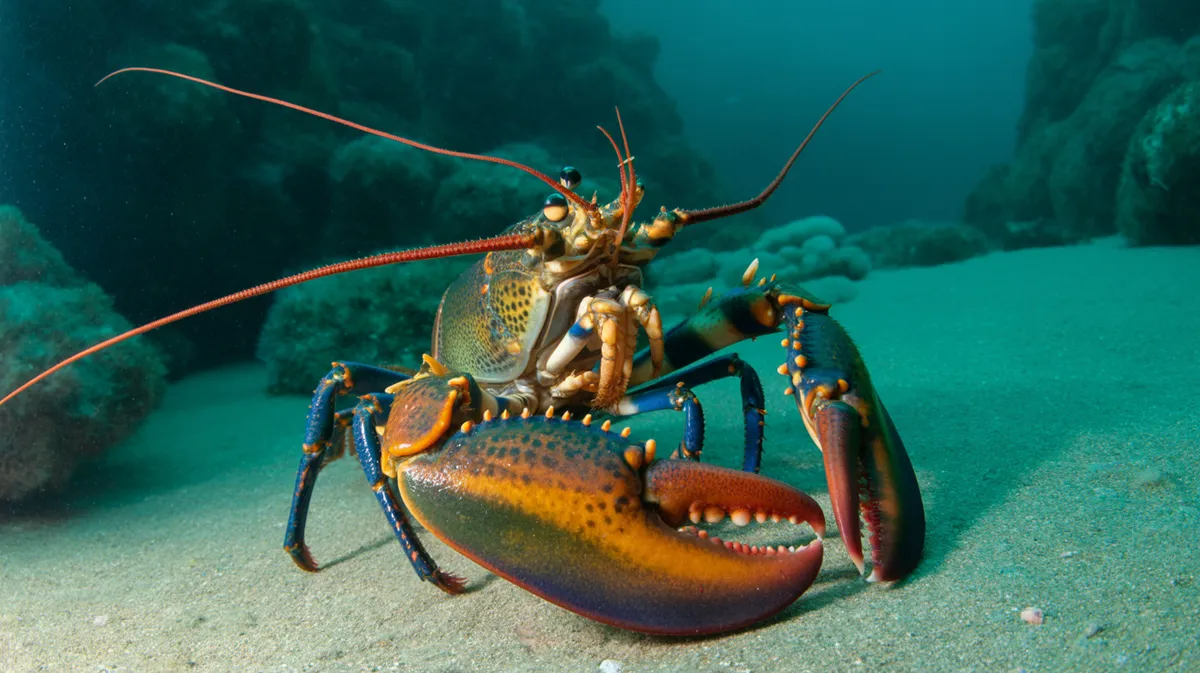
The European Lobster is a large marine crustacean distinguished by its dark blue to black coloration with lighter speckles, and it possesses robust, asymmetrical claws used for crushing and cutting prey. Found primarily in rocky crevices along the eastern Atlantic coastline, these lobsters prefer cold, temperate waters. They are mostly nocturnal and solitary, emerging at night to feed on a variety of marine organisms. European Lobsters play a crucial ecological role as both predator and prey, and they are also highly valued in commercial fisheries. Due to overfishing and habitat degradation, their populations are carefully monitored in many regions.
Fascinating facts
Color-Changing Shell
Although European Lobsters appear blue-black, their shells contain astaxanthin pigment that turns red when cooked due to heat-induced chemical changes.
Impressive Regeneration
If a lobster loses a claw, leg, or antenna, it can gradually regenerate the lost appendage over several molts.
Deep Dwellers
European Lobsters can be found at depths of up to 150 meters, though they are most common between 5 and 50 meters in rocky coastal regions.
Detailed description
The European lobster (Homarus gammarus) is a robust, heavily armored crustacean reaching lengths of up to 60 cm and weights of 6 kg, though most adults encountered are between 23–50 cm. Its exoskeleton is typically a deep blue to bluish-black, mottled with lighter spots, and turns bright red only after cooking due to the denaturation of astaxanthin pigments. The body is divided into a cephalothorax and a muscular, segmented abdomen ending in a broad tail fan. It possesses two large, asymmetrical claws: the crusher, which is broad and used for breaking shells, and the cutter (or pincer), which is slender and sharp for slicing prey. The lobster’s long, red antennae are highly sensitive, aiding in navigation and prey detection in the often-turbid, rocky environments it inhabits. It has compound eyes on movable stalks, providing a wide field of vision. European lobsters are primarily nocturnal, sheltering in crevices during the day and emerging at night to forage. They are solitary and highly territorial, aggressively defending their burrows. Their diet is diverse, including mollusks, crustaceans, echinoderms, and occasionally carrion. Growth is achieved through periodic molting, with juveniles molting several times per year and adults less frequently. Lifespans can exceed 40–50 years in the wild, making them among the longest-lived marine invertebrates.
Did you know?
European Lobsters can live for decades and may not reach sexual maturity until they are over 6 years old.
Research & sources
Wikipedia summary
Homarus gammarus, known as the European lobster or common lobster, is a species of clawed lobster from the eastern Atlantic Ocean, Mediterranean Sea and parts of the Black Sea. It is closely related to the American lobster, H. americanus. It may grow to a length of 60 cm (24 in) and a mass of 6 kilograms (13 lb), and bears a conspicuous pair of claws. In life, the lobsters are blue, only becoming "lobster red" on cooking. Mating occurs in the summer, producing eggs which are carried by the females for up to a year before hatching into planktonic larvae. Homarus gammarus is a highly esteemed food, and is widely caught using lobster pots, mostly around the British Isles.
Behaviour & social structure
European lobsters are predominantly solitary and exhibit strong territoriality, often occupying and defending a single burrow or crevice for extended periods. They are nocturnal foragers, emerging after dusk to hunt and scavenge. Their feeding strategy involves using their chelae to manipulate, crush, or cut prey such as bivalves, gastropods, small fish, and other crustaceans. Lobsters communicate and establish dominance through a combination of posturing, antennae waving, and chelae displays. Aggressive encounters can escalate to physical combat, especially during competition for shelter or mates. They are known to migrate short distances seasonally, often moving to deeper waters in winter. Molting is a vulnerable period, during which lobsters may remain hidden for days to allow their new exoskeleton to harden.
Reproduction & life cycle
Mating in Homarus gammarus occurs primarily in late spring to summer, shortly after the female has molted and her shell is still soft. Males court receptive females through tactile and chemical cues. Copulation involves the male depositing spermatophores into the female's seminal receptacle. Females carry fertilized eggs (up to 20,000–40,000 per brood) attached to their pleopods (swimmerets) beneath the abdomen for 9–12 months, depending on water temperature. This extended brooding period provides protection and oxygenation for the developing embryos. Upon hatching, larvae are planktonic and undergo three molts over 2–3 weeks before settling to the benthos as juvenile lobsters. Juvenile survival rates are low due to predation and cannibalism. Females reach sexual maturity at 5–8 years of age, depending on environmental conditions.
Adaptations & survival
European lobsters possess several adaptations for survival in their rocky, coastal habitats. Their powerful claws are specialized for both predation and defense, with the crusher claw capable of exerting forces exceeding 100 Newtons. The blue-black coloration provides camouflage among rocks and seaweed. Chemoreceptors on their antennae and legs allow them to detect food and pheromones in low-visibility environments. The ability to regenerate lost limbs is a key adaptation to predation and intraspecific conflict. Their nocturnal habits reduce predation risk from diurnal predators. The extended larval planktonic stage aids in dispersal, enhancing genetic exchange between populations.
Cultural significance
The European lobster has been a valued delicacy in European cuisine for centuries, symbolizing luxury and festivity. It features prominently in coastal traditions of the British Isles, France, and Scandinavia. Lobster fishing has shaped local economies and maritime heritage, with traditional potting methods passed down through generations. In folklore, lobsters are sometimes associated with transformation and regeneration due to their molting process. The species is also used in scientific research as a model for studying crustacean neurobiology and regeneration.
Recent research
Recent research has focused on the genetic structure of European lobster populations, revealing significant regional differentiation and limited larval dispersal, which has implications for fisheries management and stock enhancement programs. Studies on lobster behavior have elucidated the role of chemical communication in mate selection and territoriality. Advances in aquaculture techniques have improved juvenile survival rates, offering potential for restocking depleted areas. Ongoing work is examining the impacts of ocean warming and acidification on lobster physiology, shell formation, and disease susceptibility. Tagging and telemetry studies are providing new insights into movement patterns, habitat use, and the effectiveness of marine protected areas.
Videos
Habitat
Temperate coastal waters, rocky reefs

Conservation
The European Lobster is currently classified as Vulnerable on the IUCN Red List.
Threats & challenges
Major threats to European lobster populations include overfishing, particularly of large, reproductive adults, which can destabilize population structure. Habitat degradation from coastal development, pollution, and destructive fishing practices (e.g., bottom trawling) further impact their numbers. Disease outbreaks, such as shell disease, have been reported in some regions. Climate change poses additional risks by altering sea temperatures and potentially shifting suitable habitat ranges. Despite fisheries management measures (e.g., minimum landing sizes, closed seasons, and v-notching of berried females), some stocks remain vulnerable or locally depleted. The IUCN currently lists the species as Vulnerable, with ongoing monitoring and conservation actions in place.
Taxonomy
Scientific name
Homarus gammarus
- Kingdom
- Animalia
- Phylum
- Arthropoda
- Class
- Malacostraca
- Order
- Decapoda
- Family
- Nephropidae
- Genus
- Homarus
- Species
- gammarus
Community notes
Share your observations about the European Lobster.
No community notes yet. Be the first!
Discover more wildlife
More fascinating animals from the encyclopedia.