
About the European peacock butterfly
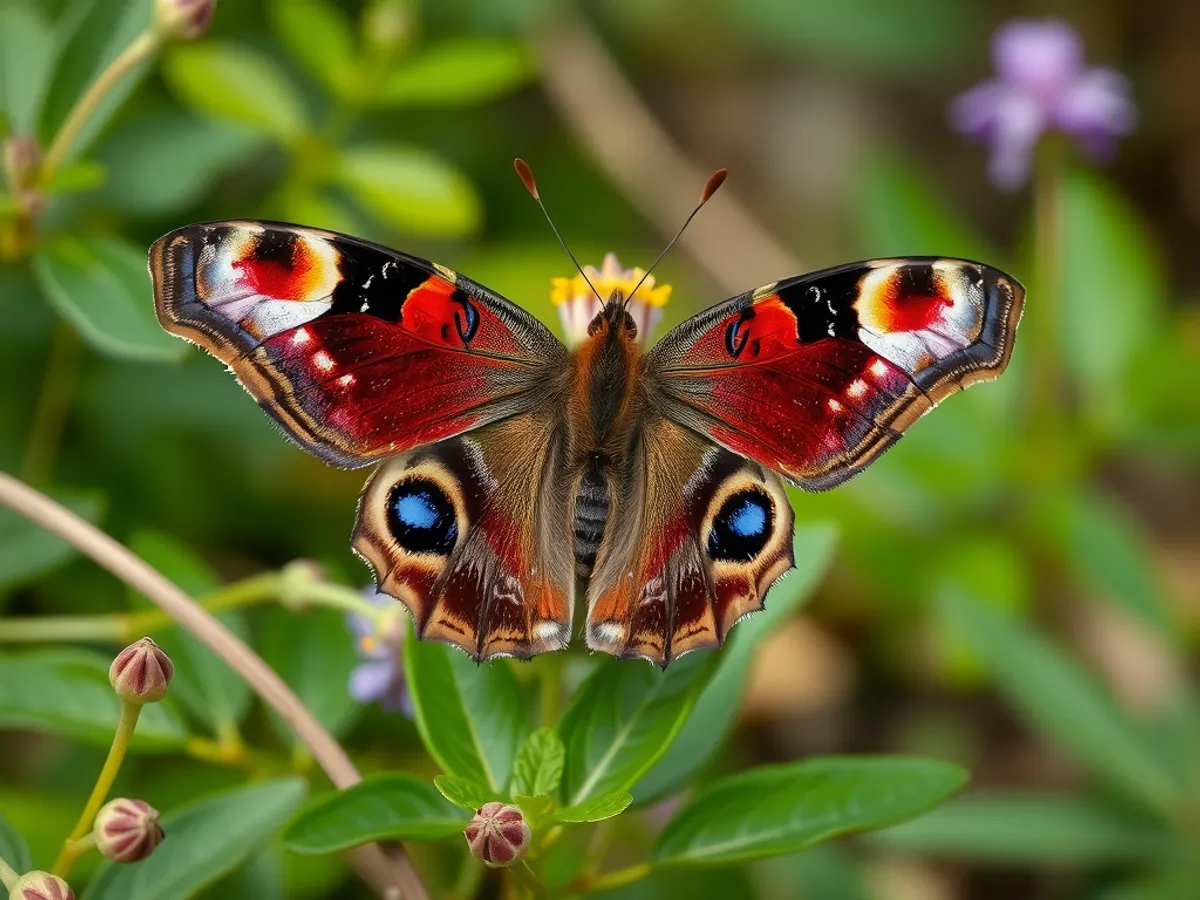
Aglais io is a butterfly with two entirely different defences and a strict sequence for using them. Its wings, when closed, are near-black with fine cryptic veining, and a resting peacock on a tree trunk or in a woodpile is essentially a dead leaf. If a predator gets close, it snaps its wings open, and four enormous eyespots — two on the forewings, two on the hindwings — appear at once. Experiments with wild blue tits have shown that this display alone is enough to make small birds abandon the attack, and that painting out the eyespots removes the protection. At the same moment the butterfly also rubs the veins of its forewings and hindwings together, producing a hissing, rasping sound audible to a human, and separate work has shown the sound alone deters mice; the ultrasonic component of it may also disrupt bats. So the peacock has a visual defence tuned to birds and an acoustic one tuned to mammals, deployed simultaneously. The species overwinters as an adult, hiding in hollow trees, sheds and lofts, which means an individual butterfly can live for the best part of a year and is among the first insects seen flying on a warm day in early spring. Its caterpillars are jet black and spiny and feed communally in a silk web on stinging nettles.
Fascinating facts
Impressive Eyespots
The bold eyespots on the wings serve as a defense mechanism, confusing or scaring off potential predators like birds.
Nettle Specialists
Caterpillars of the European peacock butterfly feed almost exclusively on stinging nettle plants, which provide both food and protection.
Winter Survivors
Adults hibernate in dark, sheltered places such as hollow trees, sheds, or attics, enabling them to survive harsh winters.
Detailed description
The European peacock butterfly (Inachis io), now often classified as Aglais io, is a medium-sized nymphalid butterfly with a wingspan typically ranging from 50 to 55 mm. Its most distinctive feature is the large, iridescent eyespots on each of its four wings, which serve as a defense mechanism against predators. The dorsal wing surface is a rich reddish-brown, while the ventral side is dark brown to black, providing excellent camouflage when the wings are closed. The body is robust and covered in fine hairs, with clubbed antennae typical of the family Nymphalidae. Adults are diurnal and exhibit basking behavior to regulate body temperature, often seen with wings fully spread in sunlight. The species is univoltine in most of its range, producing one generation per year. Larvae are black with spines and feed gregariously on stinging nettles (Urtica dioica), while adults primarily consume nectar from a variety of flowering plants. Overwintering occurs in the adult stage, with individuals seeking sheltered locations such as hollow trees, sheds, or attics. The European peacock is highly mobile and can disperse over long distances, contributing to its wide distribution across Europe and temperate Asia.
Did you know?
Despite their delicate appearance, European peacock butterflies can survive freezing winter temperatures by entering a state of dormancy.
Research & sources
Behaviour & social structure
European peacock butterflies are solitary as adults but display gregarious behavior during the larval stage, with caterpillars feeding in groups for increased protection. Adults are most active in warm, sunny conditions and are frequently observed basking to elevate their body temperature for flight. Their feeding behavior is opportunistic, with adults visiting a wide range of nectar sources, including buddleia, thistles, and dandelions. They also exhibit mud-puddling, drinking from damp soil to obtain minerals. When threatened, adults flash their wings to display the eyespots, startling potential predators such as birds. If further provoked, they may produce a hissing sound by rubbing their wings together. Daily routines include early morning basking, followed by foraging flights, and seeking shelter during inclement weather.
Reproduction & life cycle
Mating occurs in early spring soon after adults emerge from hibernation. Males establish and defend territories, often perching in sunny spots to intercept passing females. Courtship involves a series of visual and chemical cues. After mating, females lay clusters of 200–500 eggs on the undersides of nettle leaves. The eggs hatch after about 7–14 days, depending on temperature. Larvae undergo five instars over 3–4 weeks, feeding communally before dispersing to pupate. Pupation occurs in a suspended chrysalis, which lasts for approximately two weeks. There is little to no parental care beyond egg-laying, and the new generation of adults emerges in late summer. These adults feed intensively to build fat reserves for overwintering.
Adaptations & survival
The European peacock butterfly possesses several notable adaptations. The large eyespots on the wings are a classic example of deimatic (startle) coloration, deterring avian predators by mimicking the eyes of larger animals. The cryptic coloration of the ventral wing surfaces provides camouflage when at rest. Overwintering as adults allows them to exploit early spring resources before many other insects are active. Larvae are covered in spines, making them unpalatable to many predators. Physiologically, adults can enter a state of diapause to survive cold winter months, reducing metabolic activity and relying on stored fat reserves. Their ability to utilize a wide range of nectar sources and disperse over large areas contributes to their ecological success.
Cultural significance
The European peacock butterfly has long been admired for its beauty and is a popular subject in European art, literature, and folklore. Its early spring appearance is often associated with renewal and the arrival of warmer weather. In some cultures, butterflies symbolize transformation and the soul, with the peacock butterfly's eyespots adding an element of mystique. It is frequently featured in educational materials and conservation campaigns, serving as an ambassador species for butterfly-friendly gardening and habitat restoration.
Recent research
Recent research has focused on the genetic basis and developmental mechanisms underlying eyespot formation, providing insights into evolutionary biology and mimicry. Studies using mark-recapture and citizen science data have improved understanding of dispersal patterns and population dynamics. The impact of climate change on phenology and range shifts is an active area of investigation, with some evidence suggesting earlier emergence and northward expansion. There is also interest in the butterfly's overwintering physiology, particularly the mechanisms that allow adults to survive prolonged periods of cold. Ongoing monitoring programs track population trends and inform conservation strategies.
Videos
Habitat
Woodlands, meadows, gardens, and parks


Conservation
The European peacock butterfly is currently classified as Least Concern on the IUCN Red List.
Threats & challenges
Currently classified as Least Concern, the European peacock butterfly faces localized threats from habitat loss, pesticide use, and climate change. The decline of stinging nettle populations due to agricultural practices can limit larval food sources. Urbanization and intensive farming reduce suitable overwintering sites and nectar availability. Climate change may alter phenology, potentially causing mismatches between emergence and resource availability. However, the species' adaptability and wide distribution have allowed populations to remain stable or even increase in some regions. Monitoring is ongoing to detect any emerging threats, particularly in areas experiencing rapid environmental change.
Taxonomy
Scientific name
Aglais io
- Kingdom
- Animalia
- Phylum
- Arthropoda
- Class
- Insecta
- Order
- Lepidoptera
- Family
- Nymphalidae
- Genus
- Aglais
- Species
- io
Community notes
Share your observations about the European peacock butterfly.
No community notes yet. Be the first!
Discover more wildlife
More fascinating animals from the encyclopedia.