
About the Eyelash Viper
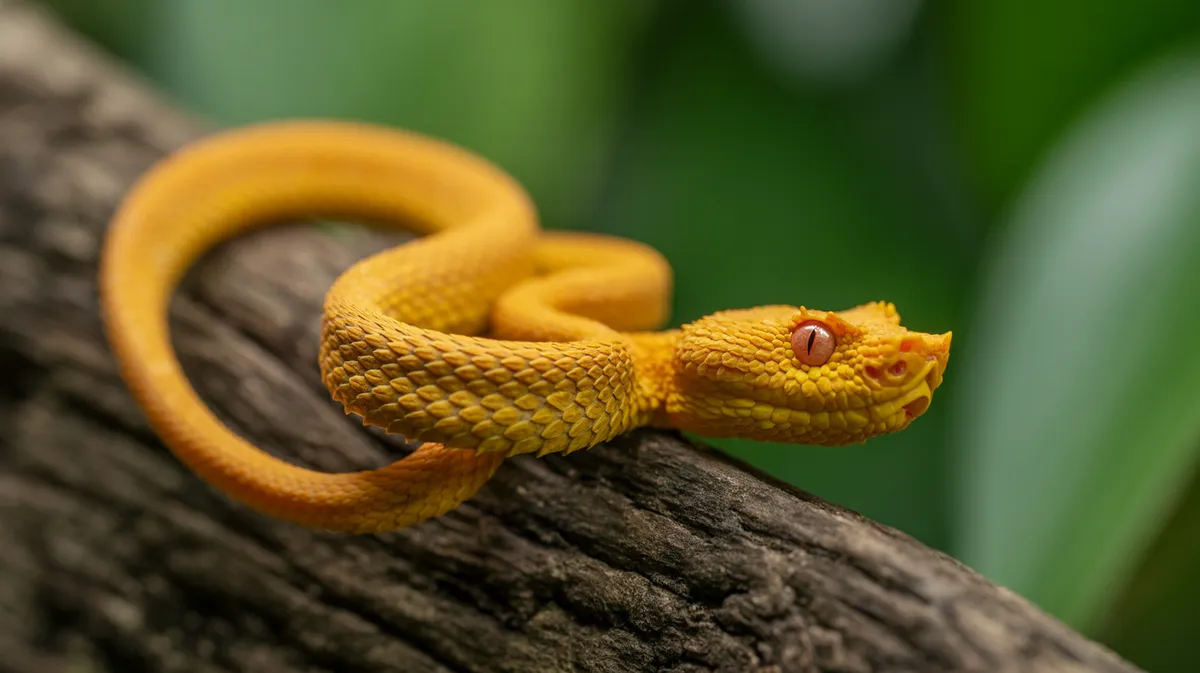
Bothriechis schlegelii is a small arboreal pit viper of Central and northern South America named for the cluster of modified scales that stand up above each eye like lashes. Their function is unresolved, but the leading suggestions are that they shield the eye as the snake pushes through foliage or that they break up the outline of the head. What makes the species genuinely unusual is its colour: within a single population it can be lichen green, mottled brown, pink, silver, or a startling uniform gold — the "oropel" form — and the different colours are not subspecies but a genuine polymorphism, with different morphs sitting in different microhabitats. It is a sit-and-wait ambusher that anchors itself to a branch with a prehensile tail and waits, sometimes for days, in exactly the same coil. Hummingbirds are a favoured target: an eyelash viper will position itself beside flowering heliconia or at a feeder and strike birds out of the air as they hover. Deep heat-sensing pits between eye and nostril let it hunt warm-blooded prey in total darkness, and young snakes, too small for birds and rodents, eat frogs and lizards instead and even wave their pale tail tip as a lure. It is a frequent stowaway in banana shipments.
Fascinating facts
Arboreal Expert
Eyelash Vipers spend most of their lives in trees, relying on their prehensile tails to navigate branches and ambush prey.
Colorful Camouflage
They display a wide variety of color morphs—yellow, green, brown, and more—allowing them to blend seamlessly into flowers, moss, and foliage.
Superciliary Scales
The unique 'eyelash' scales above their eyes are not for vision, but likely help with camouflage by disrupting the snake's outline.
Detailed description
The Eyelash Viper (Bothriechis schlegelii) is a small, slender-bodied pit viper, typically measuring 55–82 cm (22–32 in) in total length, with females generally larger than males. Its most distinctive feature is the presence of modified supraocular scales above each eye, forming 'eyelash'-like projections that may aid in camouflage by breaking up the snake’s outline among foliage. The head is broad and triangular with a pronounced neck, and the body is prehensile, allowing for adept climbing and anchoring among branches. Coloration is highly polymorphic, ranging from vivid yellow ('oropel' morph) to green, brown, red, or even pink, often with speckling or patterning that enhances concealment. The ventral surface is usually lighter, and the tail is prehensile, assisting in arboreal locomotion. The eyes have vertical pupils, and heat-sensitive loreal pits between the eyes and nostrils enable detection of warm-blooded prey. Eyelash Vipers are primarily nocturnal and arboreal, spending much of their time coiled on branches or in bromeliads. Their venom is hemotoxic, adapted for subduing small vertebrates, but bites to humans are rare due to their secretive nature. This species exhibits solitary behavior outside of the breeding season and is generally non-aggressive unless provoked.
Did you know?
Despite their small size and delicate appearance, Eyelash Vipers can deliver a venomous bite that is potentially dangerous to humans.
Research & sources
Wikipedia summary
Bothriechis schlegelii, known commonly as the highland eyelash-pitviper, Schlegel's eyelash-pitviper, or eyelash viper, is a species of pit viper in the family Viperidae, native to Colombia.
Behaviour & social structure
Eyelash Vipers are ambush predators, relying on their cryptic coloration and motionless posture to avoid detection by both prey and predators. They typically remain coiled on branches, vines, or within epiphytic plants, waiting for small birds, lizards, frogs, or rodents to approach. Prey is detected using a combination of visual cues and infrared-sensitive pit organs. Upon striking, the viper delivers a rapid envenomation and then releases the prey, tracking it by scent if necessary. Feeding occurs primarily at night, and individuals may go several weeks between meals. Social interactions are minimal; individuals are solitary and territorial, with occasional encounters during the breeding season. Defensive behaviors include rapid strikes, body inflation, and tail vibration. They are known to exhibit site fidelity, returning to favored ambush spots.
Reproduction & life cycle
Bothriechis schlegelii is ovoviviparous, meaning females retain eggs internally and give birth to live young. Mating occurs during the rainy season, typically from March to May, with males engaging in 'combat dances' to compete for receptive females. Gestation lasts approximately 5–6 months, after which the female gives birth to 6–20 neonates, each measuring about 15–20 cm (6–8 in) in length. Neonates are fully independent at birth and possess functional venom glands. There is no parental care post-birth. Sexual maturity is usually reached at 2–3 years of age, depending on environmental conditions and food availability.
Adaptations & survival
The Eyelash Viper’s most notable adaptation is its cryptic coloration, which varies geographically and even within populations, providing camouflage in diverse microhabitats. The superciliary 'eyelash' scales likely disrupt the outline of the head, aiding in concealment. Its prehensile tail is a key arboreal adaptation, enabling secure movement and anchoring in trees and shrubs. The heat-sensitive loreal pits allow precise detection of endothermic prey, even in complete darkness. Venom composition is primarily hemotoxic, rapidly immobilizing prey and aiding in digestion. Slow metabolism and the ability to go extended periods without food are advantageous in unpredictable rainforest environments.
Cultural significance
In regions where it is found, the Eyelash Viper features in local folklore and is sometimes associated with beauty or danger due to its striking appearance. The 'oropel' (golden) morph is particularly notable in Costa Rican culture. While not commonly used in traditional medicine, the species is occasionally referenced in indigenous stories as a symbol of stealth or transformation. Its vivid coloration has made it a popular subject in ecotourism and wildlife photography, contributing to local economies and conservation awareness.
Recent research
Recent research has focused on the genetic diversity and color polymorphism of Bothriechis schlegelii, revealing that coloration is not strictly linked to geography, suggesting complex evolutionary pressures. Studies on venom composition have identified unique protein profiles with potential biomedical applications, including anticoagulant and cytotoxic properties. Ongoing ecological studies are examining the species’ role in controlling small vertebrate populations and its interactions with sympatric snake species. Advances in radio telemetry have provided new insights into home range, movement patterns, and habitat use, informing conservation strategies.
Videos
Habitat
Tropical rainforest
 Elevated Terrain
Mountain
High-altitude environments with varying climates and specialized wildlife adapted to rugged terrain and thin air.
 Tropical Regions
Rainforest
Dense, wet forests with the highest biodiversity on Earth, containing more than half of the world's plant and animal species.
 Global
Forest
Wooded areas with significant tree cover and diverse plant and animal communities.
Conservation
The Eyelash Viper is currently classified as Least Concern on the IUCN Red List.
Threats & challenges
Although currently listed as Least Concern by the IUCN, Eyelash Vipers face localized threats from habitat loss due to deforestation, agricultural expansion, and urbanization throughout their range in Central and northern South America. Illegal collection for the pet trade, while not a major threat, can impact certain populations. Road mortality and persecution by humans, often due to fear or misunderstanding, also pose risks. Climate change may alter the distribution of suitable habitats, potentially affecting future population stability. Despite these challenges, the species remains widespread and adaptable in undisturbed rainforest habitats.
Taxonomy
Scientific name
Bothriechis schlegelii
- Kingdom
- Animalia
- Phylum
- Chordata
- Class
- Reptilia
- Order
- Squamata
- Family
- Viperidae
- Genus
- Bothriechis
- Species
- schlegelii
Where to see an eyelash viper
4 zoos and aquariums in 1 country are recorded as keeping this species.
 National Zoological Park🇺🇸 Washington, United States
 Gladys Porter Zoo🇺🇸 Brownsville, United States
- 🦁Tulsa Zoo🇺🇸 Tulsa, United States
 The Miami-Dade Zoological Park and Gardens🇺🇸 United States
Community notes
Share your observations about the Eyelash Viper.
No community notes yet. Be the first!
Discover more wildlife
More fascinating animals from the encyclopedia.