
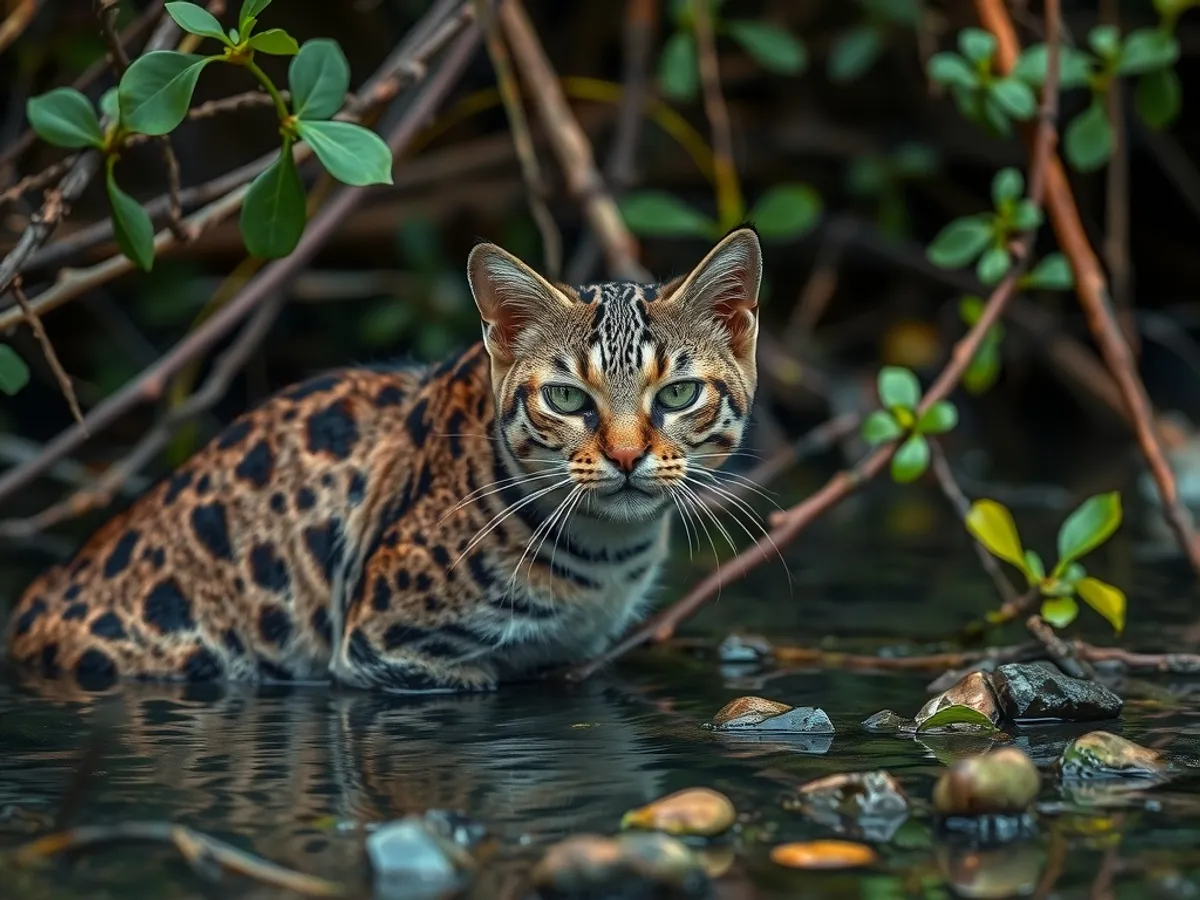
About the Fishing Cat
Prionailurus viverrinus is a stocky, roughly twice-domestic-cat-sized predator of the wetlands, mangroves and reedbeds of South and Southeast Asia, and it is one of the few cats that genuinely likes water. It swims strongly, dives, and hunts fish by crouching at the water's edge and plunging in head-first, or by wading and scooping with a paw. Its adaptations are quieter than the folklore suggests: the webbing between the toes is only modestly more developed than in many cats, but the claws do not retract fully into their sheaths, giving permanent purchase in mud and on a thrashing fish, and its coat is double-layered — a short dense underfur that traps a layer of air and keeps the skin dry, under a longer guard coat. It is not a fish specialist to the exclusion of everything else; rodents, birds, snakes and even carrion make up a large part of the diet, and in some studies rodents outweigh fish. The species is endangered, and the reason is uncomplicated: it is a wetland obligate in a part of the world where wetlands are being drained, converted to aquaculture ponds or built over faster than almost any other habitat, and its strongholds are now places like the Sundarbans, the Terai and Sri Lankan marshes.
Fascinating facts
Webbed Feet
The Fishing Cat's front feet are partially webbed, giving it an advantage when swimming and hunting aquatic prey.
Fish Specialists
Although capable of hunting various animals, these cats specialize in catching fish, often diving and swimming underwater to secure their meals.
Wetland Dwellers
Fishing Cats are closely tied to wetlands and are rarely found far from water, making them highly vulnerable to habitat loss from wetland drainage.
Detailed description
The fishing cat (Prionailurus viverrinus) is a robust, medium-sized felid distinguished by its muscular build, short legs, and relatively short tail, which measures about one-third the length of its head and body. Adults typically range from 57 to 78 cm in head-body length, with males weighing 8–17 kg and females 5–9 kg, exhibiting pronounced sexual dimorphism. Its dense, olive-grey fur is marked with dark spots that often merge into longitudinal stripes along the neck and back, providing camouflage in riparian vegetation. The skull is broad with a short, rounded muzzle and strong jaws, adapted for grasping slippery prey. Notably, the fishing cat's front feet are partially webbed, and its claws protrude slightly even when retracted, enhancing its ability to catch aquatic animals. The eyes are set forward, providing binocular vision crucial for hunting. The species is primarily nocturnal and crepuscular, with activity peaks at dusk and dawn, and is known for its solitary and elusive nature. Fishing cats are highly adapted to wetland environments, and their diet is dominated by fish, but they also consume amphibians, crustaceans, birds, small mammals, and occasionally scavenge on carrion. Their vocalizations include a range of growls, hisses, and a distinctive chuckling call. The fishing cat's life expectancy in the wild is estimated at 10–12 years, though individuals in captivity may live longer.
Did you know?
Unlike most felines, Fishing Cats can swim underwater and dive after fish, making them uniquely adapted among wild cats.
Research & sources
Wikipedia summary
The fishing cat is a medium-sized wild cat of South and Southeast Asia. It has a deep yellowish-grey fur with black lines and spots. Adults have a head-to-body length of 57 to 78 cm, with a 20 to 30 cm long tail. Males are larger than females, weighing 8 to 17 kg, while females average 5 to 9 kg. It lives mostly in the vicinity of wetlands, along rivers, streams, oxbow lakes, in swamps and mangroves where it preys mostly on fish. Other prey items include birds, insects, small rodents, molluscs, reptiles including snakes, amphibians and carrion of cattle. The fishing cat is thought to be primarily nocturnal. It is a good swimmer and can swim long distances, even underwater.
Behaviour & social structure
Fishing cats are solitary and territorial, with individuals maintaining exclusive home ranges that may overlap only at the peripheries. They are skilled swimmers, often observed wading in shallow water or swimming across channels up to several hundred meters wide. Their hunting strategy involves both active stalking along water edges and a sit-and-wait approach, where they tap the water's surface to mimic insect movements and attract fish. They have been documented to dive completely underwater to pursue prey, a rare behavior among felids. Fishing cats mark their territories with scent markings, using urine spraying, fecal deposits, and claw raking on trees or ground. Communication is primarily olfactory and visual, with limited vocal interaction outside of the breeding season. They are generally crepuscular to nocturnal, resting during the day in dense vegetation or reed beds. While typically solitary, mothers are highly attentive to their young, and temporary associations may occur during mating or between females and dependent offspring.
Reproduction & life cycle
Fishing cats are polyestrous, with breeding occurring year-round in some regions but peaking during late winter to early spring (January–March) in others. Courtship involves vocalizations, scent marking, and mutual grooming. After a gestation period of approximately 63–70 days, females give birth to litters of 1–4 kittens, usually in secluded dens constructed in dense reeds, hollow logs, or under thick vegetation. Kittens are born blind and helpless, weighing around 170–200 grams, and their eyes open after about 10–12 days. The mother provides extensive care, nursing the young for up to two months and introducing them to solid food at around 50 days. Juveniles begin to accompany the mother on hunting excursions at about three months and become independent at 8–10 months. Sexual maturity is reached at 15–18 months.
Adaptations & survival
The fishing cat exhibits several unique adaptations for its semi-aquatic lifestyle. Its partially webbed forepaws and semi-retractile claws facilitate efficient swimming and grasping of slippery prey. The dense, water-resistant fur provides insulation and buoyancy, while the short, muscular tail acts as a rudder during swimming. Their nostrils can close underwater, and they possess a robust jaw musculature for catching and subduing fish. The eyes are positioned for optimal vision in low light, aiding nocturnal hunting. Behaviorally, fishing cats have developed specialized hunting techniques, such as tapping water to lure fish and using stealth to ambush prey at the water's edge. Their ability to exploit a wide range of wetland habitats, from mangroves to freshwater swamps, demonstrates ecological flexibility.
Cultural significance
In South and Southeast Asia, the fishing cat has a complex relationship with local communities. It is sometimes regarded as a pest due to its predation on fish farms and poultry, leading to negative perceptions and persecution. However, in some regions, it features in folklore as a symbol of agility and cunning, and its presence is considered an indicator of healthy wetland ecosystems. There are no widespread traditional uses of the fishing cat, but its image occasionally appears in local art and storytelling. Conservation organizations are increasingly working to raise awareness of its ecological importance and promote coexistence.
Recent research
Recent research has focused on the fishing cat's habitat use, movement ecology, and genetic diversity. Camera trap studies and radio-telemetry have provided new insights into their spatial ecology, revealing larger-than-expected home ranges and adaptability to fragmented landscapes. Genetic analyses indicate significant population structure across its range, underscoring the need for region-specific conservation strategies. Ongoing studies are investigating the species' response to wetland restoration and the impact of human-wildlife conflict. Conservationists are also exploring community-based initiatives to mitigate conflict and promote wetland protection. Notably, the Fishing Cat Conservation Alliance and local NGOs are conducting outreach and citizen science projects to improve data collection and public engagement.
Videos
Habitat
Wetlands, marshes, mangroves, and riverbanks


Conservation
The Fishing Cat is currently classified as Vulnerable on the IUCN Red List.
Threats & challenges
The fishing cat faces severe threats from habitat loss and fragmentation, primarily due to wetland drainage, conversion to agriculture, aquaculture expansion, urbanization, and pollution. In many parts of its range, wetlands are rapidly disappearing, leading to population declines. The species is also threatened by retaliatory killings due to perceived predation on domestic poultry and fish stocks, as well as accidental trapping and poaching. Road mortality and conflict with humans are increasing as their habitats become more fragmented. The global population is believed to be in decline, with the IUCN Red List categorizing the fishing cat as Vulnerable. Conservation efforts are hampered by limited ecological data and the species' elusive behavior, making population monitoring challenging.
Taxonomy
Scientific name
Prionailurus viverrinus
- Kingdom
- Animalia
- Phylum
- Chordata
- Class
- Mammalia
- Order
- Carnivora
- Family
- Felidae
- Genus
- Prionailurus
- Species
- viverrinus
Where to see a fishing cat
9 zoos and aquariums in 3 countries are recorded as keeping this species.
 Newquay Zoo🇬🇧 Newquay, United Kingdom
 Tierpark Hellabrunn🇩🇪 München, Germany
 Zoo Duisburg🇩🇪 Duisburg, Germany
 National Zoological Park🇺🇸 Washington, United States
 Denver Zoo🇺🇸 Denver, United States
Community notes
Share your observations about the Fishing Cat.
No community notes yet. Be the first!
Discover more wildlife
More fascinating animals from the encyclopedia.