
About the Funnel-Web Spider
Australia's funnel-webs, and above all the Sydney funnel-web, are among the very few spiders with venom that can reliably kill an adult human, and the reason is a biochemical accident. The key toxin, delta-hexatoxin, jams open the sodium channels in nerve cells, and it almost certainly evolved to kill insects — but it happens to fit the equivalent channels in primates. Most other mammals shrug it off: dogs, cats and rabbits are largely unaffected by a bite that could kill a child. There is a second oddity. In nearly every venomous spider the female is the dangerous one, but in funnel-webs the male's venom is around five times more potent, and every recorded human death has been caused by a male. Males are also the ones people meet, because in warm, humid weather they abandon their burrows and wander at ground level looking for females, blundering into swimming pools, laundries and shoes. The spider will not flee; it rears back on its hind legs, holds its fangs up, and can strike repeatedly and drive fangs through a fingernail or a soft shoe. An effective antivenom was introduced in 1981, and there has not been a confirmed death from a funnel-web bite since.
Fascinating facts
Web Engineering
Funnel-web spiders build tube-like silk retreats with a broad, sheet-like entrance, giving their webs a distinctive funnel shape.
Powerful Fangs
Their fangs are so strong they can penetrate fingernails, making them one of the few spiders capable of such a feat.
Life-saving Antivenom
Since the development of antivenom in 1981, there have been no recorded deaths from funnel-web spider bites.
Detailed description
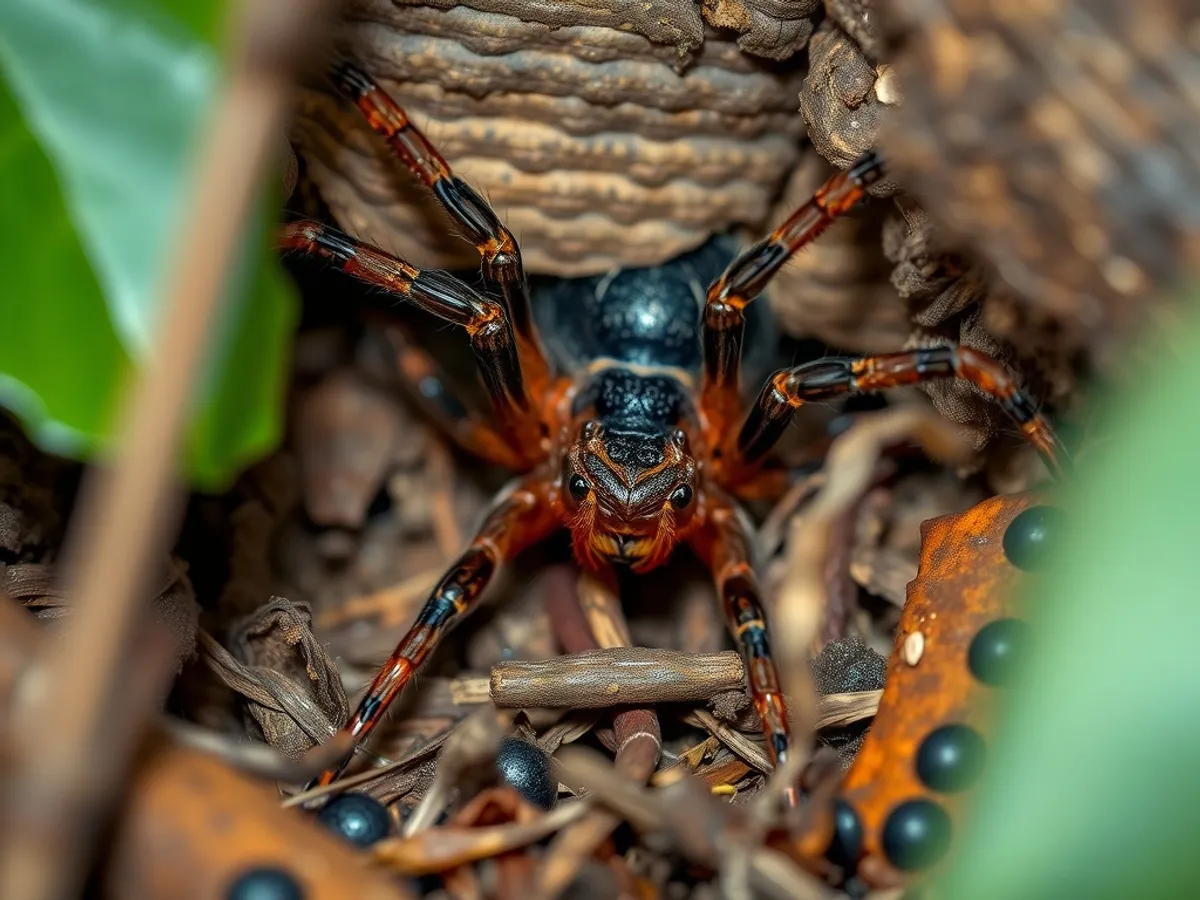
The Sydney Funnel-Web Spider (Atrax robustus) is a large mygalomorph spider, with adult females typically reaching body lengths of 35–40 mm and males slightly smaller at 25–30 mm. Its robust body is covered in a glossy, dark brown to black carapace, with a velvety abdomen and powerful chelicerae (fangs) capable of penetrating fingernails and soft shoes. The species is sexually dimorphic, with males possessing a distinctive spur on the second pair of legs, used during mating. Atrax robustus constructs silk-lined burrows with a characteristic funnel-shaped entrance, often extending into side galleries for ambush and retreat. Primarily nocturnal, it spends most of its life hidden, emerging at night to capture prey or, in the case of males, to search for mates. The spider's venom contains a unique class of neurotoxins (δ-atracotoxins), which are highly toxic to primates but less so to other mammals. Despite their reputation, these spiders are not naturally aggressive and typically bite only when provoked or threatened. Their lifespan varies, with females living up to 10 years or more in the wild, while males generally die within a year of reaching maturity. The species plays a vital ecological role as both predator and prey in its native forest ecosystems.
Did you know?
Unlike most spiders, the male Funnel-Web Spider becomes more dangerous than the female due to the specific toxins present in his venom.
Research & sources
Behaviour & social structure
Atrax robustus is a solitary and territorial species, rarely interacting with conspecifics outside of mating. It is an ambush predator, relying on its silk-lined burrow to detect vibrations from passing insects, small lizards, or even frogs. The spider waits at the mouth of its funnel, darting out with remarkable speed to seize prey with its powerful fangs. Feeding occurs within the safety of the burrow, where prey is immobilized by venom and consumed at leisure. Males become nomadic during the humid summer months, wandering in search of females, which increases their likelihood of encountering humans. Defensive behaviors include rearing up on hind legs, displaying fangs, and delivering rapid, repeated strikes if threatened. Unlike some spiders, Atrax robustus does not balloon (disperse by air) and is highly dependent on ground-based movement.
Reproduction & life cycle
Breeding typically occurs during the austral summer (November to February), coinciding with increased male activity. Males locate females by following pheromone trails to their burrows, where courtship involves leg tapping and cautious approach to avoid being mistaken for prey. After successful mating, the male usually dies within months. Females lay 50–150 eggs in a silk sac within the burrow, guarding them until spiderlings emerge after 3–4 weeks. There is no further parental care; spiderlings disperse on foot to establish their own burrows nearby. Females reach sexual maturity in 4–5 years, while males mature slightly faster, often at 3–4 years.
Adaptations & survival
Atrax robustus exhibits several adaptations for survival in moist, temperate forests. Its powerful chelicerae and rapid strike enable it to subdue a wide range of prey. The funnel-shaped web is both a retreat and a sophisticated prey-detection system, amplifying vibrations from potential food. The spider's venom, particularly potent against primates, is thought to have evolved for defense rather than predation. Its thick exoskeleton and cryptic coloration provide protection from predators and environmental extremes. Behavioral adaptations include nocturnal activity to avoid diurnal predators and desiccation, and the ability to seal its burrow entrance during dry periods.
Cultural significance
The Sydney Funnel-Web Spider holds a notorious place in Australian culture, frequently featured in media as one of the world's most dangerous spiders. Its image has been used in public health campaigns to promote awareness of venomous animals. The development of an effective antivenom in 1981 is considered a landmark achievement in Australian medical history. While not traditionally used in indigenous medicine or folklore, the spider's reputation has made it a symbol of Australia's unique and sometimes hazardous wildlife.
Recent research
Recent research has focused on the molecular structure of δ-atracotoxins, leading to advances in neurobiology and potential biomedical applications, such as novel painkillers and insecticides. Studies have also examined the spider's population genetics, revealing low genetic diversity across its range, likely due to limited dispersal. Ongoing ecological research investigates the spider's role in controlling insect populations and its resilience to environmental changes. Notably, the rapid action of antivenom has made fatalities from bites exceedingly rare since its introduction, with no confirmed deaths since 1981.
Sources
Systematics and Biology of the Australian Funnel-web Spiders (Hexathelidae: Atracinae)
Michael R. Gray (2010)
scientificThe biology of the Sydney funnel-web spider (Atrax robustus) (Araneae: Hexathelidae)
Michael R. Gray (2010)
scientificVideos
Habitat
Moist forest floors, under logs, leaf litter, or in sheltered burrows
 Various Continental Regions
Grassland
Open areas dominated by grasses rather than trees, supporting numerous herbivores and their predators.
 Elevated Terrain
Mountain
High-altitude environments with varying climates and specialized wildlife adapted to rugged terrain and thin air.
 Global
Forest
Wooded areas with significant tree cover and diverse plant and animal communities.
Conservation
The Funnel-Web Spider is currently classified as Least Concern on the IUCN Red List.
Threats & challenges
Currently classified as Least Concern, Atrax robustus faces few natural threats due to its potent venom and secretive lifestyle. However, habitat loss from urbanization and deforestation in the Sydney region poses localized risks. Human persecution, often due to fear, can impact populations in suburban areas. The introduction of invasive species and climate change may alter prey availability and habitat suitability in the future. Despite these challenges, the species remains locally abundant, especially in undisturbed forested areas.
Taxonomy
Scientific name
Atrax robustus
- Kingdom
- Animalia
- Phylum
- Arthropoda
- Class
- Arachnida
- Order
- Araneae
- Family
- Atracidae
- Genus
- Atrax
- Species
- robustus
Community notes
Share your observations about the Funnel-Web Spider.
No community notes yet. Be the first!
Discover more wildlife
More fascinating animals from the encyclopedia.