
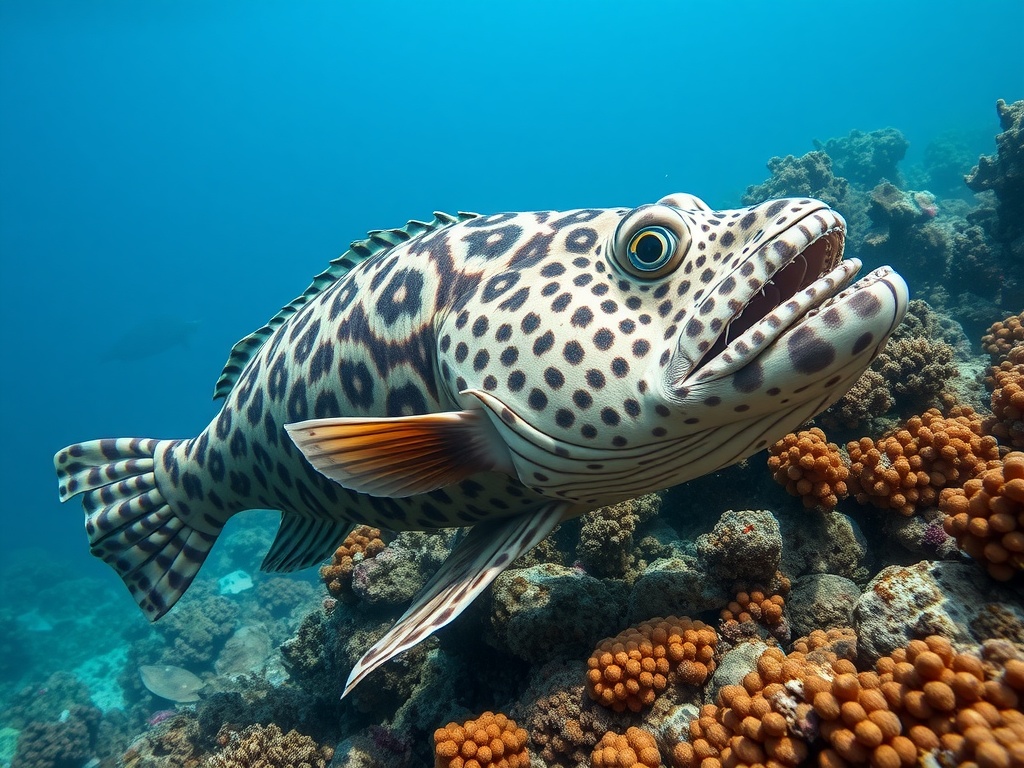
About the Giant grouper
The giant grouper is the largest bony fish found in coral reefs, reaching lengths of up to 2.7 meters (almost 9 feet). Its robust body is mottled with dark and light patches, providing excellent camouflage among rocks and corals. Native to the Indo-Pacific region, this powerful predator inhabits coastal areas, lagoons, and outer reef slopes. The giant grouper is a solitary fish, known for its slow movements and massive mouth, which it uses to engulf prey whole. Its impressive size and overfishing have made it vulnerable in some areas.
Fascinating facts
Largest Reef Fish
The giant grouper is the largest bony fish found on coral reefs, capable of growing over 2.5 meters long and weighing nearly 400 kilograms.
Voracious Predators
Their diet includes fish, crustaceans, and even small sharks and turtles, all swallowed whole thanks to their enormous mouths.
Reef Guardians
By preying on a variety of species, giant groupers help maintain the delicate balance of reef ecosystems.
Detailed description
The giant grouper (Epinephelus lanceolatus) is the largest member of the Serranidae family and among the largest bony fishes inhabiting coral reefs, with adults commonly reaching lengths of 180–270 cm and weights up to 400 kg, though unconfirmed reports suggest even larger individuals. Its body is robust, deep, and laterally compressed, with a broad, rounded head and a cavernous mouth equipped with villiform teeth. The coloration is typically mottled brown to greenish-grey with irregular pale and dark blotches, providing effective camouflage among rocky and coral habitats. Juveniles are more vividly patterned with yellow and black bands, which fade as they mature. The dorsal fin is continuous, with 11 spines and 15–17 soft rays, while the anal fin has 3 spines and 8 soft rays. The skin is thick and covered with small, rough scales. Giant groupers are solitary and territorial, often occupying the same sheltering crevice or cave for extended periods. They are slow-moving but capable of rapid bursts of speed when ambushing prey. Their massive mouths generate powerful suction, allowing them to engulf large prey whole, including fish, crustaceans, and even small sharks and sea turtles. Giant groupers are protogynous hermaphrodites, meaning individuals start life as females and may later transition to males, a trait common among groupers. Their longevity is notable, with lifespans exceeding 40 years in the wild. The species is distributed widely across the tropical Indo-Pacific, from the Red Sea and East Africa to the central Pacific, including northern Australia, Japan, and southern China.
Did you know?
A single giant grouper has been recorded eating a whole small shark in one bite!
Research & sources
Wikipedia summary
The giant grouper (Epinephelus lanceolatus), also known as the Queensland groper (grouper), brindle grouper or mottled-brown sea bass, is a species of marine ray-finned fish, a grouper from the subfamily Epinephelinae which is part of the family Serranidae, which also includes the anthias and sea basses. It has a wide Indo-Pacific distribution and is one of the largest extant species of bony fish.
Behaviour & social structure
Giant groupers are predominantly solitary and highly territorial, often defending a home range centered around a preferred shelter such as a cave, wreck, or coral overhang. They are crepuscular hunters, most active at dawn and dusk, relying on stealth and ambush tactics. Using their large mouths, they create a sudden vacuum to suck in prey, which includes a wide variety of fish, crustaceans (such as lobsters and crabs), cephalopods, and occasionally small sharks and rays. Juveniles may display more diurnal activity and are sometimes observed in shallow lagoons. Adults are generally sedentary but can exhibit aggressive displays, such as gaping mouths and lateral body posturing, to deter intruders. Social interactions are minimal outside of the breeding season, though temporary aggregations may form at spawning sites.
Reproduction & life cycle
Epinephelus lanceolatus exhibits protogynous hermaphroditism, with individuals maturing first as females and some transitioning to males later in life, typically when reaching larger sizes. Spawning is believed to occur seasonally, often during warmer months, and is synchronized with lunar cycles in some regions. Giant groupers form temporary spawning aggregations, where multiple females release eggs into the water column and dominant males fertilize them externally. Fecundity is high, with females capable of releasing millions of pelagic eggs per spawning event. There is no parental care; eggs and larvae are left to drift and develop in the open ocean. Larvae are planktonic and undergo several developmental stages before settling on reefs as juveniles. Sexual maturity is reached at approximately 6–8 years of age, with size at maturity varying by region and environmental conditions.
Adaptations & survival
The giant grouper's massive size and robust musculature provide both protection from predators and the ability to overpower large prey. Its cryptic coloration and mottled patterning afford excellent camouflage in complex reef environments. The species' large mouth and expandable pharyngeal jaws enable it to consume prey nearly half its own size. Its thick skin and dense scales offer further protection from injury and parasites. The ability to change sex (protogynous hermaphroditism) allows for flexible population dynamics and maximizes reproductive output. Behavioral adaptations include site fidelity to preferred shelters, ambush predation strategies, and the use of low-frequency vocalizations (booming sounds) for communication during territorial or mating displays.
Cultural significance
The giant grouper holds considerable cultural and economic value in many Indo-Pacific societies. It is featured in traditional folklore and is often regarded as a symbol of strength and longevity. In Chinese culture, the fish is considered a delicacy and is highly sought after for festive occasions and banquets. In some regions, it has been used in traditional medicine, though scientific evidence for medicinal properties is lacking. The species is also a popular attraction in public aquaria due to its impressive size and appearance, contributing to ecotourism and educational initiatives.
Recent research
Recent research has focused on the species' reproductive biology, genetic diversity, and aquaculture potential. Advances in captive breeding have been made, particularly in Southeast Asia, to reduce pressure on wild populations and support sustainable fisheries. Genetic studies have revealed significant population structuring across its range, highlighting the need for region-specific management. Studies on the impacts of climate change and habitat degradation are ongoing, with particular attention to larval dispersal and recruitment success. Tagging and telemetry projects have provided insights into movement patterns, home range sizes, and habitat preferences. There is also growing interest in the species' role as a top predator in maintaining reef ecosystem balance.
Videos
Habitat
Shallow tropical and subtropical marine reefs

Conservation
The Giant grouper is currently classified as Vulnerable on the IUCN Red List.
Threats & challenges
Major threats to the giant grouper include overfishing, both for commercial and recreational purposes, as well as habitat loss and degradation due to coastal development, pollution, and coral reef decline. The species is highly prized in the live reef food fish trade, particularly in East and Southeast Asia, where large individuals can command high market prices. Slow growth, late sexual maturity, and the formation of predictable spawning aggregations make the species especially vulnerable to overexploitation. Illegal, unreported, and unregulated (IUU) fishing further exacerbates population declines. Climate change, leading to coral bleaching and ocean acidification, poses additional long-term threats to their reef habitats. Population trends indicate significant declines in many regions, prompting the IUCN to list the species as Vulnerable.
Taxonomy
Scientific name
Epinephelus lanceolatus
- Kingdom
- Animalia
- Phylum
- Chordata
- Class
- Actinopterygii
- Order
- Perciformes
- Family
- Serranidae
- Genus
- Epinephelus
- Species
- lanceolatus
Where to see a giant grouper
1 zoo and aquarium in 1 country are recorded as keeping this species.

Community notes
Share your observations about the Giant grouper.
No community notes yet. Be the first!
Discover more wildlife
More fascinating animals from the encyclopedia.