
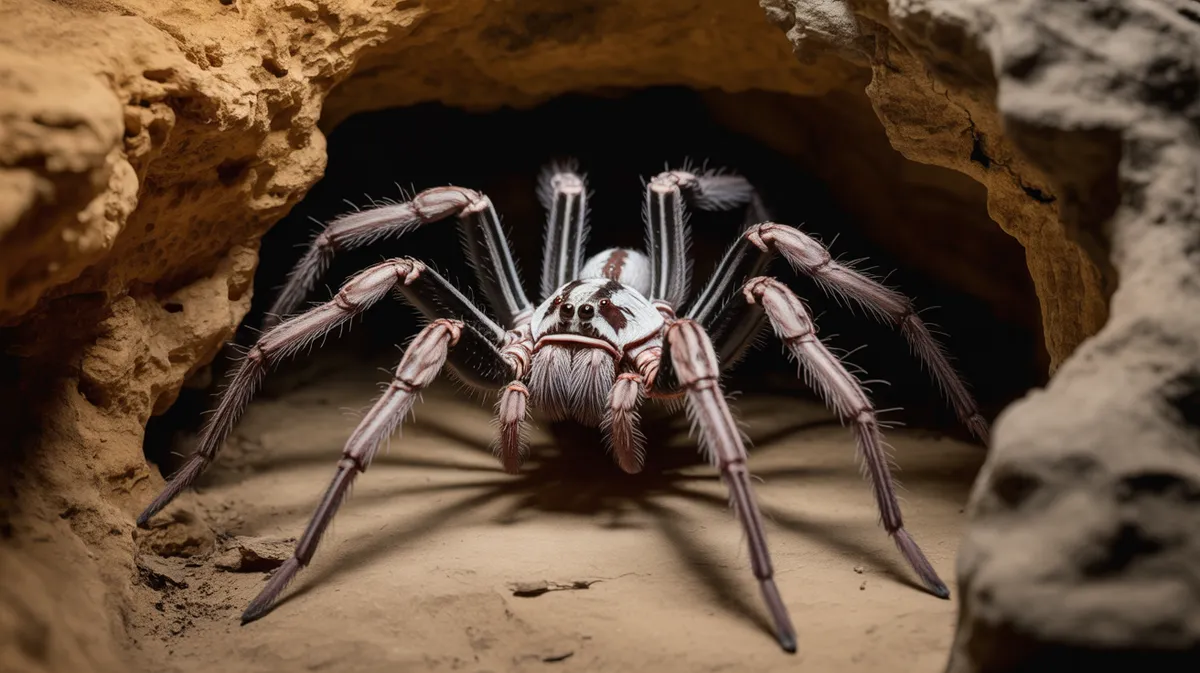
About the Giant huntsman spider
The giant huntsman spider is renowned for being the world's largest spider by leg span, which can reach up to 30 centimeters (12 inches). Discovered in Laos in 2001, this arachnid possesses long, crab-like legs and a pale, yellowish-brown body covered in dark spots. Adapted to cave habitats, the giant huntsman is agile and swift, using its speed to ambush prey rather than spinning webs. Its secretive nature and remote habitat make sightings extremely rare, contributing to the spider's mysterious reputation.
Fascinating facts
Record-Breaking Size
The giant huntsman spider's leg span can reach up to 30 centimeters (12 inches), making it the largest spider in the world by this measurement.
Cave Dweller
This species is specially adapted to live in the dark, humid limestone caves of Laos, rarely venturing outside.
Speedy Hunter
Instead of using webs, the giant huntsman relies on its remarkable speed and agility to pursue and catch prey.
Detailed description
The giant huntsman spider (Heteropoda maxima) is the largest known member of the Sparassidae family, distinguished by its extraordinary leg span, which can reach up to 30 cm, making it the spider with the greatest leg span in the world. Its body length, however, is relatively modest, averaging 4.6 to 5 cm. The spider's coloration is generally pale yellowish-brown with scattered dark spots on the dorsal side of the opisthosoma (abdomen), and its long legs are banded with broad, dark markings. The legs are laterigrade (oriented sideways), giving the spider a crab-like appearance and facilitating rapid, agile movement across vertical and uneven surfaces. The species exhibits a flattened body, an adaptation for navigating the narrow crevices and fissures of its limestone cave habitat. The chelicerae (fangs) are robust, suited for subduing a variety of invertebrate prey. Heteropoda maxima is primarily nocturnal, emerging at night to hunt. It does not construct webs for prey capture but relies on speed and ambush tactics. The species is solitary, with individuals maintaining distinct territories. Males are generally smaller and more slender than females and can be distinguished by their modified pedipalps, which are used for sperm transfer during mating. The spider's sensory hairs (setae) are highly developed, enhancing its ability to detect vibrations and air currents in the pitch-dark cave environment.
Did you know?
The species was only formally described in 2001, making it a relatively recent discovery in the world of arachnology.
Research & sources
Wikipedia summary
The giant huntsman spider is a species of the huntsman spider family Sparassidae found in Laos. It is considered the world's largest spider by leg span, which can reach up to 30 cm (1 ft).
Behaviour & social structure
Giant huntsman spiders are solitary ambush predators, relying on their exceptional speed and agility to capture prey. They are primarily nocturnal, remaining hidden in rock crevices or under loose stones during the day and emerging at night to hunt. Their diet consists mainly of insects and other arthropods, but they are capable of overpowering small vertebrates such as geckos. H. maxima does not spin webs to catch prey; instead, it uses stealth and rapid bursts of movement to seize and subdue its victims with a venomous bite. Social interactions are minimal, limited mostly to brief encounters during mating. When threatened, the spider may display defensive behaviors such as rearing up or retreating rapidly into crevices. Grooming and maintenance of sensory hairs are common daily activities, essential for optimal sensory function in the low-light environment.
Reproduction & life cycle
Reproduction in Heteropoda maxima follows the general pattern of Sparassidae spiders. Mating occurs when a male locates a receptive female, often through pheromonal cues. The male performs a courtship display involving leg tapping and vibratory signals to avoid being mistaken for prey. Copulation involves the transfer of sperm from the male's pedipalps to the female's epigyne. After mating, the female produces an egg sac containing several dozen to over a hundred eggs, which she guards vigilantly in a secluded area. Incubation lasts approximately 3-4 weeks, after which spiderlings emerge and remain near the mother for a short period before dispersing. Parental care is limited to egg sac guarding; once the spiderlings disperse, they are independent. Breeding likely coincides with the onset of the rainy season, which increases prey availability and humidity in the cave environment.
Adaptations & survival
Heteropoda maxima exhibits several adaptations for cave life (troglophily). Its laterigrade legs and flattened body allow it to maneuver through narrow rock fissures and across vertical surfaces. The spider's pale coloration provides camouflage against the limestone substrate, while its large size may deter some predators. Enhanced tactile and vibratory sensory systems compensate for the low-light conditions of its habitat, as vision is less important in the perpetual darkness of caves. The species' rapid locomotion is an evolutionary specialization for both predation and escape from threats. Its venom is potent enough to quickly immobilize a range of prey, an advantage in an environment where food encounters may be infrequent.
Cultural significance
Due to its recent scientific discovery (2001) and secretive lifestyle, the giant huntsman spider has limited presence in local folklore or traditional uses. However, its status as the world's largest spider by leg span has garnered international attention, making it a subject of fascination and occasional sensationalism in media and popular culture. In Laos, spiders are sometimes regarded with superstition, but there are no specific myths or symbolic associations documented for H. maxima. The species is occasionally featured in educational exhibits and documentaries highlighting cave biodiversity.
Recent research
Since its description by Peter Jäger in 2001, research on Heteropoda maxima has focused primarily on taxonomy, morphology, and cave ecology. Recent studies have examined its phylogenetic relationships within the Sparassidae family, revealing evolutionary divergence associated with cave adaptation. Ongoing research includes surveys of cave-dwelling arthropods in Southeast Asia, with an emphasis on biodiversity and endemism. Behavioral studies are limited due to the species' inaccessibility, but advances in remote monitoring and environmental DNA (eDNA) techniques may provide new insights into its ecology and population dynamics. There is growing interest in the spider's venom composition, which could have biomedical applications.
Videos
Habitat
Limestone caves

Conservation
The Giant huntsman spider is currently classified as Not Evaluated on the IUCN Red List.
Threats & challenges
Currently, the giant huntsman spider faces few direct threats due to its remote and inaccessible cave habitats in Laos. However, potential threats include habitat disturbance from limestone quarrying, tourism, and cave exploration. The species' restricted range and specialized habitat requirements make it vulnerable to environmental changes. There is no evidence of significant population decline, but lack of data and the spider's elusive nature hinder accurate assessment. It is not currently evaluated by the IUCN Red List, and no targeted conservation measures are in place. Collection for the exotic pet trade is a minor but possible emerging threat.
Taxonomy
Scientific name
Heteropoda maxima
- Kingdom
- Animalia
- Phylum
- Arthropoda
- Class
- Arachnida
- Order
- Araneae
- Family
- Sparassidae
- Genus
- Heteropoda
- Species
- maxima
Community notes
Share your observations about the Giant huntsman spider.
No community notes yet. Be the first!
Discover more wildlife
More fascinating animals from the encyclopedia.