
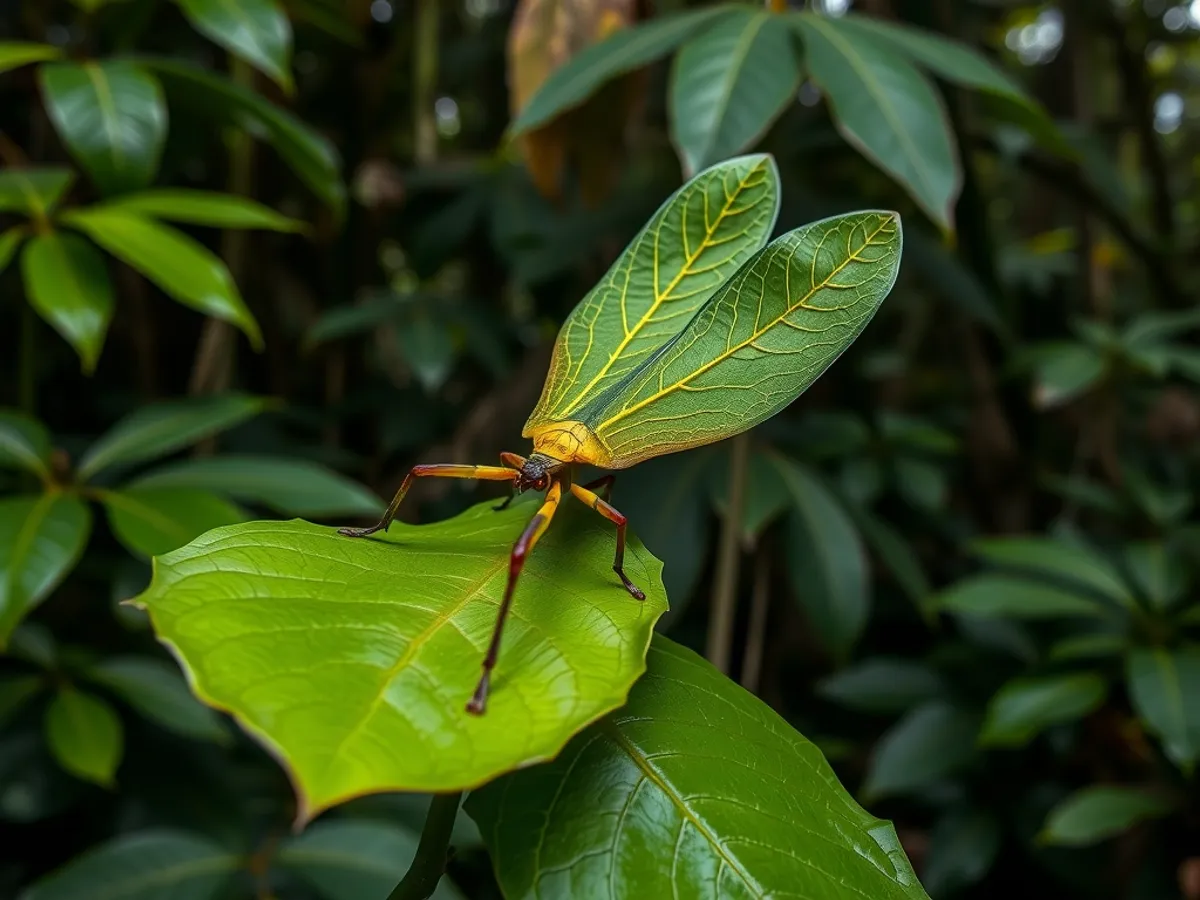
About the Giant Leaf Insect
The Giant Leaf Insect is a remarkable invertebrate known for its exceptional camouflage, mimicking the appearance of a living leaf. Native to the rainforests of Southeast Asia, this insect's body is flat, broad, and green with intricate vein-like patterns, making it nearly indistinguishable from actual foliage. Females can grow significantly larger than males and are generally flightless, while males are smaller and capable of short flights. Their unique adaptations help them evade predators by blending seamlessly into their leafy environment.
Fascinating facts
Master of Disguise
The giant leaf insect's body shape and color allow it to blend almost perfectly with the leaves it inhabits, providing exceptional protection from predators.
Sexual Dimorphism
Females are significantly larger and broader than males and are typically unable to fly, while males are more slender and possess functioning wings for flight.
Egg Camouflage
The eggs of the giant leaf insect closely resemble seeds or bits of plant matter, helping them avoid detection by potential egg predators.
Detailed description
The Giant Leaf Insect (Phyllium giganteum) is one of the largest and most striking members of the family Phylliidae, with adult females reaching lengths of up to 10–12 cm, while males are typically smaller, around 7–8 cm. Their bodies are remarkably flattened and broad, with lateral extensions on the thorax and abdomen that mimic the shape and venation of real leaves, providing exceptional camouflage. The coloration ranges from vibrant green to yellowish or brown hues, often with subtle spots or markings that resemble leaf blemishes or fungal growths. The legs are also lobed and flattened, further enhancing the illusion of leaf petioles and edges. Females are robust and heavy-bodied, rendering them flightless, whereas males possess fully developed wings and are capable of short, fluttering flights. The antennae are long and filiform, with males having more elongated and feathery antennae than females, aiding in the detection of pheromones. The mouthparts are adapted for chewing, suited to their folivorous diet. This species is primarily nocturnal, remaining motionless during the day to avoid detection by predators. When threatened, they may sway gently to mimic the movement of leaves in the wind, a behavior known as 'leaf mimicry.' Their life span in the wild is estimated at 6–12 months, with females generally living longer than males.
Did you know?
Despite their large size and striking appearance, giant leaf insects are so well-camouflaged that they are rarely seen by predators or even by humans in their natural habitat.
Research & sources
Behaviour & social structure
Giant Leaf Insects are solitary and highly sedentary, spending most of their lives clinging to the undersides of leaves. They are primarily nocturnal feeders, emerging at dusk to consume a variety of host plant leaves, including those of guava, mango, and bramble. Their feeding is characterized by slow, deliberate bites, and they rarely move far from their chosen perch. Social interactions are minimal outside of mating, and there is no evidence of territoriality or cooperative behavior. When disturbed, they may drop to the forest floor and remain motionless, relying on their camouflage. They do not exhibit aggressive behaviors and have no chemical or mechanical defenses beyond mimicry. Daily routines involve periods of inactivity during daylight, with increased movement and feeding at night.
Reproduction & life cycle
Phyllium giganteum exhibits sexual dimorphism, with males actively seeking out females using pheromonal cues. Mating typically occurs at night, with males mounting the larger, flightless females. Copulation can last several hours. Females are oviparous, laying up to 500 eggs individually over several months by flicking them away from their bodies using their abdomen. The eggs are brown, oval, and covered with small spines, resembling plant seeds or debris, further aiding in camouflage. Incubation lasts between 4–6 months, depending on temperature and humidity. The nymphs, upon hatching, are dark brown and resemble ant mimics, which may help deter predators. They undergo several molts (typically 5–6) before reaching adulthood, with no parental care provided after egg-laying.
Adaptations & survival
The most remarkable adaptation of Phyllium giganteum is its morphological mimicry, with body and limb shapes, coloration, and surface texture all contributing to a leaf-like appearance. This camouflage is enhanced by behavioral adaptations such as swaying and remaining motionless for long periods. The eggs' resemblance to plant debris provides additional protection during the vulnerable developmental stage. Sexual dimorphism, with flight-capable males and flightless, fecund females, may be an evolutionary response to maximize reproductive success and dispersal. Nymphs' initial ant-mimic appearance is another example of adaptive mimicry, reducing predation risk during early life stages.
Cultural significance
Giant Leaf Insects have fascinated humans for centuries, often featured in natural history collections and public exhibits as examples of extreme camouflage and evolutionary adaptation. In some Southeast Asian cultures, they are considered symbols of invisibility and transformation. They are popular in the exotic pet trade and are used in educational programs to illustrate concepts of mimicry and biodiversity. There is no evidence of traditional medicinal or culinary use.
Recent research
Recent research has focused on the genetic basis of leaf mimicry and the developmental pathways that produce their unique morphology. Studies using molecular phylogenetics have clarified the evolutionary relationships within Phylliidae, revealing multiple independent origins of leaf mimicry in related groups. Ongoing research is examining the chemical composition of their pheromones and the ecological interactions with their host plants. Advances in imaging technology have provided detailed insights into the microstructure of their cuticle and the biomechanics of their swaying behavior. Conservation genetics studies are beginning to assess population structure and gene flow across fragmented habitats.
Videos
Habitat
Tropical rainforest


Conservation
The Giant Leaf Insect is currently classified as Least Concern on the IUCN Red List.
Threats & challenges
Currently, Phyllium giganteum is not considered threatened, but habitat loss due to deforestation in Southeast Asia poses a potential risk to local populations. Collection for the pet trade and scientific research is generally sustainable, but overharvesting in localized areas could become problematic. Pesticide use and climate change may also impact their host plants and microhabitats. Population trends are stable, but long-term monitoring is limited due to their cryptic nature and the inaccessibility of their rainforest habitats.
Taxonomy
Scientific name
Phyllium giganteum
- Kingdom
- Animalia
- Phylum
- Arthropoda
- Class
- Insecta
- Order
- Phasmatodea
- Family
- Phylliidae
- Genus
- Phyllium
- Species
- giganteum
Community notes
Share your observations about the Giant Leaf Insect.
No community notes yet. Be the first!
Discover more wildlife
More fascinating animals from the encyclopedia.