
About the Giant Leopard Moth
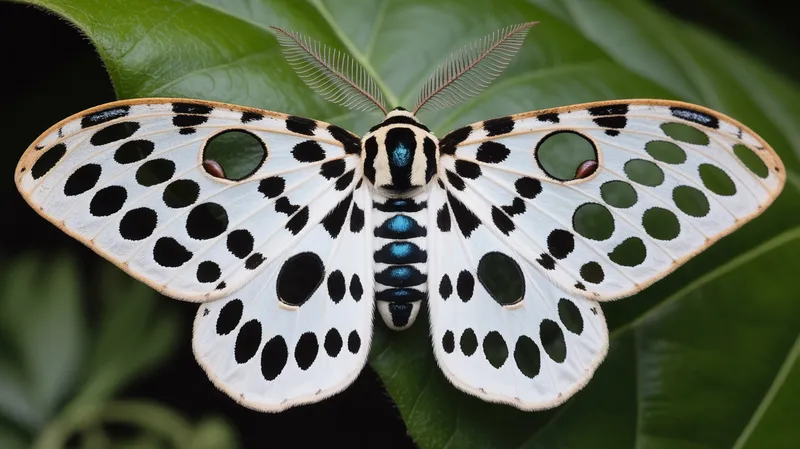
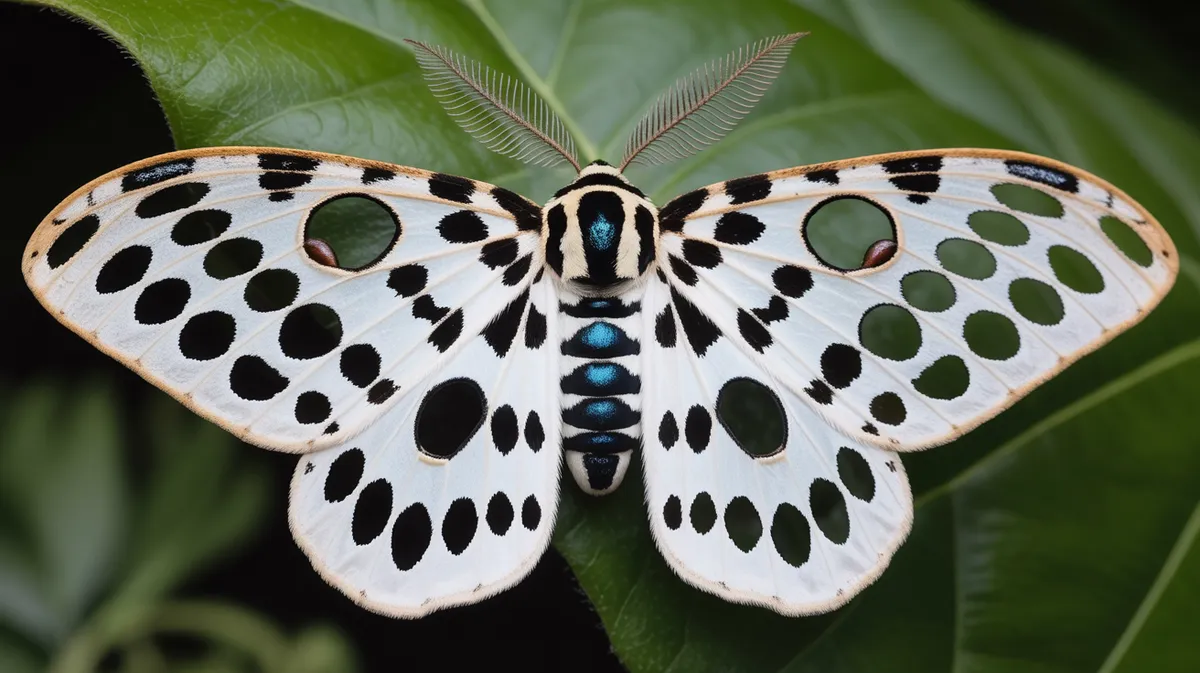
The Giant Leopard Moth is a strikingly patterned moth known for its large size and distinctive white wings adorned with black, leopard-like spots. Native to eastern North America, this nocturnal invertebrate is frequently attracted to light sources at night. Its caterpillars are equally recognizable, featuring long, bristly black setae with red or orange bands visible between the segments. Despite their intimidating appearance, both the larvae and adults are harmless to humans and play a role in local ecosystems.
Fascinating facts
Distinctive Appearance
The Giant Leopard Moth has brilliant white wings covered in black, hollow-centered spots, making it easily recognizable among North American moths.
Nocturnal Behavior
This moth is most active at night and is strongly attracted to artificial lights, which often brings it into close contact with humans.
Bristly Caterpillar
The caterpillar is covered in long, stiff black bristles, which serve as a deterrent to predators but are harmless to people.
Detailed description
The Giant Leopard Moth (Hypercompe scribonia) is a large and visually striking moth, with adult wingspans ranging from 50 to 90 mm (2–3.5 inches). Its forewings are bright white, adorned with a pattern of solid black and hollow blue-black spots reminiscent of a leopard's coat, while the abdomen is iridescent blue with orange bands. The body is robust, and the legs are banded black and white. The head is small relative to the body, with feathery antennae in males and thinner, thread-like antennae in females. The caterpillar, or larva, is equally distinctive: it is covered in dense, stiff black setae (bristles) that conceal striking red or orange intersegmental rings, which are visible when the caterpillar curls defensively. Adults are nocturnal and are strongly attracted to artificial lights, often appearing at porch lights during warm months. The species is solitary, with individuals only coming together to mate. Giant Leopard Moths are unpalatable to many predators due to chemical defenses sequestered from their host plants. Adults do not feed, relying on energy reserves accumulated during the larval stage. The species is distributed widely across eastern North America, inhabiting deciduous forests, woodlands, gardens, and suburban areas.
Did you know?
Despite their bold appearance, adult Giant Leopard Moths do not feed at all—they rely on energy stored from their caterpillar stage.
Research & sources
Wikipedia summary
The giant leopard moth is a moth of the family Erebidae. They are distributed through North America from southern Ontario, and southern and eastern United States through New England, Mexico, and south to Colombia. The obsolete name, Ecpantheria scribonia, is still occasionally encountered.
Behaviour & social structure
Giant Leopard Moths are primarily nocturnal, becoming active at dusk and remaining so through the night. Adults are strong fliers but tend to remain stationary during the day, often resting on tree trunks or in leaf litter. Their attraction to artificial lights is pronounced, a behavior known as positive phototaxis. Larvae are solitary and feed openly on a wide variety of broadleaf plants, including dandelion, plantain, violets, and sunflowers. When threatened, caterpillars curl into a tight ball, exposing their red or orange bands as a warning display (aposematism). Adults are non-feeding and do not exhibit territorial or social behaviors. Males are known to travel considerable distances in search of females, guided by pheromones released by receptive females. There is no evidence of parental care; eggs are laid singly or in small clusters on host plants.
Reproduction & life cycle
Reproduction in Hypercompe scribonia is sexual, with mating typically occurring in late spring to early summer, depending on latitude. Males locate females by following pheromone trails, and copulation can last several hours. After mating, females lay eggs on the undersides of host plant leaves. The eggs hatch in about 7–10 days, and larvae undergo several molts (instars) over a period of 3–4 weeks. Pupation occurs in leaf litter or shallow soil, where the caterpillar constructs a loose cocoon incorporating its own setae. In the northern part of its range, the species generally has one generation per year (univoltine), with larvae overwintering in the final instar and pupating in spring. In warmer southern regions, two generations (bivoltine) may occur. There is no parental care after egg-laying.
Adaptations & survival
The Giant Leopard Moth exhibits several notable adaptations. The bold coloration of both larvae and adults serves as a warning to potential predators (aposematism), signaling chemical defenses acquired from host plants. The dense setae of the caterpillar deter predation and can irritate the mouths of vertebrate predators. The ability to curl into a ball and expose warning coloration is a classic defensive behavior. Adults possess tympanal organs on the thorax, allowing them to detect ultrasonic echolocation calls of bats, their primary nocturnal predators, and perform evasive maneuvers. The species' broad diet as larvae enables them to exploit a wide range of habitats and host plants, contributing to their ecological success. Males have highly developed, plumose antennae for detecting female pheromones over long distances.
Cultural significance
The Giant Leopard Moth is admired for its striking appearance and is a favorite among amateur naturalists and photographers. It is sometimes featured in educational programs about moths and biodiversity. While it does not have a prominent role in folklore or mythology, its caterpillar is often mistaken for the stinging 'woolly bear' caterpillar, leading to misconceptions about its harmlessness. The species is occasionally referenced in art and literature as a symbol of transformation and beauty. There are no known traditional uses or significant roles in indigenous cultures.
Recent research
Recent research on Hypercompe scribonia has focused on its chemical ecology, particularly the sequestration of plant-derived toxins by larvae and their role in predator deterrence. Studies have also examined the moth's response to artificial light and its impact on reproductive behaviors. Genetic analyses are ongoing to clarify the phylogenetic relationships within the genus Hypercompe and the broader Erebidae family. Citizen science initiatives, such as moth monitoring programs, have contributed valuable data on distribution, phenology, and population trends. There is growing interest in the impact of climate change on voltinism (number of generations per year) and range shifts.
Videos
Habitat
Forests and woodlands


Conservation
The Giant Leopard Moth is currently classified as Least Concern on the IUCN Red List.
Threats & challenges
Currently, the Giant Leopard Moth is not considered threatened and is classified as Least Concern. Its wide distribution and generalist larval diet buffer it against many environmental changes. However, habitat loss due to urbanization and pesticide use in agricultural and suburban areas can locally reduce populations. Light pollution may disrupt natural behaviors, such as mating and navigation. Climate change could alter the timing of life cycle events (phenology), potentially impacting survival and reproductive success, especially in northern populations. There are no significant targeted conservation efforts for this species, but it benefits from general habitat preservation and reduced pesticide usage.
Taxonomy
Scientific name
Hypercompe scribonia
- Kingdom
- Animalia
- Phylum
- Arthropoda
- Class
- Insecta
- Order
- Lepidoptera
- Family
- Erebidae
- Genus
- Hypercompe
- Species
- scribonia
Community notes
Share your observations about the Giant Leopard Moth.
No community notes yet. Be the first!
Discover more wildlife
More fascinating animals from the encyclopedia.