
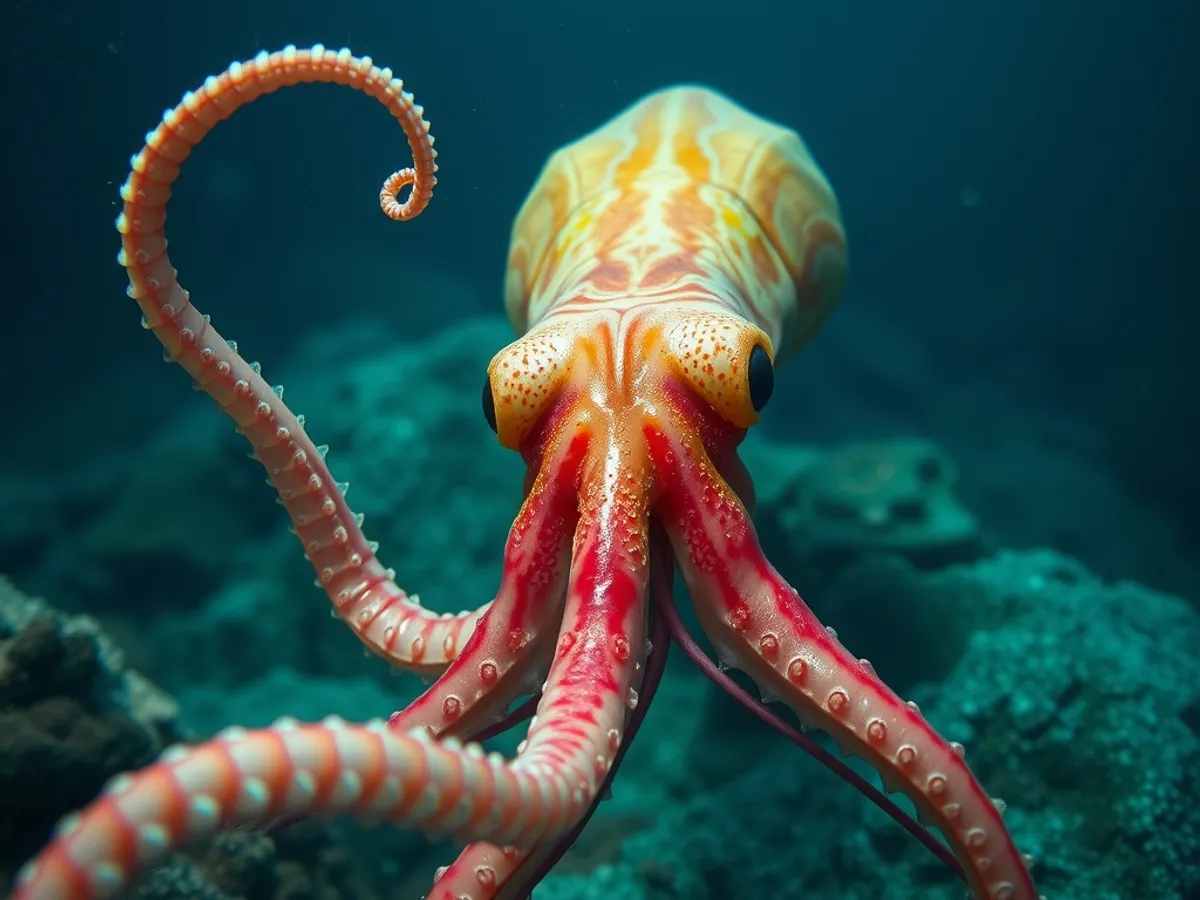
About the Giant Squid
The giant squid has the largest eyes of any animal that has ever been measured — up to around twenty-seven centimetres across, the size of a dinner plate. An eye that big is wildly expensive, and the leading explanation is not that it needs to see prey: it needs to see what is coming for it. At that size, the eye gains most in the specific task of detecting the faint bioluminescent glow of plankton disturbed by a large moving body — that is, the glowing wake of an approaching sperm whale — at a range of tens of metres, which is just enough warning to matter. It has eight arms plus two much longer feeding tentacles, tipped with clubs bearing toothed, ring-lined suckers; the circular scars they leave are found on the skin of sperm whales that hunt them. Its beak is the only hard part of its body, and beaks recovered from whale stomachs were for a long time the primary evidence that it existed at all. It was not filmed alive until 2004, nor in its own deep habitat until 2012.
Fascinating facts
Huge Eyes
The giant squid's eyes are the largest of any animal, helping it detect faint light and movement in the pitch-dark deep sea.
Tentacle Reach
Its two feeding tentacles can extend far beyond its body length, allowing it to snatch prey at a distance.
Deep-Sea Dweller
Giant squid typically inhabit ocean depths between 300 and 1,000 meters, making human encounters extremely rare.
Detailed description
The giant squid (Architeuthis dux) is a colossal deep-sea cephalopod, recognized as one of the largest invertebrates on Earth. Adult females can reach lengths up to 13 meters (43 feet), while males are typically smaller, averaging around 10 meters (33 feet). Its body is streamlined, with a mantle that can measure over 2 meters (6.6 feet) long, and it possesses eight arms and two exceptionally long feeding tentacles, each equipped with powerful, serrated suckers for grasping prey. The giant squid's eyes are among the largest in the animal kingdom, sometimes exceeding 27 centimeters (11 inches) in diameter, allowing it to detect faint bioluminescence and movement in the pitch-black depths between 300 and 1000 meters (980–3,280 feet). Its skin contains chromatophores, enabling limited color change for camouflage or signaling. The internal shell, or gladius, provides structural support. Giant squids are solitary and elusive, rarely observed alive; most knowledge comes from specimens washed ashore or retrieved from the stomachs of sperm whales, their primary natural predator. Their soft, gelatinous bodies are adapted to withstand immense deep-sea pressures. Despite their formidable appearance, giant squids are fragile and can be easily damaged during capture or stranding. Their life cycle, growth rates, and natural lifespan (estimated at 5–7 years) remain poorly understood due to the inaccessibility of their habitat.
Did you know?
Almost everything known about giant squid comes from specimens washed ashore or found in the stomachs of sperm whales.
Research & sources
Wikipedia summary
Giant squid usually refers to any large squid including Humboldt squid or sometimes even the Robust clubhook squid.
Behaviour & social structure
Giant squids are believed to be solitary hunters, relying on stealth and ambush tactics to capture prey. They use their two elongated feeding tentacles to rapidly snatch fish, deep-sea squid, and other cephalopods, drawing them toward the beak-like mouth for consumption. Their large eyes are adapted to detect the faintest light, such as bioluminescent flashes from prey or predators. There is no evidence of complex social behavior; encounters between individuals are likely rare and may be limited to mating. They are thought to be largely inactive during daylight hours, becoming more active at night when prey is abundant. Escape responses include rapid jet propulsion and the release of ink, though the effectiveness of inking at great depths is debated. Cannibalism has been suggested based on stomach content analysis, but this may result from scavenging rather than active predation.
Reproduction & life cycle
Reproductive behavior in giant squids is not well documented, but available evidence suggests that mating involves the male using a specialized arm, the hectocotylus, to transfer spermatophores (sperm packets) into the female's mantle cavity. Females are thought to lay hundreds of thousands to millions of eggs, which are likely released in gelatinous masses that drift in the water column. There is no parental care; eggs and hatchlings are left to develop independently. The breeding season is not well defined, but evidence from stranded specimens suggests spawning may occur year-round, with some regional variation. Juveniles are rarely encountered, and growth rates are inferred from statolith analysis (analogous to tree rings), indicating rapid early development.
Adaptations & survival
Giant squids exhibit several remarkable adaptations for deep-sea survival. Their enormous eyes maximize light capture, enabling them to detect faint bioluminescence and movement in the darkness. The flexible, streamlined body and fins allow for efficient movement and maneuverability at depth. Their tentacles are equipped with serrated suckers for secure prey capture. The beak is strong enough to slice through tough prey, while the radula (a toothed tongue) further processes food. Ammonium-rich tissues provide buoyancy, reducing energy expenditure for maintaining depth. Chromatophores permit limited color change, potentially for camouflage or signaling. The ability to jet-propel via siphon expulsion offers rapid escape from predators. Biochemical adaptations, such as specialized proteins, allow cellular function under high pressure and low temperature.
Cultural significance
The giant squid has held a prominent place in maritime folklore and mythology for centuries, inspiring tales of sea monsters such as the legendary 'kraken.' Early sailors described encounters with enormous tentacled creatures capable of dragging ships under the waves. In literature, the giant squid features in works like Jules Verne's 'Twenty Thousand Leagues Under the Sea.' Its mysterious nature and elusive behavior have made it a symbol of the unknown and the power of the ocean. In modern times, it continues to captivate public imagination, appearing in art, film, and popular science media. There are no known traditional uses of the giant squid in indigenous cultures, likely due to its deep-sea habitat and rarity.
Recent research
Recent advances in deep-sea exploration, including the use of remotely operated vehicles (ROVs) and deep-sea cameras, have led to the first in situ observations and video recordings of living giant squids in their natural habitat (notably in 2004 and 2012). Genetic studies have revealed that what was once thought to be multiple species of giant squid are likely a single, globally distributed species with low genetic diversity. Ongoing research focuses on understanding their life cycle, growth rates, and ecological role in deep-sea food webs. Stable isotope analysis has been used to study their diet and trophic position. The relationship with sperm whales is a subject of particular interest, as evidenced by sucker scars found on whales and squid beaks found in whale stomachs. Despite these advances, many aspects of giant squid biology remain enigmatic, making it a priority species for deep-sea research.
Videos
Habitat
Deep ocean

Conservation
The Giant Squid is currently classified as Least Concern on the IUCN Red List.
Threats & challenges
Currently, the giant squid faces few direct natural threats aside from predation by sperm whales and, to a lesser extent, large deep-sea sharks. Human impacts are minimal due to the squid's deep-sea habitat, although bycatch in deep-sea fisheries and potential impacts from deep-sea mining and climate change (such as ocean deoxygenation and warming) may pose future risks. Population trends are unknown, but the species is classified as 'Least Concern' by the IUCN due to its wide distribution and lack of evidence for significant decline. However, the lack of comprehensive data on population size, reproductive rates, and life history makes accurate assessment challenging. Conservation challenges include the difficulty of studying the species in situ and the potential for habitat disturbance from expanding deep-sea industries.
Taxonomy
Scientific name
Architeuthis dux
- Kingdom
- Animalia
- Phylum
- Mollusca
- Class
- Cephalopoda
- Order
- Oegopsida
- Family
- Architeuthidae
- Genus
- Architeuthis
- Species
- dux
Community notes
Share your observations about the Giant Squid.
No community notes yet. Be the first!
Discover more wildlife
More fascinating animals from the encyclopedia.