
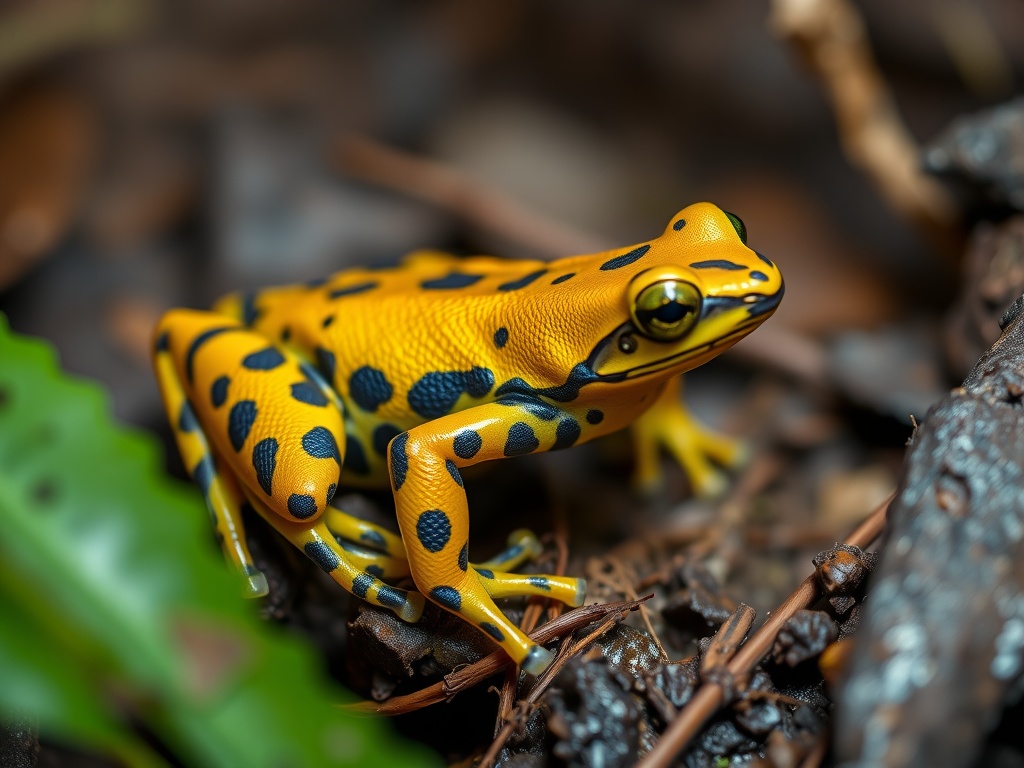
About the Golden Poison Dart Frog
Phyllobates terribilis, restricted to a small area of Pacific lowland rainforest in Colombia's Cauca department, is the most toxic vertebrate known. A single wild adult, about 5 cm long, can carry around one milligram of batrachotoxin - enough, in principle, to kill a large number of people, since the compound locks sodium channels open and causes runaway nerve firing and cardiac arrest. Crucially, the frog does not make the poison. It sequesters alkaloid precursors from its diet, most likely from small melyrid beetles and other leaf-litter arthropods, which is why captive-bred golden poison frogs raised on fruit flies are entirely harmless and can be handled freely. The frog resists its own toxin thanks to specific amino acid substitutions in its sodium channels. Its warning colouration - solid mint, yellow or orange with no pattern at all - is the extreme end of aposematism. The Embera Chocoa people used Phyllobates species to poison blowgun darts by rubbing the dart tip along the frog's back, the only genuine origin of the "poison dart frog" name; the vast majority of brightly coloured dendrobatids were never used that way. It is Endangered, its tiny range shrinking to logging and coca cultivation.
Fascinating facts
World's Most Poisonous Animal
The Golden Poison Dart Frog's skin contains enough toxin to kill up to 10 adult humans, making it the most poisonous vertebrate known.
Striking Colors
Their vivid yellow, orange, or greenish colors serve as a warning to predators that they are highly toxic.
Diet-Dependent Toxin
Their toxicity comes from their wild diet of certain ants, beetles, and mites, which provide the toxic alkaloids.
Detailed description
The Golden Poison Dart Frog (Phyllobates terribilis) is a small yet robust amphibian, typically measuring 47–55 mm in length, making it the largest species within its genus. Its skin is smooth and vividly colored, ranging from bright yellow to mint green or orange, serving as an aposematic signal to deter predators. The frog's body is compact with a broad head, large black eyes, and unwebbed fingers and toes, which aid in climbing and grasping. Unlike many amphibians, its skin secretes batrachotoxin, a potent neurotoxin, through specialized granular glands, rendering it one of the most poisonous animals known. Golden Poison Dart Frogs are diurnal and terrestrial, often found on the forest floor among leaf litter and low vegetation in the humid lowland rainforests of Colombia's Pacific coast. Their diet in the wild consists primarily of small arthropods, such as ants, beetles, and mites, which are believed to be the source of their toxicity. Socially, they exhibit a degree of territoriality, with males defending small territories through vocalizations and physical displays. Breeding occurs during the rainy season, and the species demonstrates complex parental care, with males often transporting tadpoles to suitable water sources. Their unique adaptations, including toxin sequestration and bright coloration, are the result of evolutionary pressures in a predator-rich environment.
Did you know?
Captive Golden Poison Dart Frogs lose their toxicity because they do not consume the same toxic insects found in the wild.
Research & sources
Wikipedia summary
The golden poison frog, also known as the golden dart frog or golden poison arrow frog, is a poison dart frog endemic from the rainforests of Colombia. The golden poison frog has become endangered due to habitat destruction within its naturally limited range. Despite its small size, this frog is considered to be the most poisonous extant animal species on the planet.
Behaviour & social structure
Golden Poison Dart Frogs are primarily active during the day, foraging for prey on the forest floor. They employ a sit-and-wait strategy, using their keen eyesight to detect movement before lunging at small invertebrates with their sticky, protrusible tongues. Males are vocal, emitting soft trills and calls to establish territories and attract females, especially during the breeding season. Aggressive encounters between males may involve wrestling or chasing. While generally solitary outside of breeding, individuals may be seen in loose aggregations in areas of abundant food. They are meticulous in grooming, frequently wiping their skin with their limbs, which may help distribute toxins and maintain skin health.
Reproduction & life cycle
Breeding in Phyllobates terribilis is closely tied to rainfall and humidity, typically peaking during the wet season (April to June). Males call to attract females, and courtship involves tactile interactions and leading the female to a suitable oviposition site, usually a moist crevice or under leaf litter. Females lay clutches of 4–20 eggs, which are fertilized externally. Males often guard the eggs, keeping them moist by transporting water with their bodies. Upon hatching (after about 10–14 days), the male carries the tadpoles on his back to small pools or water-filled leaf axils, where they complete metamorphosis over 45–60 days. Parental care is pronounced, with males occasionally feeding the tadpoles with unfertilized eggs.
Adaptations & survival
Phyllobates terribilis has evolved several remarkable adaptations for survival. Its bright coloration (aposematism) warns predators of its toxicity, a defense mechanism reinforced by the presence of batrachotoxin in its skin. This alkaloid toxin irreversibly binds to sodium channels in nerve cells, causing paralysis and cardiac arrest in would-be predators. The frog's resistance to its own toxin is due to mutations in its sodium channel proteins. Its terrestrial lifestyle is supported by strong limbs and adhesive toe pads, allowing it to navigate the forest floor and low vegetation. Behavioral adaptations include complex parental care and territoriality, which enhance reproductive success and offspring survival.
Cultural significance
Phyllobates terribilis holds significant cultural importance for the indigenous Emberá and Chocó peoples of Colombia, who have historically used the frog's skin secretions to poison blowgun darts for hunting. This traditional practice involves carefully collecting the toxin without harming the frog. The species has become an emblem of the region's biodiversity and is often featured in environmental education and ecotourism. Its striking appearance and potent toxin have made it a subject of fascination and caution in both local folklore and global popular culture.
Recent research
Recent research has focused on the molecular mechanisms underlying batrachotoxin resistance in Phyllobates terribilis, revealing unique sodium channel mutations. Studies have also explored the ecological origins of the frog's toxicity, linking it to the consumption of specific alkaloid-rich arthropods in its native habitat. Conservation genetics projects are underway to assess population structure and genetic diversity, informing reintroduction and habitat management strategies. Additionally, the frog's toxin has inspired biomedical research into novel painkillers and cardiac drugs, given its potent effects on nerve and muscle function.
Sources
A dangerously toxic new frog (Phyllobates) used by Embera Indians of western Colombia with discussion of blowgun fabrication and dart poisoning
Myers, C.W.; Daly, J.W.; Malkin, B. (1978)
scientificVideos
Habitat
Tropical rainforest
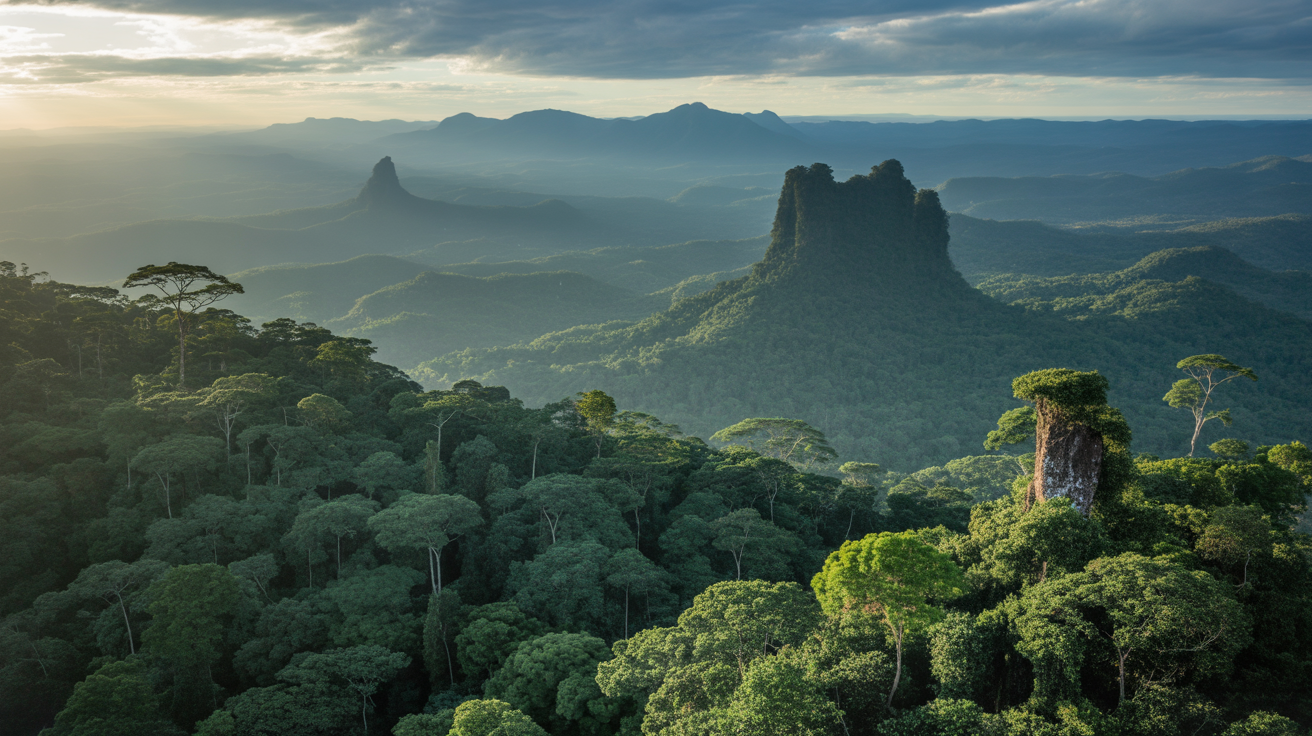 Tropical Regions
Rainforest
Dense, wet forests with the highest biodiversity on Earth, containing more than half of the world's plant and animal species.
 Global
Forest
Wooded areas with significant tree cover and diverse plant and animal communities.
 Global
Freshwater
Lakes, rivers, and wetlands with diverse aquatic ecosystems.
Conservation
The Golden Poison Dart Frog is currently classified as Endangered on the IUCN Red List.
Threats & challenges
The Golden Poison Dart Frog is classified as Endangered by the IUCN, with its population declining due to habitat loss from deforestation, agricultural expansion, and illegal gold mining in Colombia's Chocó region. Its extremely limited range (less than 5,000 km²) makes it highly vulnerable to environmental changes and fragmentation. Collection for the pet trade, although now regulated, has also contributed to population pressures. Climate change poses additional risks by altering precipitation patterns and microhabitats essential for breeding. Conservation efforts are challenged by ongoing habitat destruction and the species' dependence on specific ecological conditions.
Taxonomy
Scientific name
Phyllobates terribilis
- Kingdom
- Animalia
- Phylum
- Chordata
- Class
- Amphibia
- Order
- Anura
- Family
- Dendrobatidae
- Genus
- Phyllobates
- Species
- terribilis
Where to see a golden poison dart frog
4 zoos and aquariums in 2 countries are recorded as keeping this species.
 National Zoological Park🇺🇸 Washington, United States
 Karlsruhe Zoo🇩🇪 Germany
 Santa Ana Zoo at Prentice Park🇺🇸 Santa Ana, United States
 Los Angeles Zoo🇺🇸 United States
Community notes
Share your observations about the Golden Poison Dart Frog.
No community notes yet. Be the first!
Discover more wildlife
More fascinating animals from the encyclopedia.