
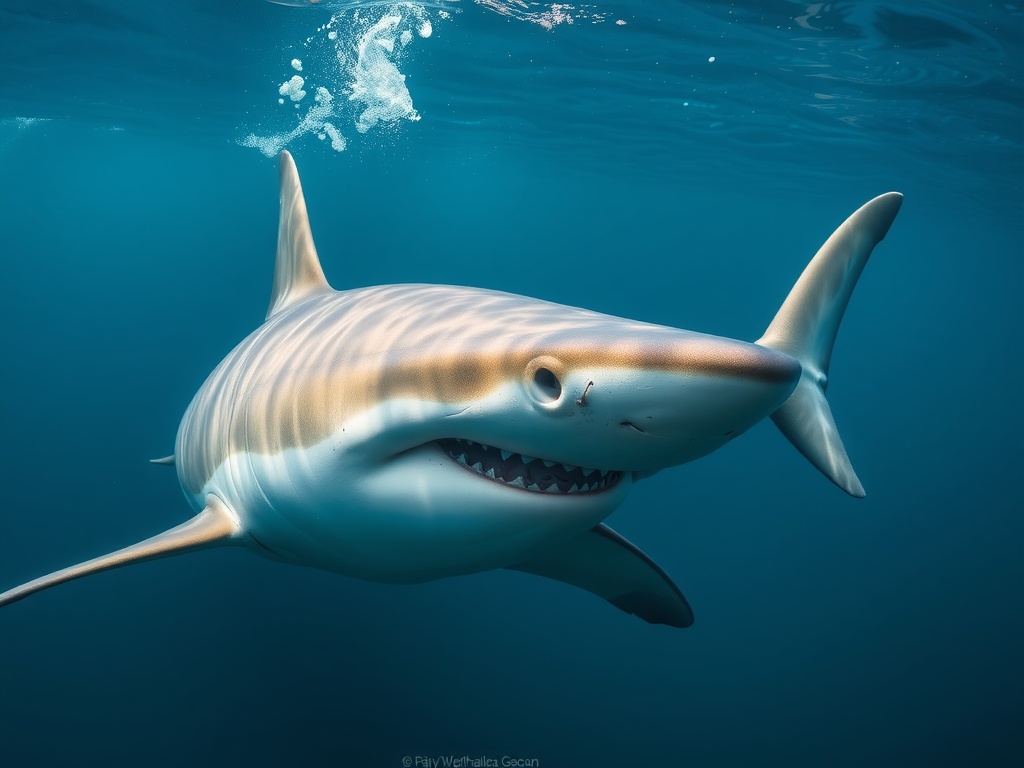
About the Great white shark
The Great white shark (Carcharodon carcharias) is a formidable predator of the ocean, renowned for its size and power. Typically measuring between 4 to 6 meters in length, some individuals have been recorded at over 6 meters, making it one of the largest predatory fish in the world. Its distinctive coloration, with a grayish top and stark white underside, is an example of countershading, an adaptation that helps it ambush prey by blending with the ocean depths when viewed from above and the sunlit surface when viewed from below. The Great white's jaws house approximately 300 serrated teeth arranged in multiple rows, continually replaced throughout its life, ensuring it remains an efficient hunter. Unlike most fish, the Great white is partially endothermic, maintaining a body temperature higher than the surrounding water. This physiological trait, known as regional endothermy, is facilitated by a specialized network of blood vessels called the rete mirabile, enabling it to hunt in colder waters where other predators cannot thrive. Its robust body is complemented by a large, oil-rich liver, which not only aids in buoyancy but also serves as an energy reserve during long migrations.
Fascinating facts
Apex Predator
Great white sharks are at the top of the marine food chain with no natural predators except, occasionally, orcas.
Long-Distance Travelers
They are highly migratory and can travel thousands of kilometers across ocean basins in a single year.
Tooth Regeneration
A great white shark can grow and shed more than 20,000 teeth in its lifetime.
Detailed description
The great white shark (Carcharodon carcharias) is a large, endothermic mackerel shark distinguished by its conical snout, crescent-shaped caudal fin, and a robust fusiform body that can reach lengths of up to 6 meters (19.7 ft), though most adults are smaller. Its countershaded coloration—dark gray to brown dorsally and stark white ventrally—provides camouflage from both prey and predators. The great white possesses serrated, triangular teeth arranged in multiple rows, which are continually replaced throughout its life. Its skeleton is composed of cartilage rather than bone, contributing to its agility and speed. The species is equipped with highly developed sensory systems, including acute olfaction, the ability to detect electromagnetic fields via the ampullae of Lorenzini, and excellent vision adapted for low-light conditions. Great whites are solitary for much of their lives but may aggregate in areas of abundant prey, exhibiting complex social hierarchies based on size and sex. They are capable of breaching the water’s surface in pursuit of prey, a behavior most commonly observed in South African populations. Reproduction is ovoviviparous, with embryos developing inside the mother and nourished by yolk sacs and, later, by consuming unfertilized eggs (oophagy). Females give birth to litters of 2–14 pups after a gestation period estimated at 11–18 months. These sharks are highly migratory, with individuals documented traveling thousands of kilometers between feeding and breeding grounds.
Did you know?
Great white sharks can go weeks between meals by storing energy in their massive livers.
Research & sources
Wikipedia summary
The great white shark, also known as the white shark, white pointer, or simply great white, is a species of large mackerel shark which can be found in the coastal surface waters of all the major oceans. It is the only known surviving species of its genus Carcharodon. The great white shark is notable for its size, with the largest preserved female specimen measuring 5.83 m (19.1 ft) in length and around 2,000 kg (4,400 lb) in weight at maturity. However, most are smaller; males measure 3.4 to 4.0 m, and females measure 4.6 to 4.9 m on average. According to a 2014 study, the lifespan of great white sharks is estimated to be as long as 70 years or more, well above previous estimates, making it one of the longest lived cartilaginous fishes currently known. According to the same study, male great white sharks take 26 years to reach sexual maturity, while the females take 33 years to be ready to produce offspring. Great white sharks can swim at speeds of 25 km/h (16 mph) for short bursts and to depths of 1,200 m (3,900 ft).
Behaviour & social structure
Great white sharks are primarily solitary hunters, though temporary aggregations occur at rich feeding sites such as seal colonies. They exhibit a diel activity pattern, often hunting at dawn and dusk when visibility is low for prey. Their hunting strategy involves stealth and ambush, utilizing their countershading and rapid acceleration to surprise prey, often breaching the surface during attacks on pinnipeds. Diet varies by age and region: juveniles feed mainly on fish and smaller elasmobranchs, while adults target marine mammals such as seals, sea lions, and occasionally dolphins and whale carcasses. Social interactions are complex, with dominance hierarchies established through non-lethal displays such as body slaps, jaw gaping, and circling. Great whites are known to investigate novel objects, including boats, with cautious bites, a behavior termed 'test biting.' They spend much of their time cruising near the surface or at moderate depths, but can make deep dives to over 1,200 meters, possibly for thermoregulation or prey pursuit.
Reproduction & life cycle
Great white sharks are ovoviviparous, with internal fertilization and embryos developing within the mother’s uterus. Mating behavior is rarely observed but is believed to involve biting by males to hold onto females, often leaving scars. Gestation is estimated at 11–18 months, among the longest for sharks. Females give birth to live young (pups), typically every 2–3 years, with litters ranging from 2 to 14 pups, each measuring 1.2–1.5 meters at birth. There is no parental care post-birth; pups are independent immediately and must avoid predation, even from adults of their own species. Sexual maturity is reached at approximately 26 years for males and 33 years for females, contributing to the species’ slow population growth and vulnerability to exploitation. Breeding grounds are not well documented, but pupping is thought to occur in coastal nursery areas with abundant prey and relative safety from larger predators.
Adaptations & survival
Great white sharks possess several key adaptations for predation and survival. Their endothermic physiology allows them to maintain body temperatures up to 14°C above ambient water, enhancing muscle efficiency and extending their range into cooler waters. The ampullae of Lorenzini enable detection of minute electrical fields produced by prey, even when hidden. Their powerful jaws and serrated teeth are specialized for cutting through tough flesh and bone. The large, oil-rich liver aids in buoyancy control. Their streamlined body and strong caudal fin enable short bursts of speed up to 25 km/h (16 mph), crucial for ambush hunting. Countershading provides camouflage, while acute vision and olfaction facilitate prey detection over long distances. Behavioral adaptations include breaching to capture agile prey and migratory patterns that exploit seasonal prey abundance.
Cultural significance
The great white shark holds a prominent place in human culture, often symbolizing power, danger, and the unknown. It has been featured in literature, film, and media—most notably in the 1975 film 'Jaws,' which significantly influenced public perception and policy regarding sharks. In some indigenous cultures, sharks are revered as totemic animals or spiritual guardians. The species is a focal point for ecotourism, particularly in South Africa, Australia, and Mexico, where cage diving attracts thousands of visitors annually. This has contributed to both conservation awareness and economic benefits for local communities. However, sensationalized portrayals have also fueled misconceptions and fear, sometimes resulting in calls for culling or lethal control.
Recent research
Recent research has revealed that great white sharks undertake transoceanic migrations, with individuals tracked moving between South Africa and Australia, and between California and Hawaii, suggesting complex population structures and connectivity. Stable isotope and satellite tagging studies have elucidated their role as apex predators and their influence on marine ecosystems. Genetic analyses indicate low global genetic diversity, raising concerns about resilience to environmental change. Studies on age and growth using radiocarbon dating of vertebrae have revised lifespan estimates upward, with individuals living up to 70 years or more. Ongoing research focuses on reproductive biology, population dynamics, and the ecological impacts of shark declines. Conservation efforts are increasingly informed by international collaborations and improved monitoring technologies.
Sources
Carcharodon carcharias (Great White Shark): Taxonomy, Distribution, and Biology
Compagno, L.J.V., Dando, M., & Fowler, S. (2005)
scientificIUCN Red List of Threatened Species: Carcharodon carcharias
IUCN Shark Specialist Group (2022)
conservationAge and growth of the white shark, Carcharodon carcharias, in the western North Atlantic Ocean
Hamady, L.L., Natanson, L.J., Skomal, G.B., & Thorrold, S.R. (2014)
scientificVideos
Habitat
Coastal and offshore marine waters

Conservation
The Great white shark is currently classified as Vulnerable on the IUCN Red List.
Threats & challenges
Major threats to great white sharks include targeted and incidental capture in commercial and recreational fisheries, bycatch in gillnets and longlines, habitat degradation, and depletion of prey populations. The demand for shark fins, jaws, and teeth, as well as trophy hunting, has historically contributed to population declines. Their slow reproductive rate and late maturity make recovery from population losses difficult. In some regions, great whites are protected by law, but enforcement and international cooperation remain inconsistent. Population trends are difficult to assess due to their wide-ranging, elusive nature, but regional declines have been documented, particularly in the Mediterranean Sea, where the species is listed as Critically Endangered. Climate change and pollution may also impact prey availability and nursery habitats.
Taxonomy
Scientific name
Carcharodon carcharias
- Kingdom
- Animalia
- Phylum
- Chordata
- Class
- Chondrichthyes
- Order
- Lamniformes
- Family
- Lamnidae
- Genus
- Carcharodon
- Species
- carcharias
Where to see a great white shark
2 zoos and aquariums in 2 countries are recorded as keeping this species.


Community notes
Share your observations about the Great white shark.
No community notes yet. Be the first!
Discover more wildlife
More fascinating animals from the encyclopedia.