
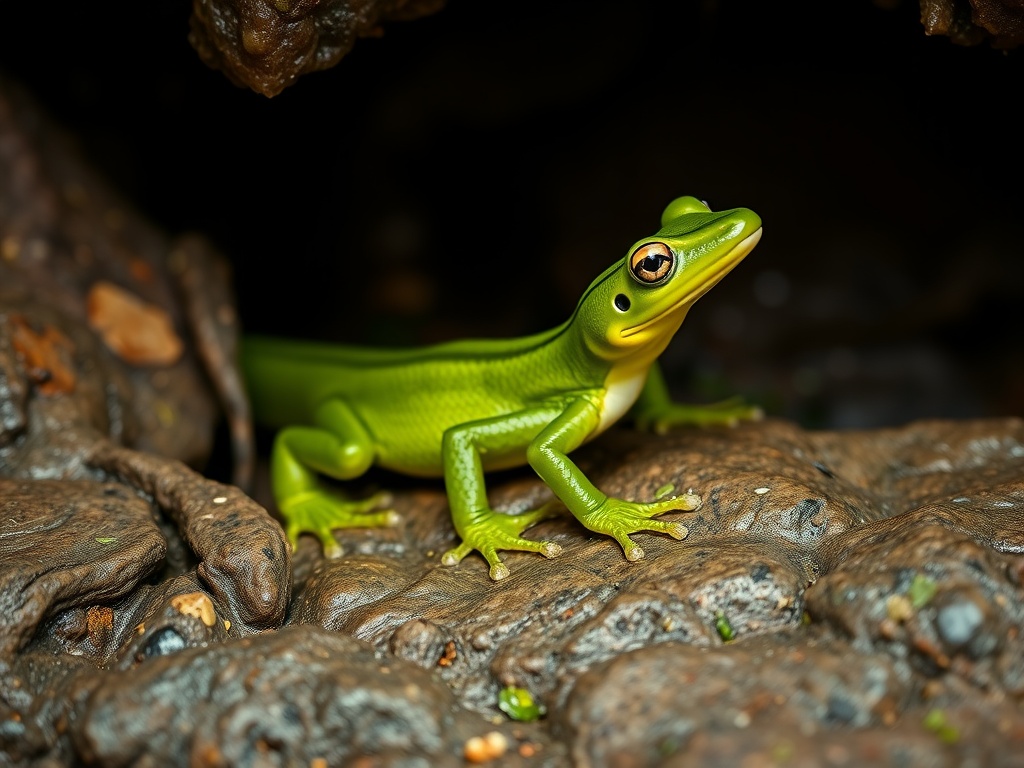
About the Green Salamander
The Green Salamander is a slender, secretive amphibian known for its distinctive bright green to yellowish-green lichen-like patches on a black background. It is highly specialized for life in narrow rock crevices and is rarely seen outside these moist, shaded habitats. This species is primarily nocturnal and possesses unique toe pads that allow it to cling to vertical rock faces and bark. Green Salamanders are sensitive to environmental changes, making them indicators of ecosystem health.
Fascinating facts
Crevice Dweller
Green Salamanders spend most of their lives hidden in narrow rock crevices, emerging only at night or during wet weather.
Climbing Adaptations
They have unique toe pads with square tips that give them a strong grip on rock and bark surfaces.
Parental Care
Female Green Salamanders protect their eggs by coiling around them and remaining with the clutch until hatching, a rare behavior among salamanders.
Detailed description
The Green Salamander (Aneides aeneus) is a slender, medium-sized plethodontid amphibian, typically measuring 8–13 cm (3.1–5.1 in) in total length. Its most distinguishing feature is the presence of bright green to yellow-green, lichen-like blotches overlaying a dark brown or black dorsum, providing exceptional camouflage among mosses and lichens on shaded rock faces. The body is dorsoventrally flattened, an adaptation for navigating narrow rock crevices, and the limbs are relatively long with expanded, squarish toe tips that function as adhesive pads. These specialized toe pads allow for strong climbing ability on both rock and bark. The skin is smooth and moist, lacking scales, and the species is entirely lungless, relying on cutaneous and buccopharyngeal respiration. The head is broad and somewhat flattened, with large eyes adapted for nocturnal activity. Green Salamanders are secretive and rarely seen outside their preferred microhabitats. They are primarily nocturnal, emerging at night to forage, and spend daylight hours deep within crevices to avoid desiccation and predation. This species exhibits strong site fidelity, often returning to the same crevice over multiple seasons. Their ecological role as both predator and prey makes them important components of the forested cliff ecosystems in which they reside.
Did you know?
Unlike most salamanders, the Green Salamander can climb vertical surfaces thanks to its square-tipped, expanded toe pads.
Research & sources
Wikipedia summary
The green salamander is a species of lungless salamander in the family Plethodontidae. It and the Hickory Nut Gorge green salamander are the only currently-described members of the genus Aneides that inhabit any areas in the eastern half of United States. Rarely seen in the field, the green salamander is an extremely habitat-specific terrestrial species that is seldom found away from its preferred surroundings: moist, shaded rock crevices. Green salamanders have one of the most specialized niches of any salamander.
Behaviour & social structure
Green Salamanders are solitary and highly territorial, particularly during the breeding season. Individuals actively defend their crevices from conspecifics using threat displays, posturing, and occasionally physical combat. They are nocturnal hunters, emerging after dusk to forage for small arthropods such as ants, beetles, spiders, and springtails. Prey is captured using a rapid projectile tongue. During dry or hot periods, activity is drastically reduced, and salamanders retreat deeper into crevices to maintain moisture balance. Home ranges are small, often limited to a single rock face or outcrop. Social interactions are generally limited to brief encounters during the breeding season, with little evidence of cooperative behavior. Green Salamanders are known for their remarkable site fidelity, with individuals occupying the same crevice for years if undisturbed.
Reproduction & life cycle
Breeding occurs from late spring through early summer (May–July), varying with elevation and local climate. Courtship involves a series of tactile and chemical cues, with males depositing spermatophores on the substrate, which females then pick up with their cloaca. Females lay clutches of 10–32 eggs in deep, moist crevices, often suspended from the crevice ceiling by a gelatinous stalk. Unlike many salamanders, Green Salamander females exhibit prolonged parental care, remaining with the eggs throughout the 2–3 month incubation period (typically 68–75 days) to guard against predation and desiccation. The eggs undergo direct development, hatching as fully formed miniature salamanders without a free-living larval stage. Juveniles remain in the natal crevice for several weeks before dispersing. Sexual maturity is reached in 2–3 years.
Adaptations & survival
Aneides aeneus exhibits several unique adaptations for its specialized habitat. The flattened body and head, along with expanded toe pads, enable efficient movement and adhesion within narrow, vertical rock crevices. Its cryptic coloration mimics lichen and moss, providing camouflage from predators. As a member of the Plethodontidae, it is lungless, relying on moist skin for respiration—a trait that restricts it to humid microhabitats. The species' nocturnal habits reduce water loss and predation risk. Prolonged egg attendance by females increases offspring survival in the challenging microclimate of rock crevices. Site fidelity and territoriality help minimize competition for limited suitable habitat.
Cultural significance
The Green Salamander has limited direct cultural significance, largely due to its secretive nature and restricted range. However, it is occasionally featured in local folklore as a symbol of forest health and is sometimes referenced in regional conservation campaigns as an indicator species for the integrity of Appalachian cliff ecosystems. Its striking appearance and rarity have made it a species of interest among naturalists and herpetologists.
Recent research
Recent research has focused on the genetic structure and phylogeography of Aneides aeneus, revealing significant genetic differentiation among populations, likely due to habitat fragmentation and limited dispersal ability. Studies using environmental DNA (eDNA) have improved detection in remote habitats. Ongoing research is investigating the impacts of climate change on microhabitat suitability and reproductive success. Conservation genetics studies are informing management plans to maintain genetic diversity. There is also active investigation into the potential effects of emerging amphibian pathogens, although no major outbreaks have been reported in this species to date.
Videos
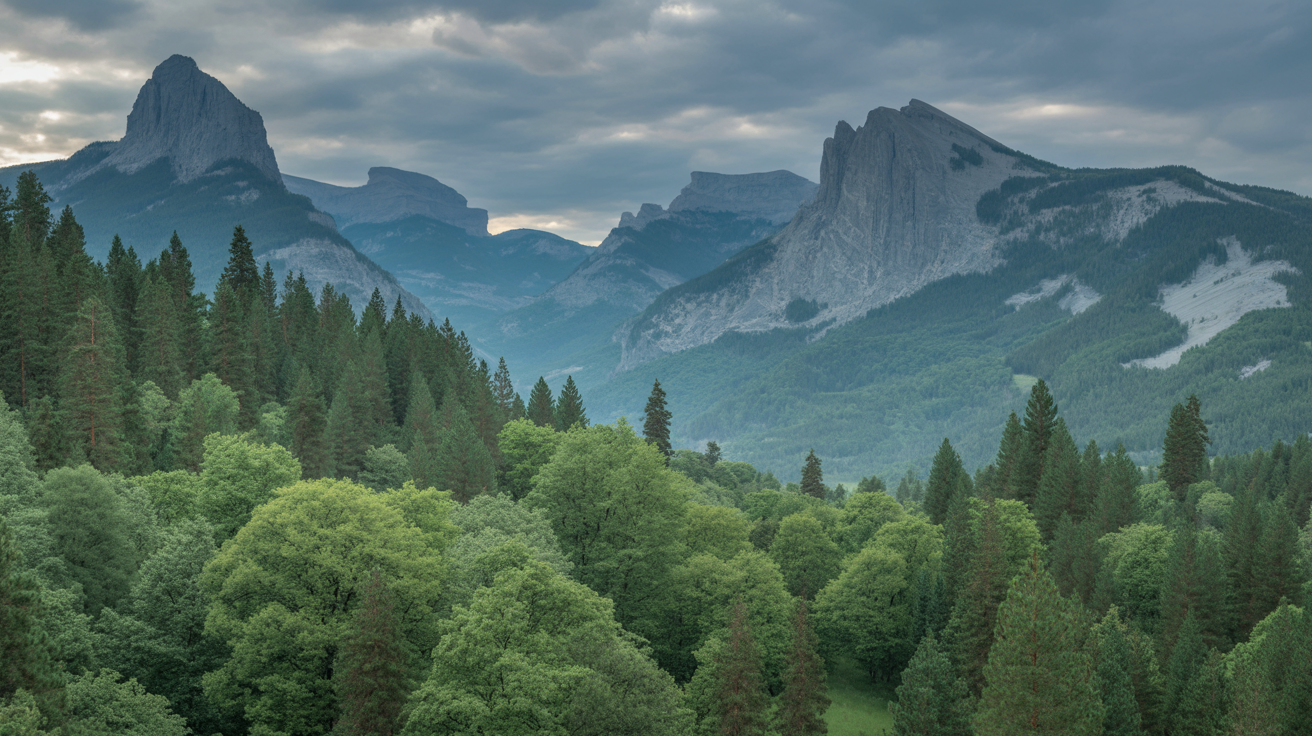
Habitat
Moist, shaded rock crevices in forests, especially sandstone outcrops and cliffs

Conservation
The Green Salamander is currently classified as Near Threatened on the IUCN Red List.
Threats & challenges
The Green Salamander faces numerous threats, primarily habitat loss and fragmentation due to logging, mining, road construction, and recreational activities that disturb or destroy rock outcrops and forest cover. Its highly specialized habitat requirements make it particularly vulnerable to microclimatic changes, such as increased temperature and decreased humidity resulting from deforestation or climate change. Illegal collection for the pet trade, although less common, is a localized threat. Populations are often small and isolated, increasing susceptibility to stochastic events and genetic bottlenecks. Fungal diseases, such as chytridiomycosis, have not been widely documented in this species but remain a potential concern. The IUCN currently lists the species as Near Threatened, with some local populations declining.
Taxonomy
Scientific name
Aneides aeneus
- Kingdom
- Animalia
- Phylum
- Chordata
- Class
- Amphibia
- Order
- Urodela
- Family
- Plethodontidae
- Genus
- Aneides
- Species
- aeneus
Community notes
Share your observations about the Green Salamander.
No community notes yet. Be the first!
Discover more wildlife
More fascinating animals from the encyclopedia.