
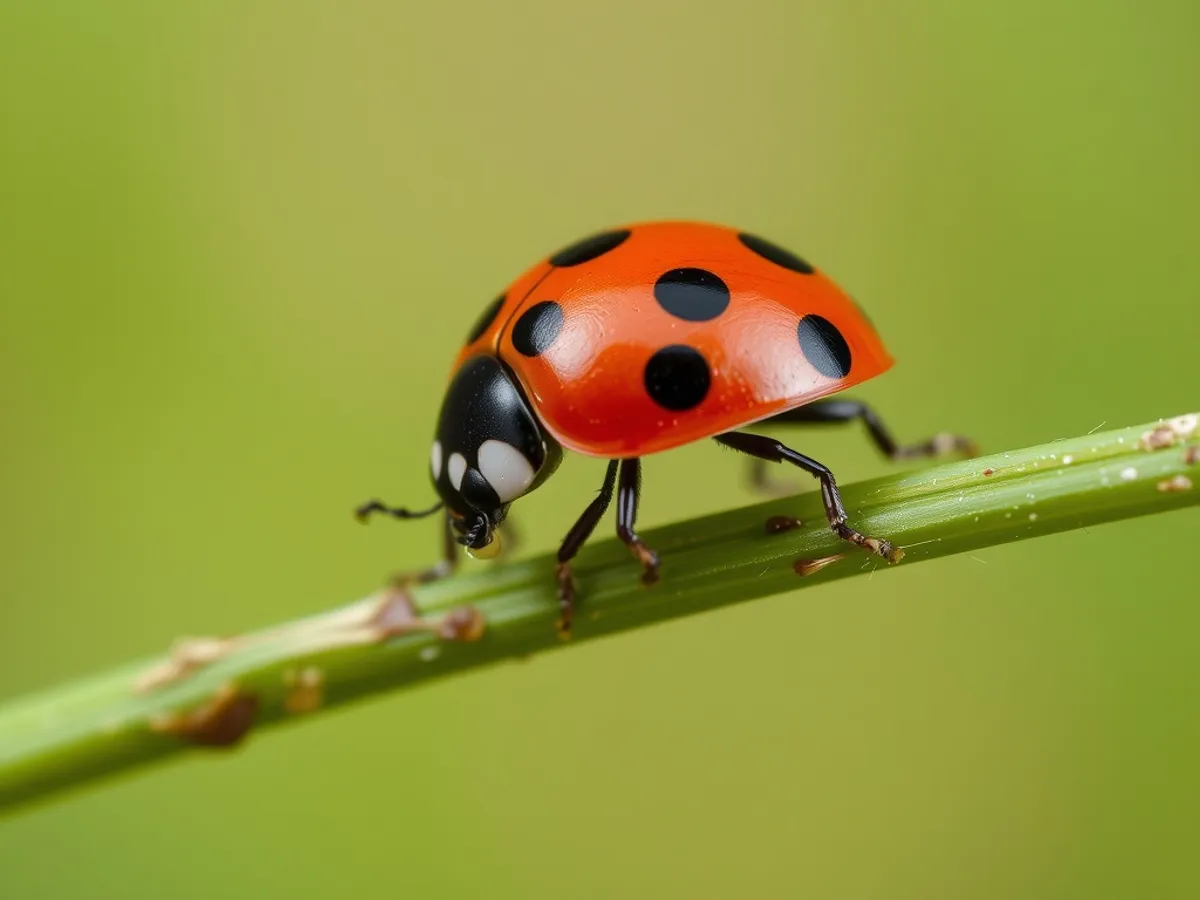
About the Harlequin ladybird
The Harlequin ladybird is a highly variable and colorful beetle native to eastern Asia but now widely spread across Europe and North America due to introductions for pest control. It is recognized for its wide range of color patterns, which can include red, orange, or yellow wing covers with varying numbers of black spots, or even entirely black forms. The species is larger and more domed than most native ladybird species, measuring 5–8 mm in length. Harlequin ladybirds are voracious predators of aphids and other small insects, contributing to their success as biological control agents. However, their rapid spread has raised concerns about impacts on native ladybird populations and biodiversity.
Fascinating facts
Highly Variable Appearance
The Harlequin ladybird exhibits an extraordinary diversity of color forms, with over 100 recognized patterns ranging from red with spots to pure black.
Worldwide Invader
Originally from eastern Asia, this species has become invasive in Europe, North America, and parts of South America and Africa due to intentional releases and accidental spread.
Winter Houseguests
Harlequin ladybirds often seek shelter indoors during the colder months, gathering in large numbers in attics and wall cavities.
Detailed description
The Harlequin ladybird (Harmonia axyridis) is a medium to large coccinellid beetle, typically measuring 5–8 mm in length and 4.5–6.5 mm in width, with a strongly convex, dome-shaped body. Its elytra (wing covers) display remarkable polymorphism, ranging from orange, red, or yellow with 0–22 black spots to entirely black forms with red or orange spots (melanic morphs). The pronotum (area behind the head) is usually white or pale yellow with variable black markings, often forming an 'M' or 'W' shape. The head is small with prominent compound eyes and short, clubbed antennae adapted for chemoreception. The legs are relatively short and robust, suited for climbing vegetation. H. axyridis exhibits a flexible, opportunistic predatory lifestyle, feeding primarily on aphids, scale insects, and other soft-bodied arthropods, but can also consume pollen, nectar, and even fruit when prey is scarce. It is capable of reflex bleeding, secreting a yellow, alkaloid-rich hemolymph from its leg joints as a chemical defense against predators. The species is highly mobile, capable of both short flights and long-distance dispersal, which has facilitated its rapid global spread. During autumn, adults aggregate in large numbers to seek overwintering sites, often invading buildings and sheltered natural locations. Its life cycle includes four larval instars, a pupal stage, and an adult stage, with larvae being spiny and alligator-shaped, also voraciously predatory. The species can produce multiple generations per year in favorable climates, contributing to its invasive success.
Did you know?
Harlequin ladybirds outcompete many native ladybird species and can even prey on their eggs and larvae, contributing to the decline of local populations.
Research & sources
Wikipedia summary
Harmonia axyridis is a large lady beetle or ladybug species that is most commonly known as the harlequin, Asian, or multicoloured Asian lady beetle. This is one of the most variable lady beetle species in the world, with an exceptionally wide range of colour forms. It is native to eastern Asia, and has been artificially introduced to North America and Europe to control aphids and scale insects. It is now common, well known, and spreading in those regions, and has also established in Africa and widely across South America. This species is conspicuous in North America, where it may locally be known as the Halloween beetle, as it often invades homes during October to overwinter. Other names include multivariate, southern, Japanese, and pumpkin ladybird.
Behaviour & social structure
Harlequin ladybirds are primarily solitary foragers, but exhibit strong aggregation behavior during overwintering, forming dense clusters in sheltered sites such as tree bark crevices, rock outcrops, or human dwellings. Their hunting strategy is active searching, using visual and chemical cues to locate prey, especially aphid colonies. Both larvae and adults are aggressive predators, and cannibalism—particularly of eggs and younger larvae—is common under crowded or resource-limited conditions. Adults are diurnal, most active during warm daylight hours, and may disperse widely in search of food or mates. When disturbed, they display a defensive posture and exude hemolymph containing toxic alkaloids (harmonine), deterring many vertebrate and invertebrate predators. In the absence of prey, adults can switch to alternative food sources, including pollen, nectar, honeydew, and even the eggs and larvae of other ladybird species, contributing to their competitive dominance.
Reproduction & life cycle
Reproduction in H. axyridis is sexual, with mating occurring primarily in spring and early summer, though multiple generations per year are possible in temperate regions. Females are highly fecund, laying clusters of 20–30 yellow, spindle-shaped eggs on the underside of leaves near aphid colonies; a single female may lay over 1,000 eggs in her lifetime. The incubation period is temperature-dependent, typically 2–5 days. Larvae undergo four instars over 12–18 days, feeding voraciously on aphids and other soft-bodied insects. Pupation lasts 3–8 days, after which adults emerge. There is no parental care beyond egg-laying site selection. In regions with cold winters, adults enter diapause, aggregating in sheltered sites and resuming activity in spring. In warmer climates, reproduction may be continuous.
Adaptations & survival
H. axyridis exhibits several key adaptations for survival and invasiveness. Its polymorphic coloration provides both aposematic (warning) signals and camouflage, depending on the morph and environment. The species' ability to reflex bleed and produce harmonine, a potent alkaloid, offers effective chemical defense against predators and pathogens. Its broad dietary range and capacity for prey switching enable survival in fluctuating environments. High fecundity and rapid development confer a reproductive advantage, while physiological tolerance to a wide range of temperatures and habitats supports colonization of diverse regions. The species' aggregation and overwintering behavior enhances survival during adverse conditions, and its competitive superiority—including intraguild predation—allows it to outcompete native ladybird species.
Cultural significance
In its native range, H. axyridis is considered a beneficial insect and symbol of good luck, often associated with agricultural prosperity. In Western cultures, ladybirds in general are regarded as omens of good fortune, though the harlequin's invasive status has led to mixed perceptions. In North America, it is colloquially known as the 'Halloween beetle' due to its tendency to invade homes in October. There are no significant traditional uses, but its role in biological control has made it a subject of agricultural and ecological interest. Its striking appearance and overwintering aggregations have also made it a focus of public attention and scientific study.
Recent research
Recent research has focused on the genetic basis of color polymorphism, with studies identifying specific loci (e.g., the pannier gene) responsible for elytral pattern variation. Investigations into the species' microbiome have revealed associations with symbiotic bacteria influencing immunity and nutrition. The ecological impacts of H. axyridis on native ladybird assemblages and aphid populations are ongoing topics, with evidence of intraguild predation and pathogen transmission (e.g., microsporidia) to native species. Studies on harmonine have explored its potential as an antimicrobial compound. Climate modeling predicts continued range expansion under global warming scenarios. Ongoing monitoring is assessing the long-term ecological consequences of its introduction and potential management strategies.
Videos
Habitat
Forests, gardens, grasslands, agricultural fields, and urban areas


Conservation
The Harlequin ladybird is currently classified as Least Concern on the IUCN Red List.
Threats & challenges
Currently, H. axyridis faces few significant natural threats due to its chemical defenses and broad ecological tolerance. However, in its invasive range, it poses substantial challenges to native biodiversity, often displacing indigenous coccinellids through competition and predation. It can also become a nuisance pest in homes during overwintering and is implicated in tainting wine when crushed during grape harvests. Pathogens such as the microsporidian parasite Nosema spp. and fungal infections (e.g., Hesperomyces virescens) have been recorded, but generally do not regulate populations effectively. Human-mediated control is limited due to its beneficial role in pest management, though research into biological control agents is ongoing. Population trends are stable or increasing in most introduced areas, with some evidence of local declines in native ranges due to habitat loss and pesticide use.
Taxonomy
Scientific name
Harmonia axyridis
- Kingdom
- Animalia
- Phylum
- Arthropoda
- Class
- Insecta
- Order
- Coleoptera
- Family
- Coccinellidae
- Genus
- Harmonia
- Species
- axyridis
Community notes
Share your observations about the Harlequin ladybird.
No community notes yet. Be the first!
Discover more wildlife
More fascinating animals from the encyclopedia.